Yes, in three separate ways that get confused with each other: the weather in the signal path, the weather on the hardware itself, and the way your booster responds to a weaker input. The one that ruins installs permanently is water inside a connector, not rain in the air.
Most articles on this topic answer only the first of the three, which is the least useful one, because you cannot do anything about the weather between your roof and the tower. The other two are things you install, inspect, and fix.
One: The Path, Which You Cannot Change
Water absorbs radio energy, so rain between your antenna and the tower costs you a little signal. Wet vegetation costs more than most people expect, because a tree line full of water attenuates far more than the same trees dry.
The important framing is scale. Rain attenuation is strongly frequency dependent, which is the whole point of the ITU's rain attenuation model, Recommendation ITU-R P.838: the specific attenuation it predicts rises steeply as frequency rises. That is why satellite links operating far above the cellular bands suffer dramatic rain fade, and why borrowing satellite intuition for a ground level path of a few miles at cellular frequencies leads people to overestimate the effect badly.
We covered the propagation side in full in does rain or snow affect cell signal. If that is your question, start there. The rest of this page is about the antenna as a piece of hardware.
Two: The Weather On the Antenna Itself
This is the part that is specific to having an outdoor antenna, and it is the part you can act on.
A film of water or a layer of ice changes the electrical environment around the antenna. Water has a very different dielectric constant from air, and an antenna encased in ice is not operating in the conditions it was tuned for. Efficiency drops. This is temporary and it resolves when the ice does.
Wet snow behaves like water, dry snow much less so. Falling dry snow is mostly air. A packed layer of wet snow sitting on a horizontally mounted antenna, or a load of ice on a mast, is a real mass of water sitting where you did not want it.
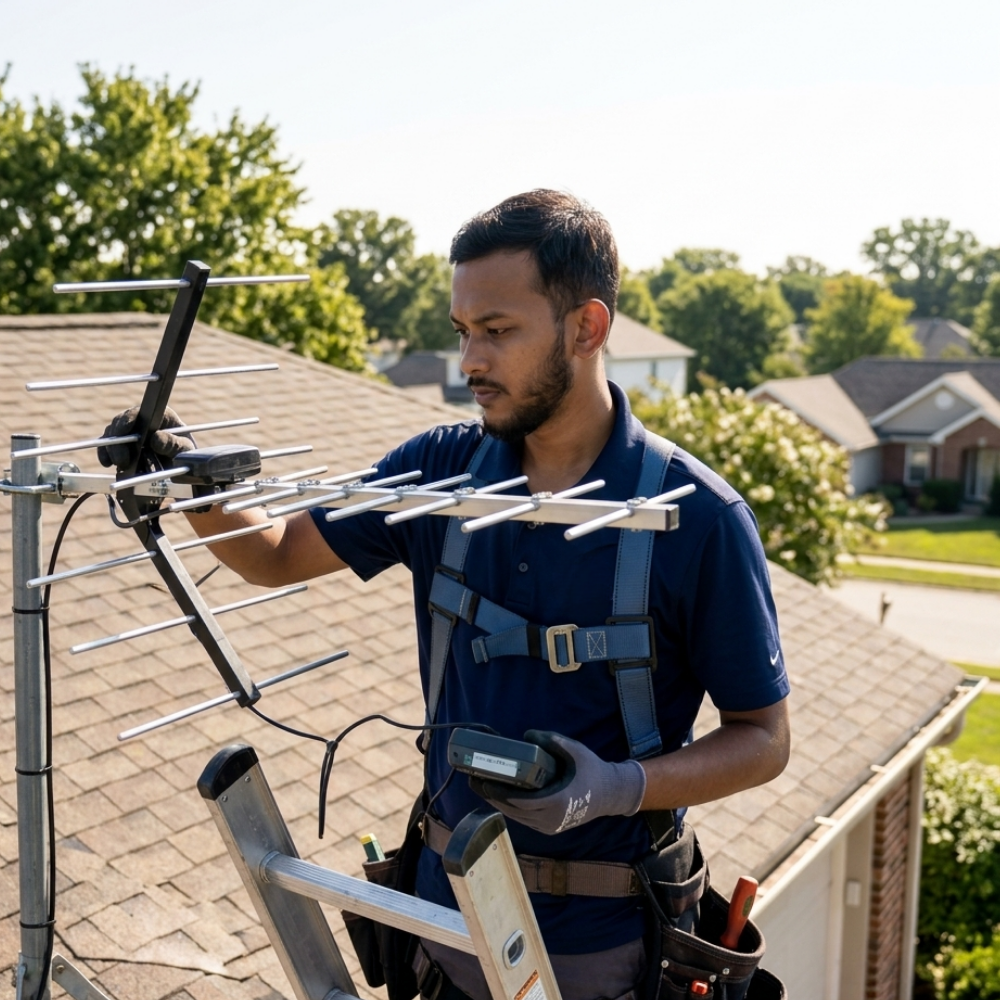
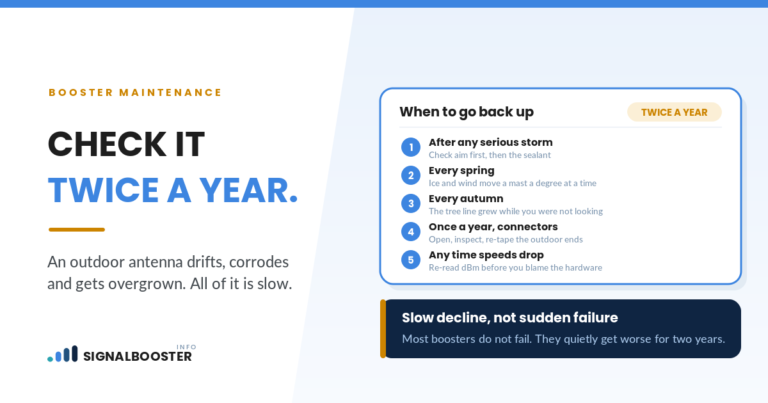
Ice and wind load move things. A directional antenna that has rotated a few degrees off aim, or a mast that has taken a set after a storm, is a permanent degradation that looks like weather but does not go away when the sun comes out. If your signal was worse after a storm and never recovered, check the aim before you check anything else.
UV and thermal cycling age the install. Sunlight degrades cheap cable jackets and unrated tape, and years of expansion and contraction loosen connectors that were tight on day one.
Three: Water Ingress, the One That Ends Installs
If you take one thing from this page, take this. Rain does not usually kill a booster install. Water inside a coax connector does.
Coax works because of the geometry between the center conductor, the dielectric, and the shield. Water in that space changes it, and once moisture wicks along the inside of a cable it does not come back out. The result is a loss that grows over months, corrodes the connector, and never recovers. This is why an install that was fine in its first summer can be quietly useless by its second.
Three things prevent it, and all three are cheap.
A drip loop. The cable should dip below the connector or the entry hole so water runs off the bottom of the loop instead of following the cable into the fitting.
Weatherproofing at every outdoor connection, done the way the manufacturer's instructions specify. Ordinary electrical tape on its own is not a weatherproofing method and it fails in UV.
Outdoor rated components, mounted so water drains away. Connectors pointing upward collect water. Connectors pointing down do not.
Why a Marginal Install Fails in Bad Weather
Here is the mechanism that ties the three together, and it explains the complaint far better than rain alone does.
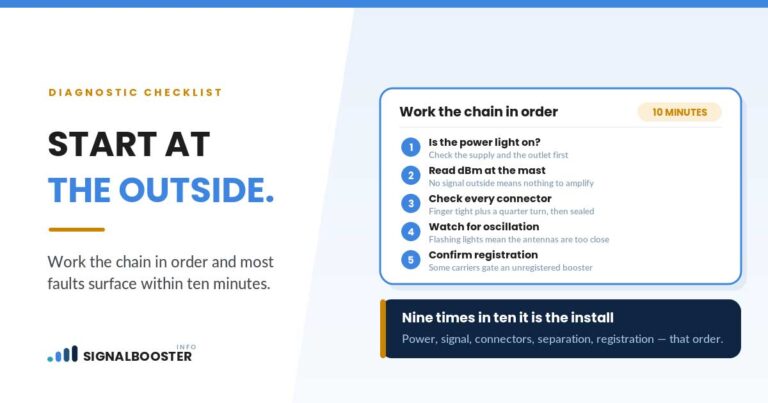
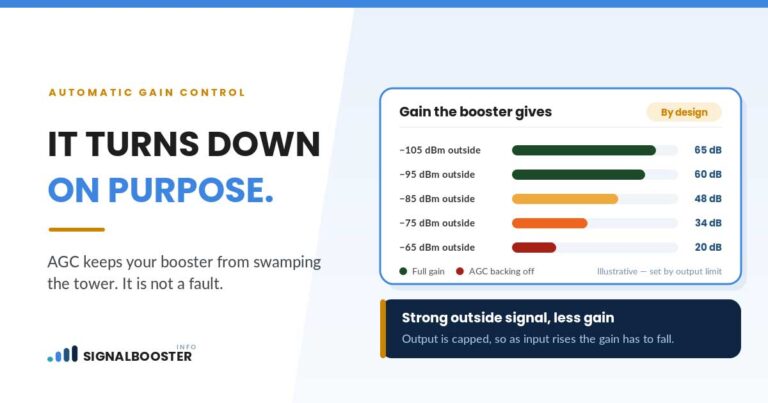
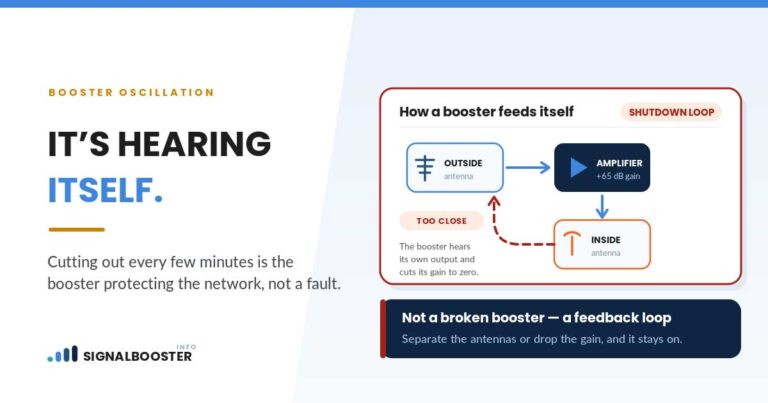
When the outdoor signal drops slightly, your booster's automatic gain control responds by using more gain, because it now has a weaker input to work with. More gain means the system is running closer to the point where it can hear its own output. An install with generous antenna separation has margin and rides it out. An install that was only just stable on a clear day has none, and it starts oscillating, cutting gain, and shutting itself down.
That is why the same rain shower makes one house's booster misbehave and does nothing at another's. The weather did not break anything. It removed the last of the margin from an install that never had much. The behavior itself is explained in automatic gain control and why your booster reduces power, and the failure it leads to is in signal booster oscillation.
The fix is separation and aim, not a bigger booster. If your system only fails in bad weather, you have a margin problem, and margin is free.
Do Not Go Up There in the Weather
The single most dangerous thing about this topic is the impulse to fix it while it is happening.
Do not climb to a roof or a mast to clear snow or ice from an antenna. Wet and icy roofs are where people fall, and the signal you are chasing is worth nothing next to that. Ice on an antenna is temporary. Snow and ice removal from a roof is work for someone equipped and trained for it, which for most homeowners means a roofer.
Do not touch the antenna, the mast, or the coax during a thunderstorm, and do not work on the system while one is approaching.
Lightning protection is a design decision, not a storm day decision. An outdoor antenna brings the electrical code into your installation, and the discharge unit and bonding belong at the point where the cable enters the building. That is covered in signal booster grounding requirements, and the bonding work belongs to a licensed electrician.
The Seasonal Check, Done From the Ground
Do this twice a year and after any severe storm, standing on the ground, with binoculars if you need them. Nothing on this list requires a ladder or a roof. If a check cannot be completed from the ground, that is the point to hire someone, not the point to climb.
- Is the antenna still aimed where it was? A directional antenna that has moved is your most likely permanent loss.
- Is the mast still plumb and the mount still tight?
- Is the weatherproofing at the outdoor connectors intact, or has the tape unwound and the sealant cracked?
- Does the cable still have its drip loop, and is the entry point still sealed?
- Is anything new in the path? Trees grow. A branch that cleared the line last spring may not this year.
- Take a dBm reading at your usual indoor spot and compare it with your baseline, using the method in our guide to checking real signal strength. A number you wrote down last year is worth more than any amount of guessing about the weather.
FAQ
Does rain affect a cell signal booster's outdoor antenna?
A little, through absorption in the path, and more if the antenna itself is coated in water or ice. Both are temporary. The lasting damage from rain is water getting inside a connector.
Does snow on my outdoor antenna hurt reception?
Dry falling snow has a small effect because it is mostly air. Accumulated wet snow and ice are a more significant mass of water and can measurably reduce efficiency until they clear.
Should I clear ice off my outdoor booster antenna?
No. Do not climb to an icy roof or mast for it. The effect is temporary, the fall is not, and roof snow and ice removal is work for someone equipped to do it.
Why does my booster only act up when it rains?
Most often because the install has very little feedback margin. A slightly weaker input makes the booster use more gain, and a system that was barely stable starts oscillating. Increase antenna separation and re-check the aim.
How do I keep water out of my outdoor connections?
A drip loop below each connector and the entry point, weatherproofing applied the way the manufacturer's instructions specify, outdoor rated parts, and connectors mounted so they drain rather than collect.