If your signal is fine in the garden and dies the moment you step through the door, the building is your problem. Not the carrier, not the phone, not the distance to the tower. Something in the shell between you and the outside is stopping the signal, and identifying which material it is changes what you should do about it.
Stucco and metal siding are the two most commonly blamed, and one of those two accusations is aimed at the wrong component.
What a Faraday Cage Actually Is (and Why Your House Is a Leaky One)
A Faraday cage is a conductive enclosure that blocks electromagnetic fields from passing through it. The important detail, and the one that makes this relevant to houses, is that it does not need to be solid metal. A conductive mesh works too, provided the openings in the mesh are small relative to the wavelength of the radio waves you are trying to stop.
That is the mechanism behind almost everything in this article. A continuous metal surface is the strongest version. A metal mesh is a partial version. And a house is never a complete enclosure (it has windows, doors, gaps and a foundation), so what you actually get is a leaky cage, where signal makes it inside through the openings while the walls reject it.
This explains the pattern people report most: usable signal in a room with a large window facing the right way, nothing at all in an interior room or on the far side of the house. The signal is not passing through the walls, it is coming in through the holes.
Stucco: The Mesh, Not the Plaster
Here is the correction that makes this topic click, and almost every consumer article on it gets it wrong.
Stucco itself is not a significant blocker. It is a cement-based render. Like concrete it absorbs some signal, especially when damp, but on its own it is not the reason stucco homes have a reputation for terrible reception.
The metal lath underneath it is. Traditional stucco is applied over a wire mesh fastened to the sheathing, which gives the render something to key into. That mesh is a conductive grid wrapping the entire exterior of the building. It is, quite literally, a Faraday cage built into the walls of the house, and it is the component doing the blocking.
This matters practically for two reasons.
First, it explains the inconsistency people notice. Not all stucco homes have a reception problem, because not all stucco is applied over metal lath, fiberglass mesh and other non-conductive alternatives exist and are used, particularly in newer construction and in synthetic stucco systems. If your neighbor’s stucco house is fine and yours is not, this is very likely why.
Second, it tells you the problem is in the wall assembly rather than the surface. Nothing you do to the exterior finish changes it, and there is no coating or treatment that undoes it.
Metal Siding and Metal Roofing: The Worst Case
Where stucco gives you a mesh, metal siding gives you a continuous conductive surface, and that is the more effective blocker of the two. The panels overlap, they cover the whole wall, and radio waves reflect off them rather than passing through.
Metal roofing does the same thing to signal arriving from above, which is a bigger deal than it sounds. Signal frequently arrives at a downward angle from a tower on higher ground or from a site some distance away, and a metal roof intercepts that path.
A building with both metal siding and a metal roof is close to a complete enclosure, with the windows as the only meaningful openings. This is the situation where people describe a house as a “dead zone” in a location where the signal outside is perfectly serviceable.
You will find pages quoting precise decibel figures for how much signal each material costs you. Those numbers are not reproduced here, because none of the ones we found traces back to a published manufacturer measurement or a regulatory document, and inventing precision on this subject helps nobody. What is reliably true is the ordering: continuous metal is the worst case, conductive mesh is a serious partial blocker, and ordinary wood framing, drywall, vinyl siding and untreated glass are comparatively transparent.
Concrete, Brick and Foil-Backed Insulation
Beyond the two headline materials, three others come up often enough to name.
Reinforced concrete combines mass with an embedded steel grid, so it blocks by absorption and by conduction at the same time. Poured concrete walls, concrete floors between storeys and concrete block construction are all substantial obstacles, which is a large part of why below-grade rooms are so consistently bad.
Brick absorbs meaningfully, more so when wet, though it lacks the conductive layer that makes metal lath so effective. A brick house is generally a harder environment than a timber-framed one and an easier one than a stucco-over-lath house.
Foil-backed insulation and radiant barriers are the quiet one. A reflective foil facing is a continuous conductive layer, and it is often installed across entire wall cavities and roof decks where nobody can see it. A house that looks like ordinary timber and drywall construction can contain a full metallic layer that nothing about its appearance reveals. If your house is inexplicably bad and none of the obvious materials apply, this is worth asking about.
Low-E Windows: The One Nobody Suspects
Windows are supposed to be the openings that let signal in. Modern ones increasingly do not.
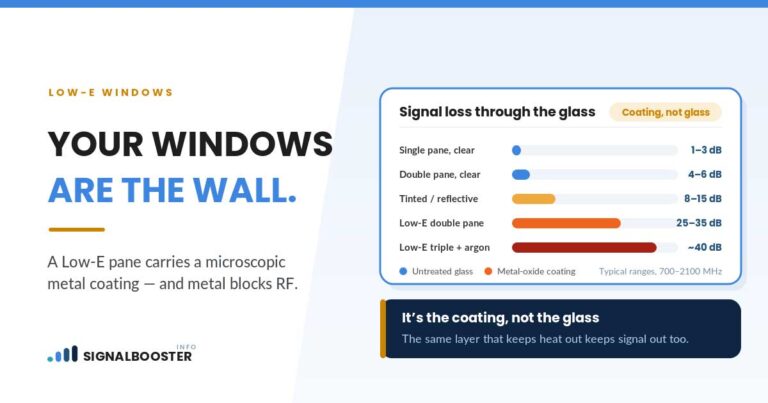
Low-emissivity glass carries a microscopically thin metal-oxide coating designed to reflect infrared energy for insulation purposes. It is highly effective at that job, and it also attenuates radio frequencies, because a metal-oxide layer does not distinguish between the energy you want to keep out and the energy you want to let in.
The consequence is a genuinely difficult scenario: a house with wooden framing, drywall, vinyl siding and no metal anywhere in its walls, that still performs badly because every window has been sealed against radio energy. It is also common in new construction and after a window replacement, which is why “the signal got worse after we had the windows done” is a real pattern rather than a coincidence.
This site covers windows specifically as their own topic later in the schedule, so this section is here for cause identification only. For now: if your walls are innocent and your windows are recent, suspect the glass.
How to Confirm the Shell Is Your Problem
The test is simple and definitive, and it is the single most informative measurement in this whole cluster. Take readings in dBm rather than reading bars; the method is in how to check your real signal strength.
- Stand outside, a few steps clear of the house, and take a reading. Do this on each side of the building and keep the best one.
- Take a reading just inside the nearest window on that same side.
- Take a reading in an interior room away from exterior walls.
- Repeat each one twice more at different times, because a single reading is noise.
The gap between the outdoor reading and the indoor readings is what the building is costing you, and it is the number that decides everything.
A large outdoor-to-indoor gap (outside is workable, inside is not) confirms the shell. That is a building problem and it has a clear category of answer.
A small gap, with both readings poor, the building is not really your issue. There is not much signal at your location to begin with, which is a coverage problem, not a materials one. Our walkthrough of why signal is weak at home covers how to tell those apart properly.
A good window reading and a poor interior reading, signal is getting in but not reaching far. Interior structure and layout are involved, and floor level may be too, which our piece on why signal is weaker on some floors than others addresses.
What Actually Works When the Building Is the Blocker
The honest thing to say here is unwelcome but useful: if the shell of your house is the blocker, most of the free advice you will find does not apply to you.
Moving around the house helps only marginally, because the whole envelope is the problem. Switching carriers does not change the physics of your walls, if the outdoor signal was fine, the carrier was never the constraint. And standing by a window is a workaround rather than a fix.
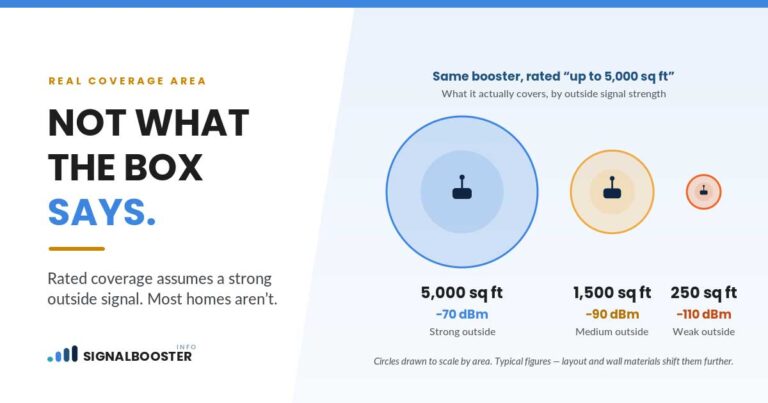
What the diagnosis actually tells you is that the signal has to be brought in from outside, because it is not getting through the walls on its own. That is the category of solution that applies to a confirmed shell problem: capture outside, deliver inside. Our overview of what a signal booster is and how it works explains how that category functions, and what square-foot coverage claims really mean is worth reading first, because the buildings that block signal from outside also block it internally between rooms, which is precisely where stated coverage figures are least reliable.
Two things to settle before you spend anything. Confirm from your own readings that there is a usable signal outdoors to work with, because amplification needs an input and no equipment creates signal that is not there. And understand the rules that apply: consumer boosters in the US are regulated equipment with certification and carrier registration requirements, and operating a unit that does not meet them is not permitted. We cover that properly in is a signal booster legal, and it is worth reading before you buy rather than after.
FAQ
Does stucco block cell signal?
The stucco render itself is a minor factor. The metal lath commonly installed underneath it is the real blocker. It forms a conductive mesh around the building. Stucco applied over fiberglass or other non-conductive mesh does not have the same effect.
Does metal siding block cell phone signal?
Yes, and it is generally the most effective blocker in ordinary residential construction, because a continuous metal surface reflects radio waves rather than letting them through. Metal roofing does the same for signal arriving from above.
Is my house a Faraday cage?
If it has metal lath, metal siding, metal roofing or foil-backed insulation, it has the ingredients of a partial one. Houses are never complete cages because of windows and doors, which is why signal is usually better near them.
Do Low-E windows block cell signal?
Low-emissivity glass carries a thin metal-oxide coating that attenuates radio frequencies as well as infrared. It is a common and frequently overlooked cause, particularly in new construction or after window replacement.
How do I know if it is my house or my carrier?
Compare a dBm reading taken outside with one taken inside. A large difference means the building is the constraint. Similar readings, both poor, mean there is little signal at your location regardless of the building.
Can I fix a metal-sided house without a booster?
Not really, if the shell is genuinely the blocker. Repositioning inside and standing near windows are workarounds rather than fixes, because the whole envelope is rejecting signal. The signal has to be brought in from outside.