Yes, low-emissivity (low-E) windows can block cell signal, and the mechanism is real, not marketing talk. Low-E glass carries a microscopically thin metallic oxide coating (usually silver-based) that reflects infrared heat to improve energy efficiency. That same conductive layer also reflects radio frequency energy, including the bands cell phones use. Manufacturer lab testing puts the attenuation at roughly 40 decibels (dB) for one coated pane in the 800-3000 MHz range, which is enough to turn a usable signal into a dead zone in the room behind the glass. The window is not coming out, so the real question is what to do about it, and that has an honest answer with real tradeoffs, not a quick fix.
What “Low-E” Actually Means (the Coating, Not the Glass)
“Low emissivity” describes how little heat radiation a surface gives off. Ordinary glass is fairly emissive: it lets solar heat pass through easily in both directions. To cut heating and cooling costs, glass manufacturers apply an ultra-thin coating, typically one to three layers of metallic silver sandwiched with other materials, to the glass surface. That coating reflects infrared wavelengths back toward their source instead of letting them pass through.
The important detail most articles skip: it is the coating doing the work, not the glass itself. Plain, uncoated glass is close to invisible to radio waves. A window replaced with a modern, energy-efficient low-E unit is a different material electrically, even though it looks the same from across the room. If you have not yet worked through the general causes of a weak signal at home, the full diagnostic walkthrough is the place to start before narrowing in on windows specifically.
Why a Heat-Blocking Coating Also Blocks Radio Signal
Metals are conductive, and conductive materials reflect and absorb electromagnetic energy across a wide range of frequencies, not just infrared. A continuous or near-continuous layer of silver behaves the same way toward a cell tower’s radio signal as it does toward the sun’s heat: it reflects a large share of it rather than letting it pass through.
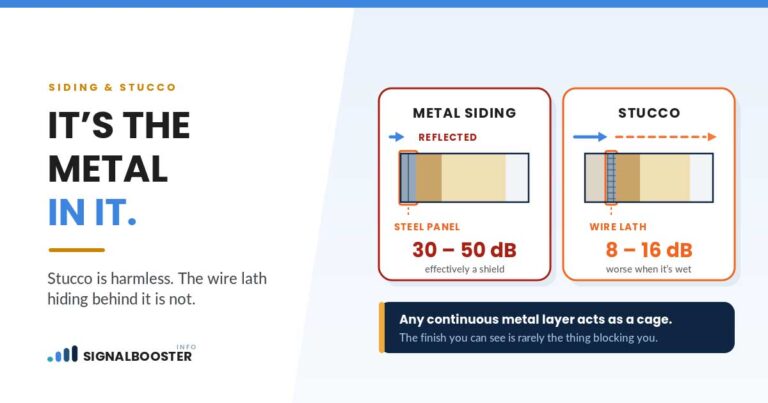
This is the same physical principle behind a Faraday cage, a conductive enclosure that blocks external electromagnetic fields. A single low-E window is not a full cage (the rest of the wall usually lets some signal in through other paths), but a room with several low-E windows and little other signal entry can behave like one in practice. This is also why low-E glass shows up on the same suspect list as metal siding and stucco lath: both work through the same conductive-layer mechanism, just in different parts of the building envelope.
How Much Cell Signal Low-E Windows Actually Block
This is the part worth getting right, because most pages on this topic quote a number with no source and no frequency band attached, which makes the number meaningless. Attenuation is band-dependent: a coating that blocks 40 dB at cellular frequencies will not necessarily block the same amount at Wi-Fi or millimeter-wave 5G frequencies. Here is what is actually documented:
- PPG Industries, a major architectural glass manufacturer, published Glass Technical Document TD-151, “Radio and Microwave Frequency Attenuation in Glass.” Its own lab testing across 800-3000 MHz, the band PPG’s document states covers cellular, Wi-Fi and Bluetooth communications, measured approximately 40 dB of attenuation for a laminate with one embedded triple-silver low-E coating, and approximately 54 dB for a laminate with two such coatings. For comparison, the same tests measured ordinary uncoated glass laminate at close to 0 dB, meaning it barely attenuates the signal at all.
- Cardinal CG, another major glass coating manufacturer, had an independent lab (Garwood Labs) measure the shielding effectiveness of two of its own coatings, named E272 and E366, across 500 MHz to 5 GHz, the UHF band that carries cell phone signal along with GPS and other wireless services. The result: on average, only about 4.5% to 5.7% of the signal’s original strength made it through the coated glass across that range.
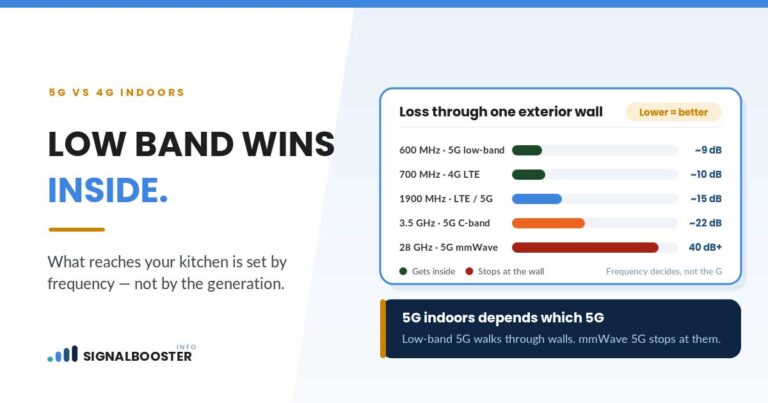
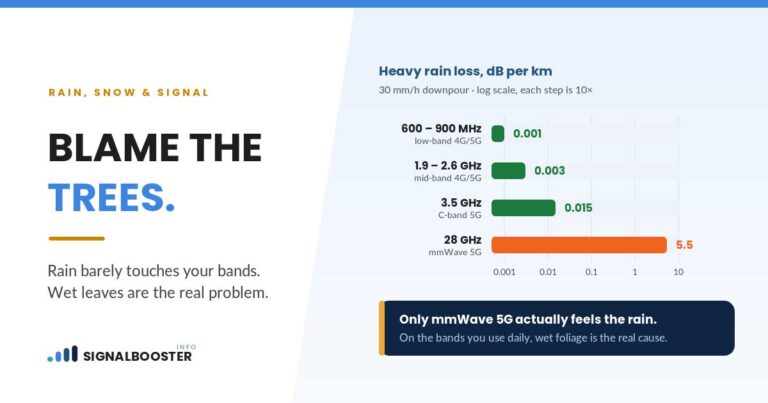
- At 5G’s higher millimeter-wave frequencies, the loss gets worse, not better. Wireless network design firm Ranplan Wireless cites an indoor 28/60 GHz channel-measurement study reporting roughly 27 dB of loss at 28 GHz and 33 dB at 60 GHz through low-E glass, consistent with the general pattern that higher frequencies are attenuated more by a metallic coating.
Those are named, dated, first-party test sources, not a blog’s unsourced estimate. None of these companies are being recommended for purchase here; they are cited because they are the ones who actually measured this and published the number. A rough rule the data supports: expect somewhere from a handful of dB up into the 50s dB of loss depending on the specific coating, the number of silver layers, and the exact frequency, not one fixed number for “low-E glass” in general.
Confirming Windows Are Your Actual Cause
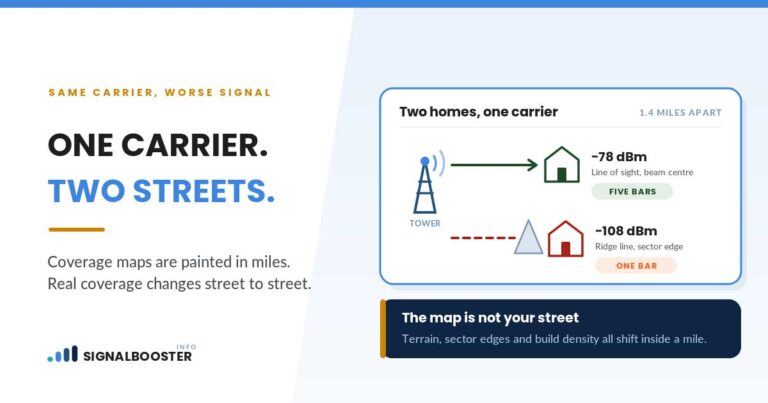
Before assuming the windows are the problem, rule out the obvious alternative explanation: distance from the tower or a weak signal outside to begin with. Walk to a window, check your phone’s signal reading (see how to check your dBm signal strength if you have not done this yet), then step just outside the same wall and check again. A meaningful jump in reading right at the glass line, with the rest of the house behaving normally, points at the window itself rather than the building generally or the distance to the tower.
Two supporting clues: the problem tends to be worse on sides of the house with more glass area, and it often appears or worsens right after a window replacement, since not all old windows were low-E but nearly all new energy-efficient windows are.
What You Can Actually Do About It
The glass is not coming out for a signal problem alone, so the realistic options work around it rather than through it. Each one has a real limitation worth knowing before you commit to it.
A signal booster with an outdoor, wall- or roof-mounted antenna. This is the most direct fix because the outdoor antenna captures signal before it ever has to pass through the glass, then relays it indoors (see what a signal booster actually is if the mechanics are new to you). The limitation: it requires drilling or mounting an antenna outside the structure, which is not always possible in a rental or a building with exterior restrictions, and the booster itself must meet the legal requirements covered below.
Wi-Fi calling. If your carrier supports it and you have working home internet, this routes calls and texts over your Wi-Fi network instead of the cellular network, sidestepping the window problem entirely for calls placed from inside the house. The limitation is real: it depends on your home internet staying up, and it does nothing for cellular data use, or for calls once you step outside your Wi-Fi range. See the full comparison of Wi-Fi calling versus a signal booster for how to decide between them.
An in-building repeater or distributed antenna system (DAS). Some sites push this as if it were a simple consumer purchase. In practice it is typically a commercial-grade, multi-antenna system designed for offices or larger buildings with heavy low-E glazing across many rooms, not something most homeowners install for a single dead room. Worth knowing it exists, and worth being honest that it is not the household-scale answer for most low-E window problems.
The FCC Rule Most Pages Skip
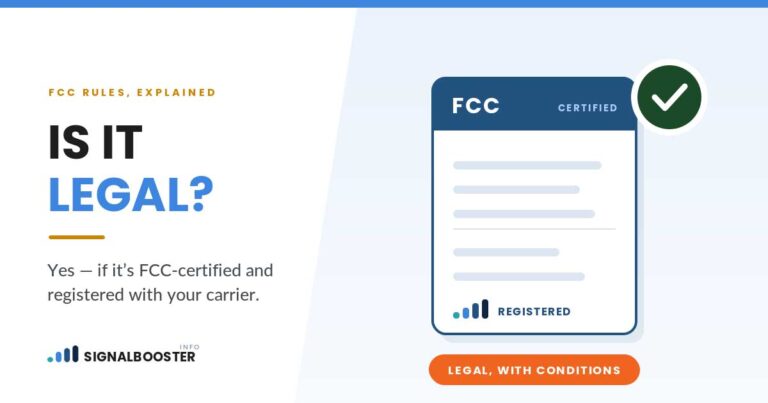
If a booster with an outdoor antenna is the route you take, there is a legal requirement almost none of the low-E window content online mentions: consumer cell signal boosters sold and used in the United States must be FCC-certified, and the FCC requires that you register the booster with your wireless carrier before turning it on. This is not optional paperwork; using a non-certified or unregistered booster is not legal under the FCC’s consumer signal booster rules. For the full detail on what certification and registration actually require, see is a signal booster legal to use.
Why This Matters More Than It Used to
Low-E glass has become the default in new residential construction and replacement windows because of energy codes and utility incentives, not because anyone was thinking about cell signal. That means more homes are picking up this specific dead-zone cause every year, often without the homeowner connecting the new windows to the new signal problem. If your signal was fine for years and then dropped after a remodel or a window replacement, the glass is a reasonable first suspect, not an unusual one.
FAQ
Do all low-E windows block cell signal, or only some?
Not all low-E coatings are identical. Attenuation depends on how many metallic layers the coating uses and how continuous the layer is, so the effect ranges from mild to severe rather than being one fixed amount. Manufacturer testing (PPG’s TD-151, for example) shows attenuation roughly doubling when a laminate uses two coated layers instead of one.
Can I just replace the windows with non-low-E glass to fix my signal?
That would technically work, but it means giving up the energy-efficiency benefit the coating provides, and it is a significant expense for a signal problem alone. Working around the glass (booster with an outdoor antenna, Wi-Fi calling, or a repeater) addresses the signal without touching the windows.
Does tinted glass cause the same problem as low-E glass?
Some window tints use metallic particles for heat rejection and can attenuate signal in a similar way to low-E coatings, though the mechanism and degree vary by product. The safest test is the same one described above: check your reading at the glass versus just outside it.
Will a phone case or screen protector make a low-E window problem worse?
It can add a small amount of additional loss, but the glass itself is the dominant factor here. Confirm the window is the cause first using the indoor-versus-outdoor signal check before troubleshooting anything else.
Is this the same thing as a house acting like a Faraday cage?
It is the same underlying principle (a conductive layer reflecting radio waves) but usually a partial version of it. A full Faraday-cage effect needs continuous conductive material around most of the structure; low-E windows alone typically create a strong but localized dead zone near the glass rather than blocking signal throughout the whole house.