Because cellular coverage is not a blanket. It is built from directional beams aimed at specific places, and your street can sit outside one while your friend’s street sits inside it. A cell tower does not radiate a uniform circle. It carries sectors, each pointing in a fixed direction with a deliberate downward tilt, engineered around where the traffic is: highways, commercial strips, dense housing. Two homes half a mile apart on the same carrier can be in completely different situations, one in the middle of a sector’s main beam, the other on the boundary between two towers, behind a ridge, or underneath the tower’s coverage rather than inside it. Add terrain, mature trees, and a local tower-siting history that varies street by street, and the difference stops being mysterious.
The Mental Model That Is Wrong
Almost everyone pictures cellular coverage as circles on a map: a tower in the middle, signal fading evenly outward, and a clean boundary where it runs out.
Coverage maps encourage this, because circles and smooth gradients are what they draw. The reality on the ground is closer to a set of overlapping spotlights of different shapes, aimed by engineers, shaped by terrain, and interrupted by whatever stands in the way. Where two spotlights barely overlap, you get a seam. Streets sit on those seams.
What a Tower Actually Does
Three features of real cell sites explain most street-level differences.
Sectors. A typical macro site is divided into sectors, commonly three, each served by its own directional antennas covering a slice of the compass. Coverage is strong in the middle of a sector’s beam and weaker at the edges where two sectors meet. It is not a circle.
Downtilt. Sector antennas are tilted downward on purpose, both mechanically and electrically, to concentrate signal in the intended service area and to stop it from spilling into distant cells where it would cause interference. The engineering consequence is direct: the area immediately underneath and very close to a tall tower can be a weak spot, because the beam is aimed past it. This is why “but I can see the tower from my yard” is such a common and genuinely confusing complaint.
Cell edge. Networks are planned so coverage from neighboring sites overlaps, and the handoff zone between them is the weakest part of both. If your house sits in that zone, you get the worst signal either site provides, plus a phone that keeps reselecting between them. Your friend two streets over may sit comfortably in one site’s core.
None of this is visible from the street. It is why the same carrier, in the same zip code, produces two totally different experiences.
Then the Ground and the Trees Get Involved
Radio planning happens on top of terrain that does not cooperate.
Terrain. A ridge, a hill, or a valley floor between you and the serving site removes signal in a way that no amount of proximity compensates for. A neighborhood in a hollow can be two miles from a site with a clear view of it and still be in a hole.
Foliage. Trees absorb and scatter radio, and this is seasonal. An established neighborhood with mature canopy can measurably underperform a newer development on the same street grid with the same carrier, and the gap widens once the leaves fill in for summer.
Buildings between you and the site, including the neighbor’s house, are part of the path.
Sorting terrain and obstruction from raw distance is its own diagnostic, and this site covers it in cell tower distance versus obstructions. Once you know roughly where your serving site is, that comparison stops being abstract, which is why how to find the nearest cell tower to your home is a sensible first step. The FCC maintains a public antenna structure registration system, which is one of the tools that makes locating structures possible at all.
The Part Nobody Puts in Writing: Coverage Follows Money and Permission
Two forces shape where sites go, and neither is about your household.
Networks are built for traffic, not for households. Capacity gets deployed where the usage is: highways, commercial corridors, dense housing, venues, and campuses. A quiet residential pocket generates comparatively little traffic, so it is more often served from the edge of a site built for something else than by a site built for it. That is a rational engineering decision, and it produces exactly the pattern readers describe.
Sites go where a municipality and a landowner allow them. Tower siting is a local planning process. Zoning rules, historic district protections, height limits, HOA covenants, and organized neighborhood opposition all shape where a site can be built, and the result varies from one municipality to the next inside the same metro area. A neighborhood that successfully opposed a site is, years later, a neighborhood with a coverage complaint. Both facts are usually true at once, and no one connects them.
This is the honest structural answer to “why here and not there,” and it explains something the technical answers do not: why the gap persists for years rather than being fixed.
Weak Signal or a Busy Tower? Two Different Complaints
Here is the distinction that changes what you should do next, and it is missing from nearly every page on this question.
Weak signal means not enough power is arriving. The symptom is bad everywhere in the house, all day, consistently, and the dBm reading is poor whenever you check it.
Congestion means plenty of signal is arriving but the site is carrying more users than it has capacity for. The symptom is different: a strong reading, decent bars, and yet slow data and unreliable calls, concentrated at predictable times such as weekday evenings, or during a local event.
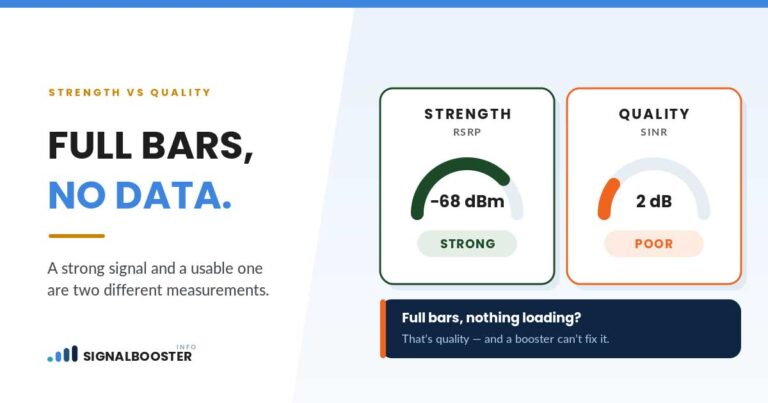
They feel identical to the user and have nothing in common underneath. A booster raises the signal level at your phone, so it addresses the first and does essentially nothing for the second. If your street is congested rather than weak, hardware in your house cannot buy you capacity on the tower. The way to tell them apart is to look at signal strength and signal quality as separate readings, which is exactly what signal strength versus signal quality covers, and to note the time of day every time you test.
How to Diagnose Your Own Street in an Evening
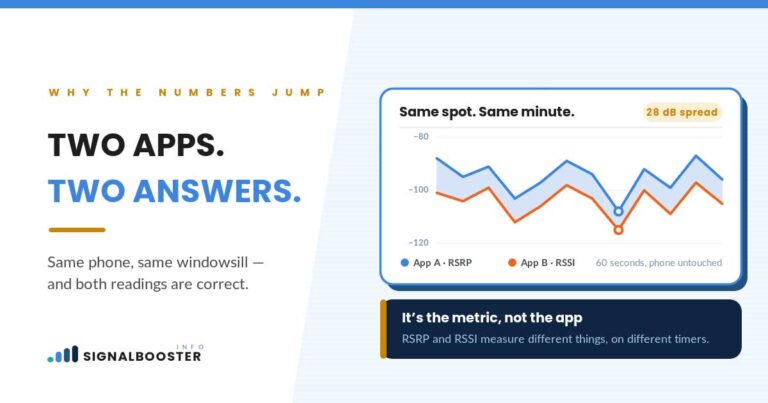
- Take real dBm readings, not bars, outside the front of the house, outside the back, and in the worst room. Bars are vendor-defined and not comparable between handsets; the dBm figure is a measurement. How to check your real dBm signal strength shows where it lives on each platform.
- Repeat at two times of day, including a weekday evening. A reading that stays strong while performance collapses at 8pm points at congestion, not coverage.
- Compare outside to inside. If the outdoor reading is decent and the indoor one is poor, your problem is your building, not your neighborhood, and whether your siding or stucco is blocking signal becomes the relevant page.
- Walk half a block toward your friend’s house and read again. A sharp change over a short distance suggests a sector edge or a specific obstruction. A gradual change suggests distance from the serving site.
Those four measurements tell you which of the three fixes applies: something inside your house, hardware that captures a usable outdoor signal, or a different carrier whose site geometry happens to favor your street.
When the Answer Really Is “Change Carriers”
Because coverage depends on where each operator built its sites, one carrier can be strong on your street while another is weak, and the reverse can be true a mile away. If your outdoor reading is poor for your carrier and a neighbor on a different network has a strong outdoor reading at the same spot, that is meaningful evidence, and it may be the cheapest fix available to you. Signal booster versus switching carriers works through that decision honestly, including the cases where the switch is the better answer.
The case for hardware is strongest when there is a usable signal somewhere on your property, typically outdoors or at roof level, that simply is not reaching the rooms where you need it. If no usable signal exists anywhere on the property for any carrier, no equipment creates one.
FAQ
Why does my neighbor have better cell signal than me on the same carrier?
Because tower coverage is directional, not circular. Their house may sit in the main beam of a sector while yours sits at a sector edge, on the boundary between two sites, behind a rise in the ground, or under denser tree cover. Small differences in position can produce large differences in received signal.
Can I have bad signal even though I can see the cell tower?
Yes, and it is common. Sector antennas are deliberately tilted downward to serve their intended area and avoid interfering with distant cells, so the ground immediately around the base of a tall tower can receive less signal than an area farther out along the beam.
Why is my signal fine in the morning and bad in the evening?
That pattern points at congestion rather than weak coverage. If the dBm reading stays strong while speeds and call quality collapse at predictable busy times, the site is carrying more users than it has capacity for, and a signal booster will not help.
Do trees really affect cell signal in a neighborhood?
Yes. Foliage absorbs and scatters radio, and the effect is seasonal, so an established neighborhood with a mature canopy can perform noticeably worse in summer than in winter on the same network.
Will a signal booster fix a neighborhood-wide coverage problem?
It can fix it inside your own building, provided a usable signal exists somewhere accessible on your property to capture and amplify. It cannot add capacity to a congested tower, and it cannot create signal in a location where none is arriving at all.