There is no single correct separation distance, and any page that gives you one number for every installation is guessing on your behalf. What prevents feedback is isolation: the total signal loss on the path from your indoor antenna back to your outdoor antenna. Your system is stable when that isolation is greater than the amplifier’s gain, and it oscillates when it is not. Distance is the most convenient way to buy isolation, which is why installation guides talk about feet. But the required figure changes with the gain of your amplifier, the gain and pattern of both antennas, and what your building puts in the path. The number that applies to your system is the minimum separation published in your own unit’s manual, not a rule of thumb from a blog.
The One Equation Underneath All of It
Strip away the product marketing and a booster install comes down to a comparison between two quantities.
Gain is how much the amplifier increases the signal. It is a specification of the unit you bought, stated on the data sheet, and on many units it is adjustable downward.
Isolation is how much of the indoor antenna’s output is lost before it gets back to the outdoor antenna. It is a property of your installation: distance, structure in the way, and how the two antennas are aimed relative to each other.
If gain exceeds isolation, the amplifier is re-amplifying its own output and the system oscillates. If isolation exceeds gain, with margin to spare, the system is stable. That is the whole design problem, and it is why the same pair of antennas can be perfectly fine on one house and unusable on another.
A high-gain amplifier needs more isolation than a low-gain one. A directional outdoor antenna with high gain aimed carelessly needs more than a modest one aimed well. There is no way for a universal number to be right across all of those combinations, and stating one as a rule does readers active harm: it tells the person with a high-gain kit that they are fine when they are not, and it tells the person in a small house that their install is impossible when it is not.
For the mechanism behind the failure itself, including what the booster is required to do when it detects the loop, start with why your signal booster keeps cutting out: oscillation explained.
What the Published Figures Actually Are
Consumer booster manufacturers do publish minimum separation figures, and you should use them. Two things are worth understanding about what they are.
They are product-specific guidance, calculated for a given kit’s gain and antenna set with margin built in. They are not a legal requirement, and they are not a constant of physics. The FCC’s consumer booster rules at 47 CFR 20.21 regulate the equipment’s behavior (certification, and automatic detection and mitigation of oscillation) rather than prescribing how many feet apart you must mount your antennas. Nobody is going to cite you for a tape-measure violation. Your booster will simply shut itself down, as it is certified to do.
They also distinguish vertical from horizontal separation, and the vertical figure is consistently the smaller of the two. In manufacturer support documentation for consumer kits, the horizontal figures commonly quoted sit around 50 feet while the vertical figures sit closer to 20 feet, but treat those as illustrative of the pattern rather than as your number. The reason the vertical figure is lower is the interesting part, and it leads directly to the practical advice below.
Why Vertical Separation Is Worth More Than Horizontal
Two antennas separated horizontally across an open floor have air between them. Air is a poor attenuator, so you have to buy your isolation almost entirely with distance.
Two antennas separated vertically, one on the roof and one a floor or two down, have air and a roof, an attic, insulation, and a ceiling between them. Every layer on that leakage path absorbs some of the leaked signal. You are buying isolation with material as well as distance, and material is far more efficient per foot.
This is the single most useful design principle in booster installation, and it is why a two-story house is often an easier install than a large single-story one. The same building physics that causes indoor dead zones in the first place, the reason signal is weaker on some floors than others, becomes your ally the moment you are trying to keep two antennas from hearing each other.
The practical translation: measure the leakage path, not the map distance. Straight-line distance between two points on a floor plan is not what determines isolation. What determines isolation is what the signal has to travel through to complete the loop. Two antennas 30 feet apart with a roof and a ceiling between them can be better isolated than two antennas 60 feet apart with a clear line of sight through an open garage door.
The Four Ways to Buy Isolation
In rough order of how much they typically give you:
1. Vertical separation with structure in the path. Outdoor antenna high on the roof, indoor antenna on a lower floor, ideally not directly beneath it. This is the default good answer.
2. Physical distance. Straightforward, and the easiest to plan for. It is also the one people over-rely on, because a long cable run costs signal of its own, and a booster fed by a long, lossy cable is delivering less than its data sheet suggests.
3. Structure on the path. Any wall, floor, or roof section between the antennas contributes. Line of sight between the two is the worst case at any distance.
4. Antenna orientation and pattern. A directional outdoor antenna is least sensitive off the back of its beam, so aiming it at the tower and away from the indoor antenna helps twice. Choosing an indoor antenna whose pattern points into the space you want to cover, rather than spraying in all directions, does the same on the other end.
And the option people forget, which is not a way to buy isolation but is a legitimate way to solve the same equation: turn the gain down. A stable system at reduced gain covers real area. A system at maximum gain that trips its own shutdown covers nothing. If your unit has adjustable gain and your building cannot give you the separation the manual asks for, reducing gain is the correct engineering response, not a compromise.
Planning It Before You Drill
The order of operations matters, because two of these decisions constrain each other.
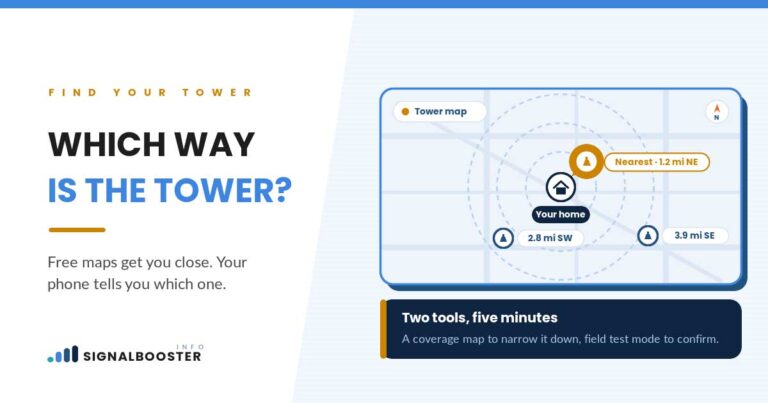
- Find the best outdoor signal position first. Take a real dBm reading at each candidate spot rather than assuming the highest point wins, using the method in how to check your real dBm signal strength. The outdoor antenna’s job is to capture usable signal, and no amount of clever isolation compensates for mounting it in a poor spot.
- Then choose the indoor antenna position for coverage and isolation together. Where does the coverage actually need to be? Which of those positions is furthest from the outdoor antenna in leakage-path terms?
- Check the pair against your unit’s published minimum separation. If you cannot meet it, change something now: a different indoor position, a directional indoor antenna, more vertical offset, or a lower gain setting.
- Set expectations on coverage honestly. The pressure to push gain up almost always comes from wanting to cover more area than the system can support. How much coverage a signal booster really gives you explains why the box figure assumes a starting signal level you may not have.
The Compliance Points That Come With the Hardware
Separation planning sits inside a regulatory frame worth stating plainly, because most installation guides leave it out entirely.
In the US, a consumer signal booster must be FCC certified, and the user must register it with their wireless provider and operate it with the provider’s consent. The major carriers have given blanket consent for FCC-certified consumer boosters and maintain free registration mechanisms for their subscribers, so this is a step to complete rather than an obstacle. If the booster causes harmful interference, the provider can require you to switch it off, and an oscillating booster is exactly the scenario that rule exists for.
One point bears directly on antenna choices: you may not modify a certified booster or substitute antennas it was not certified with. Swapping in a higher-gain antenna to reach a distant tower can take the system outside the configuration its certification was granted for, and it also raises the isolation you need at the same time. The full picture is on is a cell phone signal booster legal, and the component-level overview is in what a signal booster is. Rules differ by country, and in some jurisdictions operating a repeater without the network operator’s authorization is outright illegal, so check your own regulator if you are outside the US.
The Honest Summary
Separation distance is a proxy. What you are really managing is the relationship between how much your amplifier adds and how much your building takes away on the return path. Use your unit’s published minimum as the floor, prefer vertical separation with structure in the path, aim the antennas away from each other, and treat a lower gain setting as a legitimate tool rather than a failure.
If your install already oscillates, more distance is only one of the four levers available, and it is often not the cheapest one to change.
FAQ
How far apart do signal booster antennas need to be?
There is no universal figure. The requirement depends on your amplifier’s gain, both antennas’ gain and pattern, and what your building puts in the path between them. Use the minimum separation published in your own kit’s manual, which is calculated for that specific product.
Is vertical or horizontal antenna separation better?
Vertical, in most buildings. Vertical separation puts the roof, attic, and ceiling in the leakage path, so you gain isolation from material as well as distance. Manufacturer guidance consistently specifies a smaller vertical figure than horizontal figure for this reason.
Is the required separation distance an FCC rule?
No. The FCC’s rules at 47 CFR 20.21 require consumer boosters to be certified and to detect and mitigate oscillation automatically. The separation figure is the manufacturer’s specification for their product, not a legal minimum you can be penalized for missing.
What if my house is too small to separate the antennas enough?
Use vertical separation with structure in the path, aim the antennas away from each other, choose a more directional indoor antenna, and turn the amplifier’s gain down if it is adjustable. A stable system at lower gain delivers real coverage; one that keeps tripping its own shutdown delivers none.
Can I add a bigger outdoor antenna to fix weak signal?
Not freely. Consumer boosters are certified as a system, and substituting antennas the unit was not certified with is not permitted under the FCC rules. A higher-gain antenna also increases the isolation your install needs, so it can trade one problem for another.