Run the shortest practical route, use the cable the kit was certified with, keep the bends gentle, and treat the attic as the dangerous part of the job rather than the cable.
Every extra foot of coax costs you signal, and so does every crushed bend and every badly seated connector. But the biggest losses on a home install are not exotic. They are a route twice as long as it needed to be, a cable kinked around a joist, and a swapped cable that was never part of the certified system in the first place.
This page is general information, not a code interpretation or an instruction to do electrical work. Where it describes work on wiring, structure, or anything behind a permit, it describes the work of a licensed trade, and it says which one.
Plan the Route Before You Buy Cable
The route is the decision. Everything else is execution.
Start at the outside antenna and the amplifier, and find the shortest path between them that a person can physically reach. Attics and crawlspaces win most of the time because they let you drop straight down into a room instead of running around the outside of the house and back in.
Two things matter more than neatness. Length, because loss accumulates with every foot, and it accumulates faster at higher frequencies. And bends, because coax has a published minimum bend radius in its datasheet and going tighter than it permanently deforms the dielectric inside. A crushed cable is not a cosmetic problem. It changes the impedance at that point and reflects your signal back the way it came.
If you are choosing cable rather than using what shipped in the box, the loss figure to compare is the manufacturer’s published loss per 100 feet at your band, not a general reputation for quality.
Before You Drill: Wiring, Pipes, and Structure
Do not drill blind into a cavity. This is the paragraph that matters most on this page.
Walls, top plates, and floor plates carry electrical cable, water lines, gas lines, and low voltage runs, and they are not always where you would put them. Use a detector, check both sides of the wall for what is above and below, and think about what is directly upstairs and downstairs from the hole. Anything near a service panel, a meter, or a run of old wiring is a stop, not a challenge.
If you hit wiring, stop and call a licensed electrician. Not later, and not after you finish the cable run. A nicked conductor inside a wall is a fire you will not see start.
If the member you want to drill is structural, that is a structural engineer’s call, not yours. Joists, rafters, trusses, and headers have limits on where and how large a hole can be, and an engineered truss generally cannot be drilled at all.
The Attic Is the Hazard, Not the Cable
Nobody selling you a booster describes what an attic in August is actually like, so here it is plainly.
Attic heat is the real risk. An unventilated attic on a hot afternoon is much hotter than the air outside, and heat illness comes on faster than people expect. Do the run early in the morning, take water up with you, and come down before you feel like you need to.
There is often no floor. You walk on the joists or on a board laid across them, never on the insulation, and never on the drywall between joists. Putting a foot through a ceiling is the single most common way a small cable job becomes a drywall job.
Insulation is an irritant and older buildings can contain materials you do not want to disturb at all. If you find anything you cannot identify, leave it and get it identified before you continue.
Also expect protruding roofing nails at head height, no lighting, and no easy way to turn around. Getting up there is a ladder job, and the ladder rules from OSHA’s construction guidance and from the label on the ladder itself are the same ones: three points of contact, the ladder secured, no overreaching. If the route needs you on the roof, that is a roofer, and it is a reasonable place to hire out.
The Cable Is Part of the Certified System
This is the part that surprises people, and it is a rule, not an opinion.
Under the FCC’s signal booster rules at 47 CFR 20.21, a subscriber may operate a Consumer Signal Booster only if they, among other conditions, obtain the consent of the licensee providing their service, register the booster with that licensee, and “only operate the Consumer Signal Booster with approved antennas, cables, and/or coupling devices” as specified in the rule. Read on the eCFR text at law.cornell.edu on 2026-08-24.
In practice that means the cable and the antennas are not a free choice. The booster was certified as a system, and the components it was certified with are the ones you are authorized to use. Buying a longer, lower loss cable from a different manufacturer because it looks better on paper is exactly the kind of substitution the rule addresses. If you need a different length, the manufacturer’s own accessory list is where to look, and their support line will tell you what is approved for your model.
The same rule requires that you not deactivate any feature designed to prevent harmful interference, and the legality of signal boosters in general covers the registration and consent side in detail.
Where Signal Actually Disappears on a Cable Run
Loss on a home install comes from a short list, and it is rarely the one people worry about.
Length. Straightforward and cumulative. Plan the route to be short before you optimize anything else.
Bends tighter than the datasheet allows. A single hard kink around a joist can undo the benefit of better cable.
Connectors. A loose or poorly made connection loses more than several feet of cable, and it is the most common defect on a self install. Hand tight then snug with a wrench, and do not use a connector that was not made for that cable type.
Splices and adapters. Every joint is a place to lose signal and let moisture in. One continuous run beats two joined runs.
Water. A cable entering the building without a drip loop will carry water along it to the entry point, and moisture inside a connector destroys performance permanently.
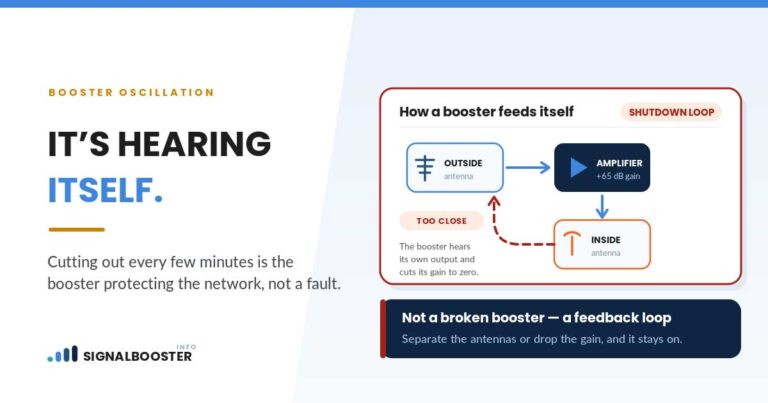
None of that changes what happens at the ends. Where the outside antenna points and how far it sits from the inside one still dominates the result, which is why antenna separation distance and why a booster oscillates and cuts out are worth reading before you commit to a route. A short, clean cable run into a badly separated pair of antennas is still a booster that shuts itself down.
Sealing, Entry, and the Boring Parts That Matter
Where the cable enters the building, three things need to be right.
A drip loop so water runs off the low point of the cable instead of into the hole.
A properly sealed penetration, with an exterior rated sealant, so you have not made a path for water, air, or pests. If the run passes through a fire rated assembly, the penetration has to be sealed to the requirements for that assembly, and that is a local code question.
A grounded entry. An outside antenna brings the electrical code into your install, and the discharge unit and bonding belong at the point of entrance. That is covered separately in signal booster grounding requirements, and the bonding portion is licensed electrician work.
What I Would Do Differently
My own first install failed for a reason that had nothing to do with cable: the antennas were too close together and the system fed back on itself. The lesson generalizes. Get the geometry right on paper first, then run the cable to match it, rather than running the cable where it is convenient and discovering the geometry afterward.
The other honest note is about measurement. Do not judge the route by how it looks. Take a dBm reading at the spots you care about before you start, using the method in our guide to checking real signal strength, and take the same readings after. That is the only thing that tells you whether the route cost you anything.
FAQ
Can I run booster coax in the same hole as my electrical wiring?
No. Keep the coax run away from mains wiring, and never share a penetration or a box with it. If the only practical route puts them together, that is a question for a licensed electrician before you proceed.
Does a longer cable really matter that much?
Yes, and it matters more at higher frequency bands. Compare the manufacturer’s published loss per 100 feet for your cable at your band, and plan the shortest route that is physically reachable.
Can I use a different coax than the one in the kit?
Only if it is approved for that booster. 47 CFR 20.21 conditions consumer booster operation on using approved antennas, cables, and coupling devices, so check the manufacturer’s accessory list rather than substituting on spec alone.
Is running the cable through the attic better than around the outside?
Usually, because it is shorter and the cable is protected from weather and sun. The trade is that attic work carries heat, fall, and insulation hazards that an exterior run does not.
Do I need a permit to run a coax cable?
Running low voltage coax generally does not, but drilling structural members, penetrating fire rated assemblies, and any work on the building’s grounding system can. Your local building department, not this page, is what applies to your building.