It depends entirely on whether any part of your installation is outside.
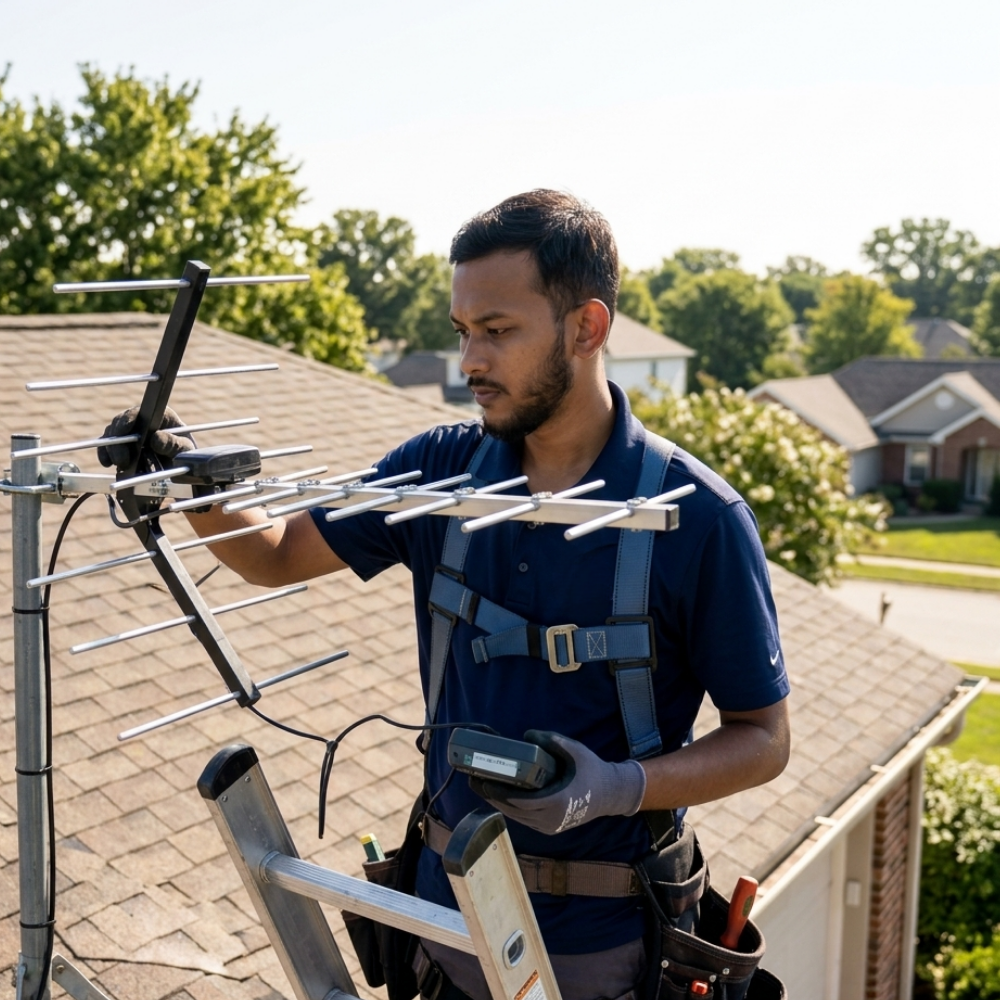
An indoor-only kit, where everything including the donor antenna sits inside the building and plugs into a wall outlet, has no antenna grounding requirement of its own. The moment you mount an antenna on the roof, on a mast, or on an exterior wall and run a cable from it into the building, you are in the scope of the electrical code, and the requirements are specific.
This page is general information, not a code interpretation for your installation. Codes are adopted and amended locally, and the authority having jurisdiction has the final word. Where this describes work on your building's grounding system, it describes the work of a licensed electrician.
What the Code Actually Requires
In the United States, outdoor receiving antennas fall under NEC Article 810, Radio and Television Equipment. A cellular booster's outside antenna is a receiving antenna, and the article covers the antenna, its support structure, and the lead-in cable that comes into the building.
Three requirements matter for a typical booster installation.
An antenna discharge unit on the lead-in
Each lead-in conductor from an outdoor antenna requires a listed antenna discharge unit. It goes nearest the point of entrance to the building, and it must not be installed near combustible material.
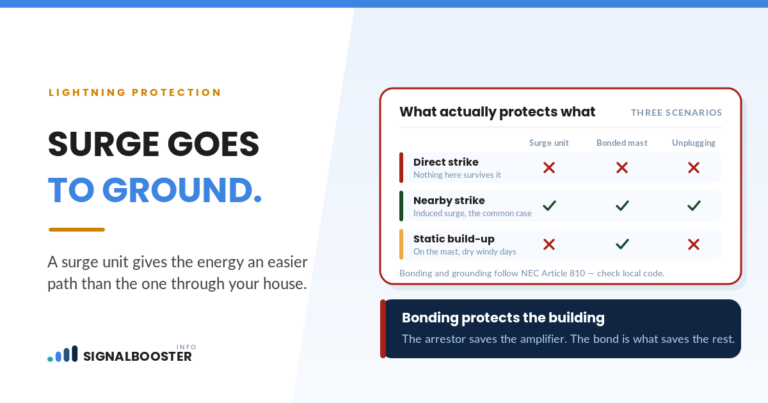
In practice this is the surge protector that sits where the coax passes into the house, with a bonding conductor from it to the building's grounding system. This is the part most self-installed booster kits do not include and most DIY installations skip.
The mast and supporting structure grounded
Outdoor masts and metal structures that support the antenna must be grounded, per 810.21. This is separate from the discharge unit on the cable. A metal mast with an ungrounded lead-in is half a job, and so is a grounded lead-in on an ungrounded mast.
The bonding conductor run straight, and terminated correctly
Two details in the code that are easy to get wrong and that matter more than they look.
The bonding or grounding electrode conductor must be run in as straight a line as practicable. Not neatly routed around corners, not looped, not stapled along the eaves and down the far side. Lightning current does not follow tidy paths, and a sharp bend is where it leaves the conductor and finds something else.
It must terminate to the intersystem bonding termination required by 250.94, where one is available. That is the point on the building's service equipment provided for exactly this, and it is what keeps every system in the house at the same potential.
Why This Is Not Optional Paperwork
The purpose is not to protect the booster.
Grounding the lead-in and the mast is what stops a voltage surge, from a static buildup or a nearby lightning strike, from traveling down the center conductor of the coax into the building. That cable does not stop at the booster. It runs to an amplifier that is plugged into the wall and connected to an indoor antenna, and the surge continues from there.
A direct strike is not the common case. The common case is a nearby strike or a charged cloud passing overhead, which induces enough voltage on an isolated outdoor antenna to destroy the equipment at the other end of the cable and, in the wrong circumstances, start a fire. That is the risk the discharge unit exists to divert.
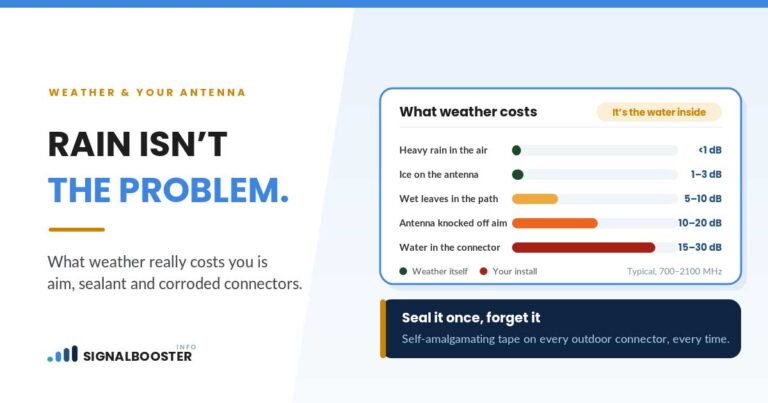
Weather affects signal quality in ordinary ways too, which is a separate topic covered in does weather affect cell signal. This is about the electrical side, not the reception side.
What People Get Wrong
Driving a separate ground rod for the antenna. This is the most common mistake, and it makes things worse rather than better. A second, isolated ground creates a difference in potential between it and the building's electrical ground, and current will travel between them through whatever is in the way, which is your equipment. The antenna system bonds to the building's existing grounding system, not to a new one of its own.
Bonding to a water pipe, a gas line, or a random piece of metal. None of these are the intersystem bonding termination and none of them are an acceptable substitute for it.
Grounding the amplifier instead of the antenna. The amplifier is indoors and plugged into a grounded outlet. That does nothing for the cable coming in from outside, because the surge arrives ahead of it.
Running the bonding conductor the pretty way. As short and as straight as practicable is a code requirement, not a suggestion, and it is the one most likely to be quietly ignored on a self-install.
Assuming the kit covers it. Most consumer booster kits ship with an antenna, cable, amplifier and mounting hardware, and no discharge unit. The absence of one in the box is not evidence that none is required.
Where This Sits Against the Other Rules
Grounding is an electrical code matter and is separate from the FCC requirements that govern boosters themselves, which are about registration with your carrier and operating within the rules for consumer devices. Those are covered in is a signal booster legal. Meeting one set of rules says nothing about the other, and both apply to the same installation.
It is also separate from the things that determine whether the booster works at all: where the outside antenna points, how far it is from the inside one, and how much you lose in the cable between them. Those are in antenna separation distance and signal booster oscillation and feedback.
The Practical Decision
Indoor-only kit, nothing mounted outside. No antenna grounding requirement of its own. Plug it into a properly grounded outlet and you are done.
Outside antenna, and you are hiring the install. Ask the installer specifically about the discharge unit and where the bonding conductor terminates. A professional installer will have an immediate answer. Hesitation is informative.
Outside antenna, and you are doing it yourself. The antenna mounting and the cable run are within reach of a competent DIYer. The bonding to the building's grounding electrode system generally is not, and it is the part where getting it wrong is dangerous rather than merely ineffective. Running the coax yourself and having an electrician do the bonding and the discharge unit is a reasonable split, and a common one.
Check your local requirements before you buy hardware. NEC adoption and amendment varies by state and municipality, and outside the United States the governing standard is different entirely. Your jurisdiction, not this page, is what applies to your building.
The Short Version
- Indoor-only booster: no antenna grounding requirement. Outside antenna: yes, and specifically.
- NEC Article 810 covers it: a listed antenna discharge unit on the lead-in nearest the point of entrance, a grounded mast, and bonding run as straight as practicable.
- Bond to the intersystem bonding termination, per 250.94 where available. Not to a new ground rod, not to a pipe.
- A separate ground rod makes it worse, not better.
- Most kits do not include a discharge unit. That is not the same as not needing one.
- Local code and the authority having jurisdiction govern. The bonding work belongs to a licensed electrician.