Lightning protection for an outdoor booster antenna comes down to three parts working together: a grounded mast, a surge protector (the electrical code calls it an antenna discharge unit) on the coax where it enters the building, and a bonding conductor run as short and straight as practicable to the building's existing grounding system. That combination handles static buildup and the surges a nearby strike induces in the cable. It is not designed to survive a direct hit, and no booster surge protector claims to. If your kit is indoor only, with nothing mounted outside, none of this applies to you.
The rest of this page covers what each part does, what a surge protector's spec sheet actually tells you, where it goes, and where the work stops being yours.
What lightning protection for an outdoor antenna actually consists of
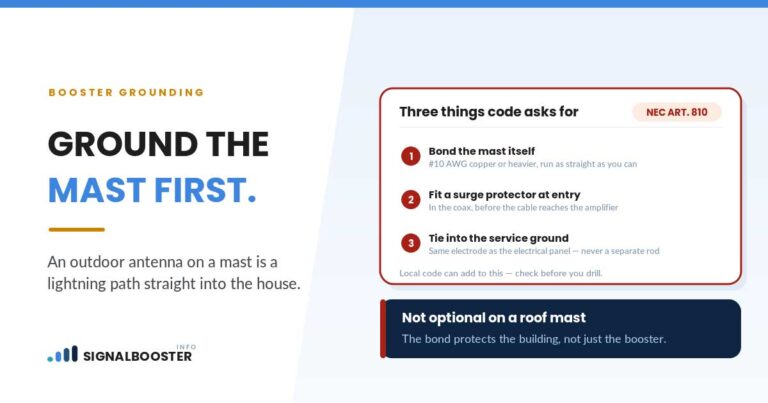
An outdoor antenna on a mast is a tall metal object with a long conductor attached, and that conductor runs straight into your house. Lightning protection means giving any surge on that metal a short, deliberate path to ground before it reaches the amplifier, the power adapter and the outlet behind them.
In the United States, outdoor receiving antennas fall under NEC Article 810, and a cellular booster's donor antenna is one of them. Our page on signal booster grounding requirements walks through what that article asks for. In short:
- The mast and any metal support structure are grounded.
- Each coax lead-in gets a listed antenna discharge unit, located nearest the point where the cable enters the building.
- The bonding conductor runs as short and straight as practicable to the building's grounding electrode system, at the intersystem bonding termination where one exists.
Those three are one system. A surge protector with no ground wire does nothing. A grounded mast with an unprotected coax still leaves a path indoors.
Static, a nearby strike and a direct hit are three different events
Most confusion about booster lightning protection comes from treating these as one thing.
| Event | What happens | What the protection does |
|---|---|---|
| Static buildup | Wind, blowing snow and charged clouds build charge on an isolated antenna | The grounded mast and protector bleed it off |
| Nearby strike | A strike near the house induces a surge on the mast and cable | The protector diverts the surge to ground before it travels indoors |
| Direct strike | Lightning hits the antenna or the structure | Far beyond what a coax surge protector is built for; expect damage |
The middle row is the one the hardware exists for, and it is the common case. A direct strike is rare, and the current involved is enormous. Protecting a building against that is the job of a structural lightning protection system, with air terminals and down conductors designed by a lightning protection contractor. A coax surge protector is not a smaller version of that system. It is a different device for a different problem.
This is also separate from how weather affects reception. Rain, ice and snow on the hardware change the signal in their own ways, covered in does weather affect your outdoor booster antenna. This page is only about the electrical side.
What a booster surge protector's spec sheet tells you
Reading one real spec sheet makes the choice concrete. weBoost's product page for its 50 ohm lightning surge protector (weBoost, read September 11, 2026) lists a frequency range of up to 3 GHz, 50 ohm impedance, N-female connectors, attenuation of less than 0.2 dB, a note that it requires an additional ground cable, and a replaceable gas discharge element.
Each line matters for a different reason.
Impedance has to match your system. Booster kits are built as either 50 ohm or 75 ohm systems, and protectors are sold in both. A 75 ohm part in a 50 ohm system, or the reverse, adds a mismatch to the line.
The frequency range has to cover your booster's bands. Check your booster's own spec sheet for the bands it amplifies, and confirm the protector's rated range covers all of them.
The loss is small, but it is not zero. A fraction of a dB is why protection is not a meaningful performance trade. It is still one more connection in the line, and every outdoor connection needs to be made up and weatherproofed properly.
"Requires additional ground cable" means the box is not the whole job. The protector only works once it is bonded.
A replaceable discharge element means the part is sacrificial. After a surge, the protector may have done its job by damaging itself. If a booster goes quiet after a storm, the protector is one of the places to look.
There is a regulatory point here too. The FCC's consumer booster rule, 47 CFR 20.21 (read September 11, 2026 via Cornell's Legal Information Institute), requires a consumer booster to be operated with approved antennas, cables and coupling devices, and forbids deactivating any feature designed to prevent harmful interference. The simplest way to stay inside that is to use the protector your booster's manufacturer sells or lists for your kit, not a generic part with a similar connector. The FCC's consumer signal booster page (checked September 11, 2026) adds the two conditions every owner has to meet: only properly certified consumer boosters may be used, and each must be registered with your wireless provider before use, at no charge.
Where it goes: the manufacturer's guide and the code read differently
weBoost's installation guide (How to Install a Lightning Surge Protector, published November 8, 2022, read September 11, 2026) says to install the protector near the outside antenna and to attach a copper ground wire of up to 10 gauge to a grounding bus or grounding point. It also advises checking local building codes, and calling an electrician if you are not comfortable doing the job.
NEC Article 810, as summarized on our grounding page, places the discharge unit nearest the point where the lead-in enters the building.
On many houses these are the same place, because the antenna sits on a wall or roof edge close to the cable entry. When they are not, the code position is the one an inspector looks for, and the entry point is also where the bonding conductor can reach the building's grounding system with the shortest, straightest run. Your electrician and your local authority having jurisdiction decide which applies to your building. Both sources agree on the part people skip: the protector has to be bonded, and not being comfortable with the work is a good reason to hand it over.
Do not drive a separate ground rod for the antenna. An isolated second ground can sit at a different potential from the building's ground during a surge, and the current then flows between them through whatever connects them, which is your equipment. The antenna system bonds to the building's existing grounding system.
An attic mount changes the exposure
An antenna inside the attic is not standing above the roofline on a metal mast, which is one of the quieter reasons some people choose it. It trades some reception for less exposure and no work on the roof surface. The full trade is in attic mount vs. roof mount. Whether any grounding applies to your particular attic install is a question for your electrician, not an assumption to make from this page.
The real hazards are the ladder, the roof and the power line
People worry about lightning and then take bigger risks installing the thing that protects against it.
Never work on the antenna, the mast or the coax with a storm in the area. The National Weather Service's lightning safety guidance (weather.gov, read September 11, 2026) says there is no safe place outside when thunderstorms are in the area, to wait 30 minutes after the last lightning or thunder before going back out, and to avoid items connected to electrical outlets while sheltering indoors. That includes the booster.
Look up before you raise anything. A CPSC news release from May 1, 2002 (CPSC, read September 11, 2026) reports that between 1990 and 1998 more than 300 people in the U.S. were electrocuted when an antenna or pole they were holding touched a high-voltage power line. It advises keeping the distance from an antenna or pole to a power line at least one and a half times the height of the antenna or pole, and never assuming an overhead line is insulated. A metal ladder near a line carries the same risk. If a mast position fails that test, it is the wrong position.
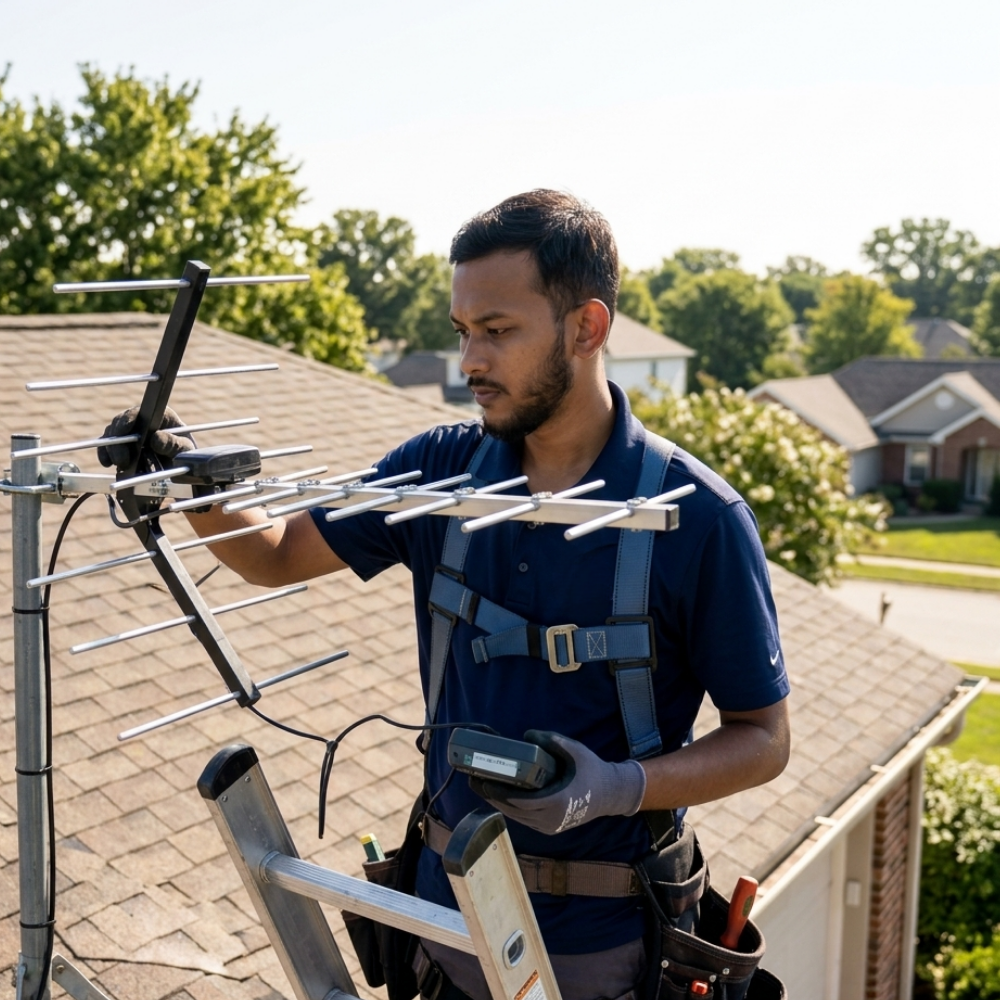
Falls from ladders and roofs are how antenna jobs go badly wrong. If the mounting point means standing on a pitched roof, or working at a height you would not be comfortable at in calm weather, hire a roofer or an antenna installer. The errors that come from rushing this part are in signal booster antenna mounting mistakes.
The bonding is electrical work. Running the coax is within reach of a careful homeowner. If the bonding conductor has to connect at the service panel, the meter base or the building's grounding electrode, stop there: that is a licensed electrician's job, and in many jurisdictions it is not homeowner work at all. Splitting the job this way is common, and DIY install vs. professional covers how to decide where your own line sits.
After a storm: what to check, from the ground
Once the storm has passed and the 30 minutes are up:
- Look at the mast and antenna from the ground. Is the antenna still aimed where it was? Is anything bent or scorched?
- Check the protector and ground wire where you can see them safely. Is the ground wire still attached and continuous?
- Check the booster indoors. Power adapter, outlet, status lights.
- If the booster is dead or behaving oddly, the surge protector's discharge element, the power adapter and the outlet are the first suspects. Contact the manufacturer before replacing anything, and never open the amplifier.
If something on the roof needs hands on it, that is a visit from an installer, not a climb.
FAQ
Do I need a lightning arrestor for my signal booster?
If any antenna is mounted outside, yes. A listed antenna discharge unit on the lead-in, a grounded mast and a proper bonding conductor are what the electrical code expects. An indoor-only kit with no outside antenna does not need one.
Will a surge protector save my booster from a direct lightning strike?
Do not count on it. Booster surge protectors are designed for static and for the surges induced by nearby strikes. A direct strike carries far more energy than they are built to divert.
Can I ground the antenna to its own ground rod?
Not as a separate, isolated ground. The antenna system should bond to the building's existing grounding system, because two unconnected grounds can sit at different potentials during a surge. An electrician makes that connection.
Does a lightning surge protector reduce my signal?
Very little. The weBoost 50 ohm protector's spec sheet lists attenuation of less than 0.2 dB. Match the impedance and frequency range to your kit, and weatherproof the extra connection.
The short version
An outdoor booster antenna needs a grounded mast, a bonded surge protector on the lead-in and a straight run to the building's grounding system. That setup handles static and nearby strikes, not direct hits. Use the protector your booster's maker lists for your kit, match 50 or 75 ohm, and confirm the frequency range. Keep the whole job clear of power lines and storms, leave pitched roofs to installers, and leave the bonding connection to a licensed electrician.
Where this comes from. The consumer booster operating conditions are from 47 CFR 20.21 as published by Cornell's Legal Information Institute, and the certification and registration points from the FCC's consumer signal booster page; both apply in the United States. Surge protector specifications and installation guidance are weBoost's own, as published on the dates given. Storm guidance is from the National Weather Service and the power line figures from the CPSC release cited above. The grounding points reference NEC Article 810 and are general information, not a code interpretation for your building; local codes and the authority having jurisdiction govern. This site has not tested any surge protector.