A consumer signal booster is designed to be installed by the person who bought it, and nothing in the FCC's rules requires a licensed installer to do it. The rule that governs consumer boosters, 47 CFR 20.21, lets a subscriber in good standing operate a certificated consumer booster under the authorization held by the carrier providing their service, once the unit is registered with that carrier. Registration is a form, not an inspection, and it is free.
So the real question is not legal. It is practical, and it splits into two parts that most pages run together: the parts of the job that decide whether the booster works at all, and the parts of the job that can hurt you or your house. They have different answers.
The legal part, in one paragraph
Two conditions have to hold. The unit has to be FCC-certificated as a consumer booster, and you have to register it with your carrier before you turn it on. The four major carriers have already granted blanket consent for properly certificated units, so registration is generally the only step left on your side. Our page on whether a signal booster is legal sets out both conditions in full and what happens if you skip the second.
The category matters here more than most buyers realize. Consumer boosters are one class of device. Industrial and commercial boosters, the kind sold for large buildings and multi-carrier deployments, sit under different rules and are not designed around a subscriber installing them. If a supplier is quoting you a commercial system, professional installation is part of what you are buying and not an upsell. If you are holding a consumer kit from a retail box, the rules assume you will install it.
The parts of the job that decide whether it works
None of these needs a trade license. All of them are where DIY installs actually fail, and none of them are hard once you know they are the decisions.
Measure before you buy anything. The single most common reason a booster underperforms is that the outside signal was never strong enough to work with in the first place. A booster amplifies what reaches the donor antenna; it does not create signal. Take a reading in dBm rather than reading the bars, at the spot where the outside antenna will actually go, and know what the number means before you spend anything: what counts as a good dBm signal strength explains the scale.
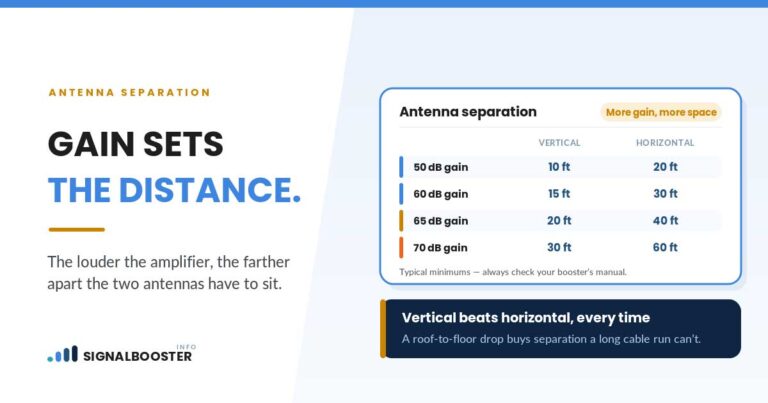
Separation between the two antennas is the install. More than any other single decision, the vertical and horizontal distance between the outside donor antenna and the inside antenna determines whether the system runs at useful gain or spends its life turning itself down. Get this wrong and the booster protects the network by reducing its own power, which reads to you as "it barely does anything." We cover the distances and the geometry in antenna separation distance for a signal booster, and it is worth reading before you decide where anything goes rather than after.
Know what oscillation looks like, because a self-installed system that has gone into feedback rarely announces it in plain language. It shows up as a flashing light, a system that works for a minute and then does not, or coverage that shrinks over the first hour. Signal booster oscillation and the feedback loop describes the failure and how to break it.
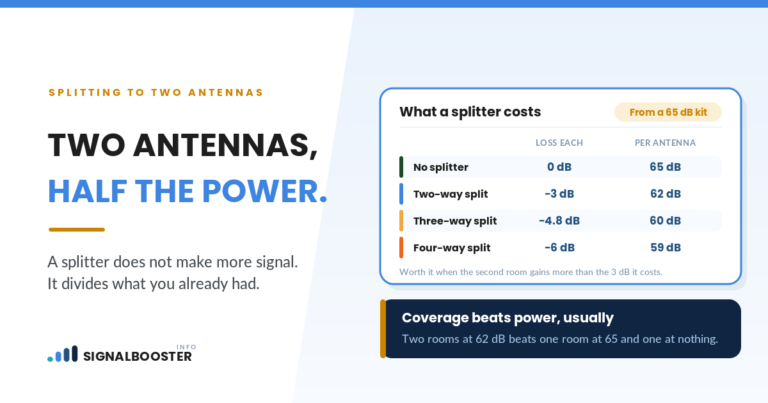
Plan the cable run before you drill anything. Coax loses signal over distance, and the loss depends on the cable type as well as the length. A run that wanders around the house because it was routed after the fact can give back a meaningful part of what the booster gained. Measure the route first and pick the cable to suit it.
Decide where the inside coverage has to be. A single indoor antenna covers one area, and the shape of that area depends on the antenna type and where it is placed. Deciding this after mounting the outside antenna is how people end up with strong signal in a hallway.
If those five decisions are made deliberately, a consumer kit installed by its owner can work exactly as intended. If they are made by improvisation, a professional install of the same hardware will outperform it, and the difference will not be the installer's skill so much as the fact that they made the decisions in the right order.
The three parts that are genuinely somebody else's job
Here is where this page stops being about performance. These are the parts of a booster install where the failure mode is injury or damage, and where the answer is a trade rather than a weekend.
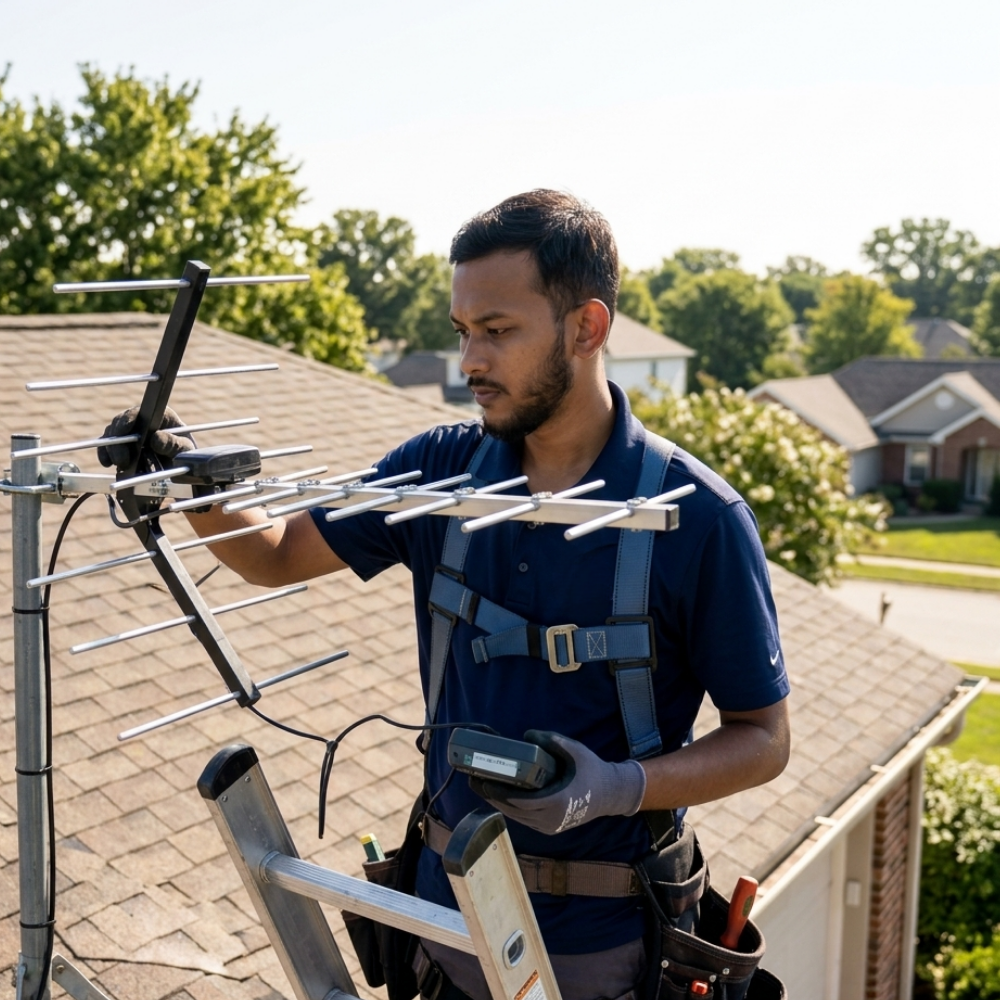
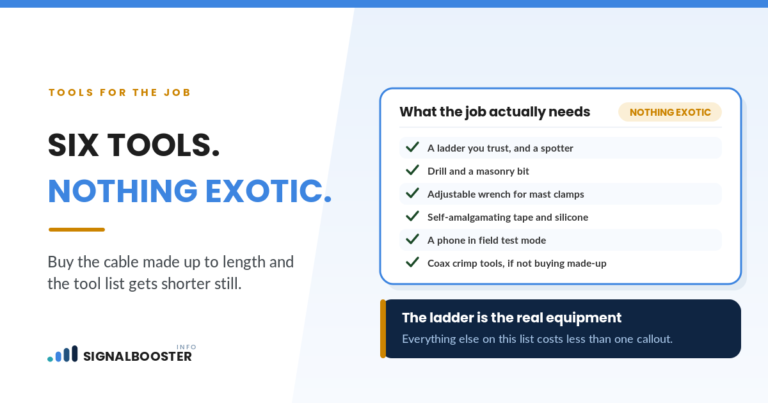
Anything on the roof. Most home booster installs put the donor antenna at height, which means a ladder, an edge, and often a pitched surface. Falls from height are among the most common serious home-improvement injuries, and the standard advice from workplace safety bodies applies to homeowners too: three points of contact, a ladder set at a safe angle on level ground, and no work on a roof in wind or wet. If the mounting point requires you to be on a pitched roof rather than at the top of a ladder against a fascia or a gable wall, hire it out. A roofer or an aerial and satellite installer does this daily with the right anchors and the right ladder. There is no signal benefit worth a fall.
The grounding and bonding. The moment an antenna and a coax run go outside, the installation is inside the scope of the electrical code, and the code is specific about the discharge unit, the conductor and where it bonds to the building's grounding electrode system. Bonding to the electrical service is not a cable job, it is electrical work, and in many jurisdictions it is work a homeowner may not lawfully do on their own service. Read the requirement, then decide who does it, and if the answer involves opening or connecting at the service equipment, that is a licensed electrician. Our separate page on grounding requirements sets out what the code asks for and what an indoor-only kit does not need.
Drilling through the building envelope or into structure. An exterior wall penetration has to be sealed properly or it becomes a water path, and any drilling into a wall or ceiling has to account for wiring and pipe runs. Use a detector, know the service routes, and stop if you do not know what is behind the surface. Structural questions, including anything involving cutting a member to route cable, stop at a professional.
So which do you need?
| Your situation | The honest answer |
|---|---|
| Indoor-only kit, plugs into an outlet, both antennas inside | Do it yourself. No height, no penetration, no grounding. Separation is still the whole game. |
| Outside antenna on a gable wall or fascia you can reach from a ladder, existing cable route, single indoor antenna | Do it yourself, with the grounding requirement checked and handled properly. |
| Outside antenna on a pitched roof, a mast, or anything requiring you to stand on the roof surface | Hire the mounting. You can still do the indoor half and the registration. |
| Grounding or bonding that touches the electrical service | Licensed electrician, and in many places that is not optional. |
| Multi-antenna install, several floors, or a commercial building | Professional, and probably a commercial-class system with different rules. |
| You measured, and the outside signal is very weak at every candidate mounting point | Neither yet. Amplifying almost nothing produces almost nothing. Solve the donor-signal question first. |
Notice that most rows split the job rather than assigning the whole thing. That is the practical answer for a lot of homes: pay someone for the twenty minutes at height, do the rest yourself, and register the unit in your own name because it is your subscription.
What a professional install actually buys you
It is worth being specific rather than dismissive, because there are real things in this column.
- Someone else takes the height risk, with equipment suited to it.
- The separation and aiming decisions get made by someone who has seen the failure modes before, which usually means a better mounting position than the obvious one.
- A grounding job that is done to code the first time, which matters for insurance as much as for safety.
- A tidy, correctly terminated cable run, which is where a surprising amount of signal is lost on self-installs.
What it does not buy you is a different result from physics. If the donor signal at your property is very weak, an installer cannot amplify it into a strong one, and a reputable one will tell you that before quoting.
Before you decide, do this
- Take a dBm reading at each candidate outside mounting position, not just at your desk.
- Look at where the outside antenna has to go and be honest about whether you can reach it safely from a ladder.
- Check what the grounding requirement means for your installation and decide who is doing it before you buy the kit, not after.
- Sketch the cable route and measure it.
- Register the unit with your carrier once it is in place. That step is yours regardless of who mounted the hardware.
On sourcing. The FCC rules for consumer signal boosters, including operation under the carrier's authorization and the registration requirement, are set out in 47 CFR 20.21 and summarized on the FCC's own consumer signal boosters pages. We attempted to retrieve both the eCFR text of 20.21 and the FCC consumer page directly while writing this on 2026-08-26 and could not: the eCFR request was redirected to a challenge page and the FCC page returned a 403 to our fetcher. That is our retrieval failing, not the FCC withholding anything; both documents are public. The rule points stated here are the ones this site verified against those sources when it published its page on booster legality, and readers who want the primary text should go to ecfr.gov and fcc.gov directly.
Not published here: any installation price, any figure for signal gained or lost by a given cable run or mounting position, and any claim about installs this site has performed. Nothing on this site has been installed or measured by us.