Because one amplifier has one power budget, and adding antennas divides it rather than adding to it. A single booster produces a fixed maximum output. Split that output across two indoor antennas and each one radiates less than a single antenna would, with the splitter taking a share as well. Past a certain point, adding antennas to one system spreads a weak result thinner instead of covering more house. A second complete system, with its own outdoor antenna, its own amplifier and its own power budget, is what actually adds coverage.
The trigger is rarely square footage on its own. It is distance, separation, and building layout, and the four situations below account for most of it.
The distinction that makes this decision simple
There are two different upgrades and people run them together.
Adding an indoor antenna to an existing system shares one amplifier's output between more places. It is the right move when the amplifier still has headroom and the extra antenna is close enough on the cable run to be worth feeding. When one antenna is enough and when a second earns its place is covered in how many indoor antennas you actually need.
Adding a second complete system adds a second outdoor antenna, a second amplifier and a second power budget. It is the right move when the problem is that one system cannot reach, not that it lacks a distribution point.
The question to ask is not "how big is my house". It is "is the far area failing because it has no antenna, or because whatever reaches it is already too weak to matter". The first is a splitter question. The second is a second system question.
Before either, be honest about what one system was ever going to do. Coverage claims on boxes assume a starting signal level most homes do not have, which is the subject of how much coverage a signal booster really gives you.
The four cases where a second system is the real answer
One: separated structures. A detached garage, a workshop, a barn, a guest house or an accessory dwelling is not part of your house as far as radio is concerned. The cable run alone can eat much of what you would send there, and the walls in between finish the job. A separate small system for the outbuilding, with its own outdoor antenna, generally beats a heroic cable run from the main one.
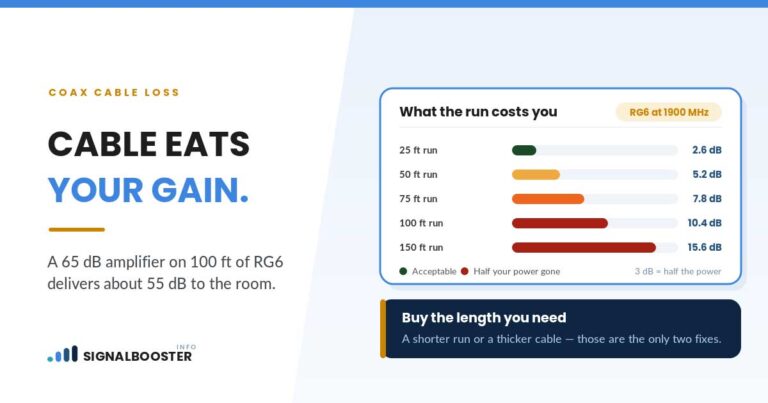
Two: long, spread out layouts. A long ranch, a house with wings, or a property where the far end is a long way from the outdoor antenna position. Every foot of coax loses signal, so the far antenna on a shared system starts at a disadvantage before it radiates anything.
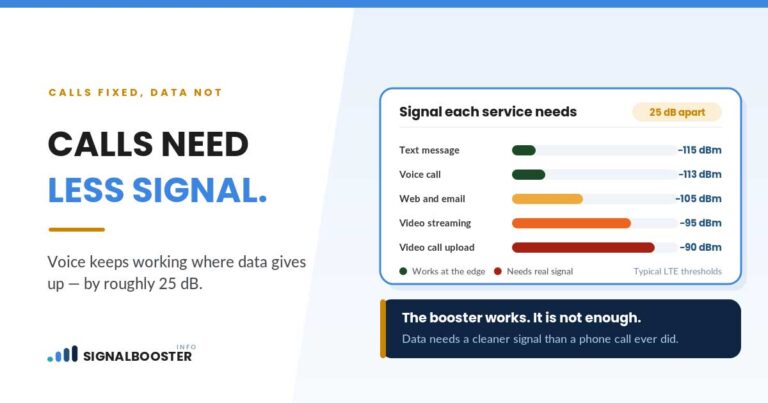
Three: a fully below grade level under a house that also needs upstairs coverage. Concrete does not attenuate cellular signal gently, it blocks it. A basement antenna needs real power arriving at it, and a share of a split output arriving through a long run frequently is not enough. If the basement is the reason you bought a booster, do not let it be the antenna that gets the leftovers.
Four: donor signal from different directions. If the usable signal for the areas you care about comes from different tower directions, one outdoor antenna aimed one way cannot serve both well. Two systems, aimed differently, solve a problem that no amount of indoor antennas will.
Notice that in three of the four cases, a house with the same floor area but a different shape would need only one system. That is why square footage is a poor guide.
What two systems in one house actually costs you
This is the part that gets skipped, and it is the reason a second booster is a considered decision rather than an obvious upgrade.
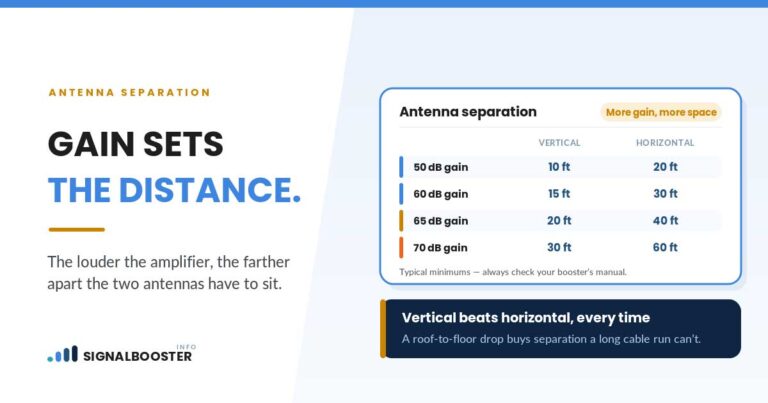
Each system has to be isolated from the other one, not just from itself. The standard install problem is keeping one system's outdoor antenna from hearing its own indoor antenna, which is what antenna separation distance is about. With two systems on one house, you now have four antennas and four leakage paths to consider. System A's outdoor antenna can pick up system B's indoor antenna, and the loop closes just as effectively as if it were one system. The result is the same feedback behavior, and the same automatic shutdown, described in oscillation and the feedback loop.
The practical consequence: two systems on one house want their outdoor antennas well apart and their indoor coverage areas genuinely separated, which usually means opposite ends of the building or one system serving a different structure. Two boosters in a small house is not a stronger booster, it is two systems fighting.
Each system is a separate device with separate obligations. The FCC's consumer signal booster rules at 47 CFR 20.21 require the provider's consent and registration of the device before it is operated, and the registration record identifies the make, model and serial number of that unit along with its location. Two units means two registration records, not one. The full picture is on our page on whether a signal booster is legal. These are United States rules. If you are elsewhere, your national regulator sets the equivalent conditions.
Each outdoor antenna brings its own code requirements. Two antennas means two lead-ins, and the electrical code treats each one. In the United States, NEC Article 810 calls for a listed antenna discharge unit on each lead-in near the point of entry, a grounded mast or supporting structure, and a bonding conductor run as straight as practicable to the building's grounding electrode system. Bonding both systems back to the building's single grounding system is the requirement. Driving a separate ground rod for the second antenna is the classic mistake, and it makes things worse by creating a potential difference between two grounds with your equipment in between. This is electrical work, and where it involves connecting at the service equipment it is a licensed electrician's job, which in many jurisdictions is not optional. Local codes and the authority having jurisdiction govern.
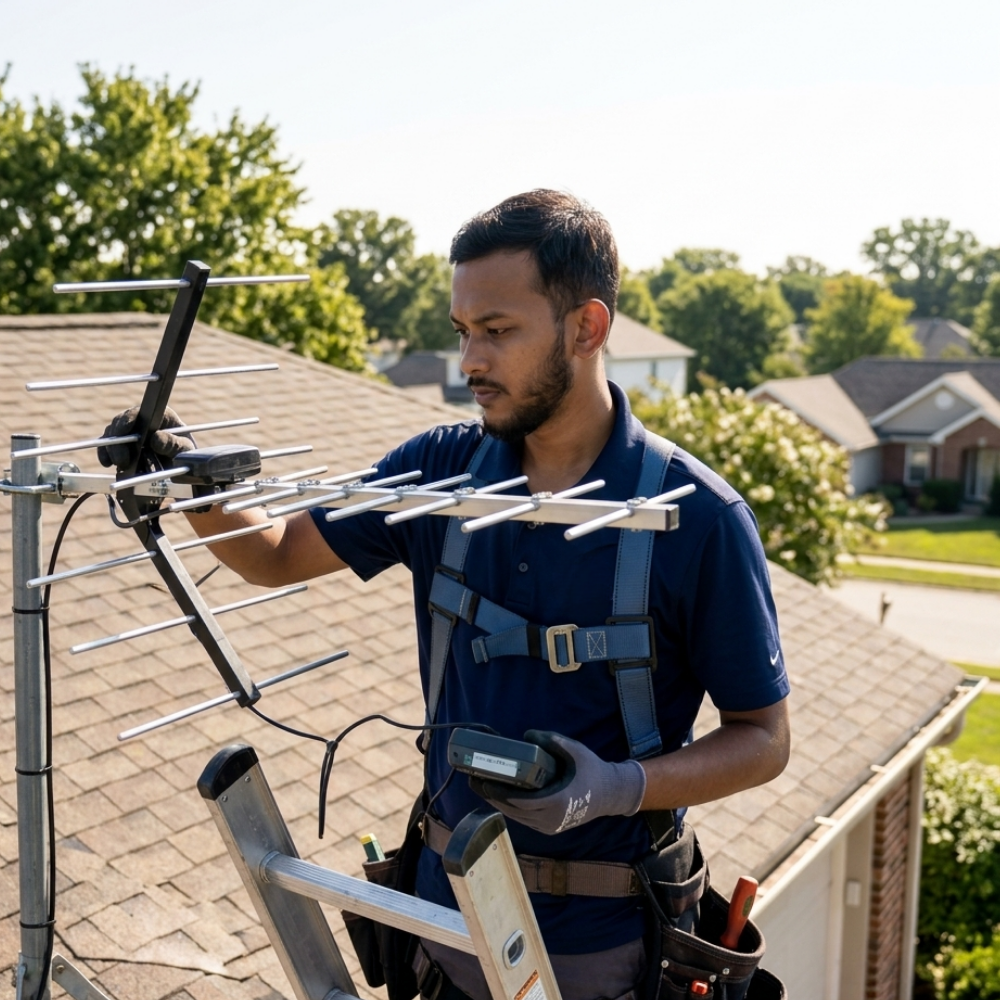
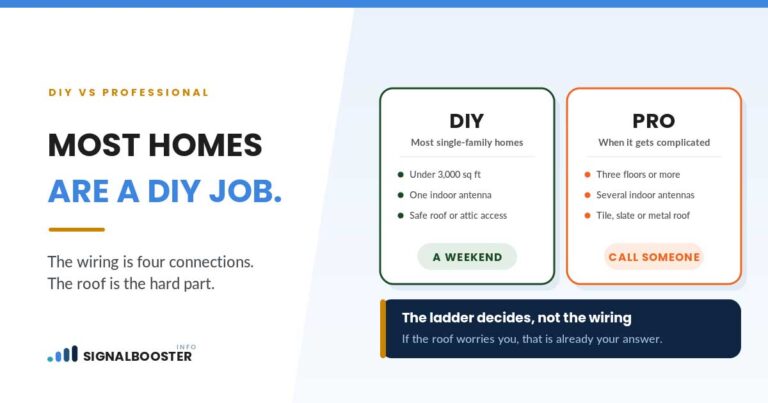
Each outdoor antenna also means more work at height. Two mounting positions, two cable entries, two lots of sealing. If you were on the fence about hiring the mounting for one, two is a stronger case for it. This site does not publish ladder or roof technique, and if the mounting point requires standing on a pitched roof surface, that is a roofer or an aerial and satellite installer.
The decision table
| What you are seeing | Likely answer |
|---|---|
| Good coverage near the indoor antenna, poor at the far end of one open floor | Second indoor antenna on the same system |
| One room fine, the next room not, in a normal sized house | Placement problem, not a capacity problem |
| Basement plus main floor, wood joists between | One system, two antennas |
| Basement plus main floor, concrete slab between, basement is the priority | Consider a dedicated system for the below grade level |
| Detached garage, workshop or guest house | Separate system for the outbuilding |
| Long layout, far end is a long cable run away | Second system, sited at that end |
| Best signal for different areas comes from different directions | Second system, aimed differently |
| A commercial building or many users across carriers | Neither. This is a different device class, see below |
| The donor signal is very weak everywhere outside | Neither yet. Two systems amplifying almost nothing produce almost nothing twice |
If your symptom is closer to the second row, the diagnosis in why a booster works in one room but not others will save you the price of a second unit.
Where consumer kits stop being the right product
There is a limit that buying more consumer boosters does not solve. 47 CFR 20.21 also provides for Industrial Signal Boosters, which may be operated by someone who holds an FCC license or who has obtained the express consent of the licensees affected. That class exists for large buildings and multi user deployments, and those systems are designed and installed professionally rather than bought as kits.
Three consumer units bolted onto a commercial building is not an equivalent to one properly designed system. It is a harder isolation problem, three registrations, and a worse result. If your property is genuinely at that scale, the right next step is a site survey by an installer rather than another retail box.
The honest summary
A second booster adds coverage because it adds a second power budget and a second donor antenna, and those are the two things a splitter cannot manufacture. Add antennas when the amplifier has headroom and the far area simply lacks a distribution point. Add a system when the far area is out of reach, is behind concrete, is in another building, or is served by a tower in a different direction. And plan the isolation between the two systems before you buy the second one, because the failure mode of two boosters on one house is the same feedback loop as one badly placed booster, with twice the hardware.
FAQ
Can you use two signal boosters in one house?
Yes, and for large or spread out properties it is often the correct approach. Each unit needs its own outdoor antenna, its own registration with your carrier, and enough separation from the other system's antennas to avoid creating a feedback path between them.
Will two boosters interfere with each other?
They can. One system's outdoor antenna picking up the other system's indoor antenna closes a feedback loop exactly as if it were a single system. Keep the outdoor antennas well apart and the indoor coverage areas separated, ideally by putting the systems at opposite ends of the property or in different structures.
Is a second indoor antenna cheaper than a second booster?
Usually, but it solves a different problem. Splitting one amplifier's output divides the power between antennas and the splitter adds loss, so a second antenna helps only where the amplifier still has headroom to share.
How big does a house have to be before it needs two boosters?
There is no square footage threshold worth quoting, because layout, construction and cable distances decide it. A compact three story home may need one system, while a long single story home of the same area may need two.
Do I have to register both boosters with my carrier?
Yes. The registration identifies a specific unit by make, model and serial number along with its location, so two units means two registration records, each made before that unit is operated.
Where this comes from. The registration and consent requirements, the details recorded at registration, and the industrial signal booster provision are from 47 CFR 20.21 as published in the Code of Federal Regulations, and apply in the United States. The grounding and bonding points reference NEC Article 810 and are general information rather than a code interpretation for your building. No coverage area, cable loss or power figure is stated here as a measurement, because those vary by kit and by building and this site has not tested any unit.