The best way to fix weak cell signal in a basement depends on one reading: the signal outside, at a spot where an outdoor antenna could go. If that reading is usable, a signal booster for the basement, with its outdoor antenna mounted above grade and its indoor antenna in the room where you actually spend time, is the most complete fix. The concrete that caused the dead zone even works in your favor, because it isolates the two antennas from each other. If your home internet is solid and you mainly need calls and texts, try Wi-Fi calling first.
This page is about what to do. Why basements lose signal in the first place is a subject of its own; the short version is that below grade, every obstacle stacks up at once.
Start with the decision, not the product
| What you find | The fix that fits |
|---|---|
| Reliable home internet, and you mainly need calls and texts | Wi-Fi calling, switched on in your phone's settings |
| Usable signal outside, dead in the basement | A certified consumer signal booster |
| Weak signal everywhere, including outside | A booster has little to amplify; look at carrier options or another carrier |
| Weak in one corner, fine elsewhere downstairs | Move where you use the phone first; it costs nothing |
Wi-Fi calling needs no hardware and costs nothing to try. Wi-Fi calling vs. signal booster covers what each one does and does not fix. If the problem is the signal outside, a booster is the wrong tool, and booster vs. network extender explains the carrier-side alternative that runs over your internet connection.
Measure before you buy anything
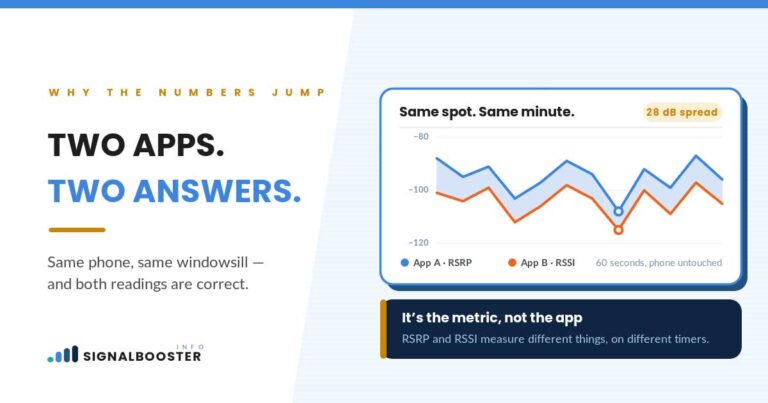
Take three readings in dBm, not bars, using the method in how to check your real signal strength:
- Outside, at the spot where an outdoor antenna would realistically go, on the side of the house with the best signal.
- On the ground floor, in a central room.
- In the basement, where you want coverage.
If the outside reading is usable and the basement reading is not, you have the classic booster case. If the outside reading is poor too, a booster starts with too little to work with.
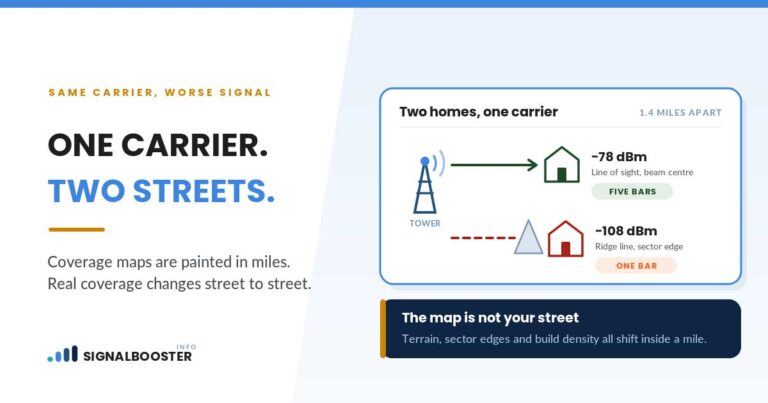
Carrier maps will not answer this for you. AT&T's map (att.com, read September 11, 2026) states that it displays approximate outdoor coverage and that actual coverage may vary. Verizon's coverage map and T-Mobile's coverage map are likewise presented as approximate outdoor coverage. None of them models your basement.
What concrete and rebar change about a booster install
Most basement guides stop at "concrete blocks signal". That part is true. NIST's laboratory study of signal attenuation through construction materials, which included reinforced concrete and steel reinforcing bar grids (NISTIR 6055, 1997, read September 11, 2026), measured how loss grows with material thickness. But concrete does three separate things to a booster design, and only the first is bad news.
It blocks the tower. This is why the outdoor antenna has to be above grade and outside the building envelope. An antenna in a basement window well or at foundation level still sits below most of the house's mass and gains you little.
It isolates the antennas from each other. The most common failure in any booster install is the indoor antenna's output leaking back to the outdoor antenna, which makes the booster cut its gain or shut itself down. A floor or two of house plus a concrete foundation between an antenna up high and an antenna in the basement is a lot of isolation. That usually gives a basement install more room before feedback than an install with both antennas on the same level. Antenna separation distance explains the mechanism.
It traps the coverage. The slab and foundation that keep the tower out also keep the basement antenna's signal in. An indoor antenna in the basement will do little for the floor above, and an upstairs antenna will not reach down. Plan coverage level by level.
Where each part goes in a basement install
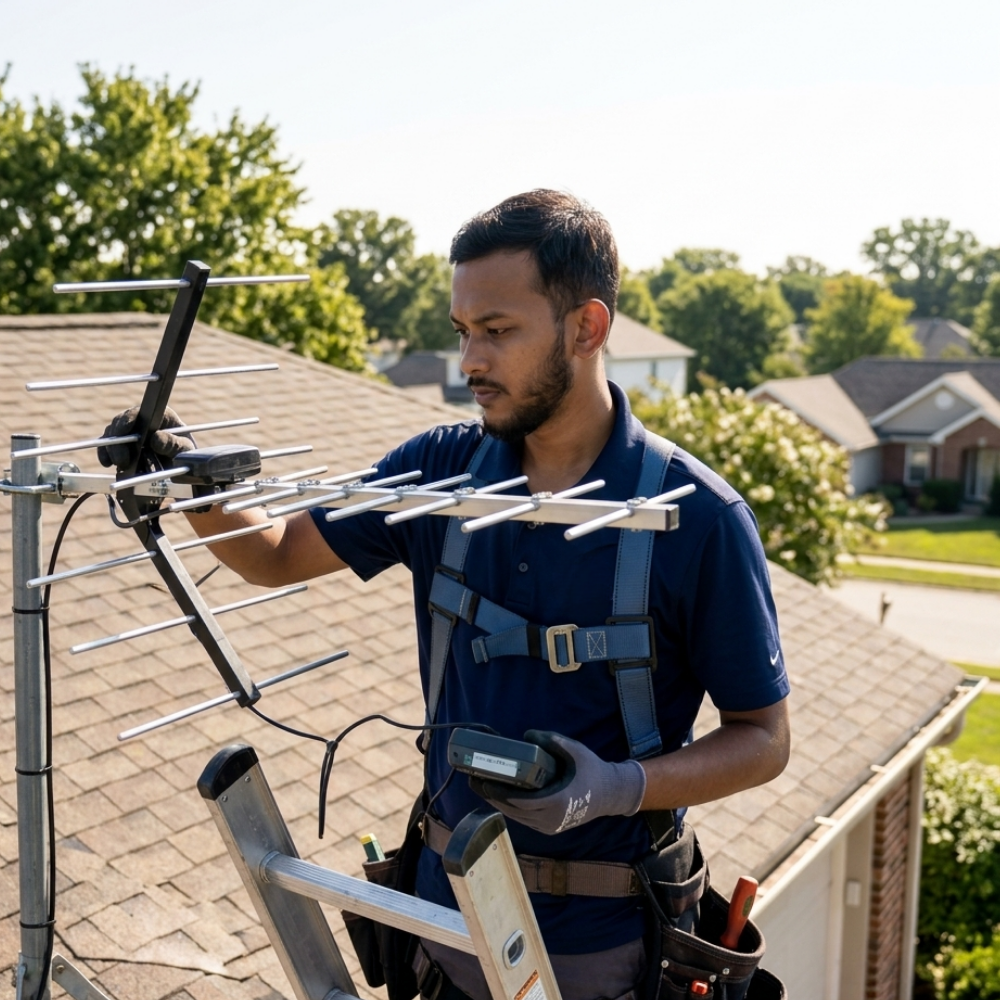
Outdoor antenna: above grade, where your outside reading was best. That is often an exterior wall near the roofline or a mast, not necessarily the highest point on the house. Mounting involves ladders and sometimes the roof, and the hazards are real.
- Look up for power lines before raising any mast or ladder. A CPSC news release from May 1, 2002 (CPSC, read September 11, 2026) reports that more than 300 people were electrocuted between 1990 and 1998 when an antenna or pole they were holding touched a high-voltage line, and advises keeping the distance to a line at least one and a half times the height of the antenna or pole.
- Falls from ladders and roofs are the other serious risk. If the mounting point requires standing on a pitched roof, hire a roofer or an antenna installer.
- An outdoor antenna brings grounding requirements under the electrical code. The bonding connection to the building's grounding system is a licensed electrician's job.
Cable run: as short as the house allows. Every foot of coax costs signal. Basement installs often come down an exterior wall and in through the rim joist area, or through an existing service penetration. Before drilling any hole, check for wiring and pipes with a detector, stay clear of the areas around outlets, switches, the electrical panel and plumbing runs, and stop if you hit anything you cannot identify. Drilling through a poured foundation wall is a waterproofing decision as much as a cable one. If that is the only route, have an installer do it.
Indoor antenna: in the room where people are. Not in the utility room because the cable happens to arrive there. Mount it on the ceiling of the main living area, away from furnace ductwork and large metal. A dome suits an open central space, and a panel suits a long room.
Amplifier: somewhere dry and ventilated, off the floor and away from the sump, the water heater and anywhere a leak could reach it.
The legal part, which is simple
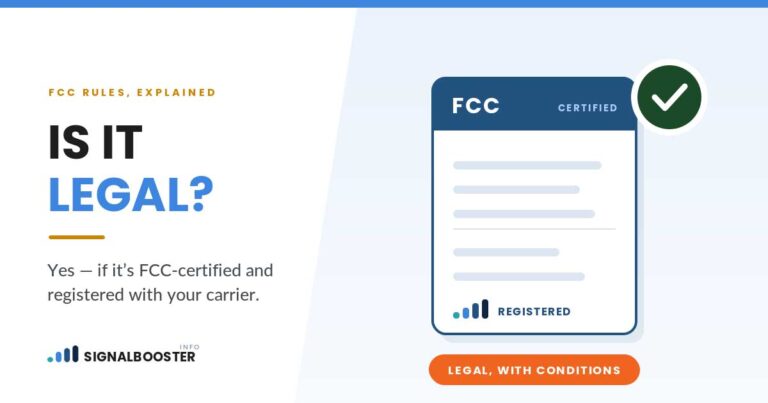
Only FCC-certified consumer boosters may be used, and each has to be registered with your carrier before it is switched on. The FCC's consumer signal booster page (checked September 11, 2026) says the major carriers have committed to allowing properly certified consumer boosters on their networks and that registration is free. The rule itself, 47 CFR 20.21 (read September 11, 2026 via Cornell's Legal Information Institute), requires your provider's consent and your registration before operation, operation with approved antennas, cables and coupling devices, and never disabling the booster's interference protection features.
Register on your carrier's own page. Verizon's registration page (read September 11, 2026) states there is no fee to register or use a signal booster, and T-Mobile's is on its register a signal booster support page.
When a booster is the wrong answer for a basement
- The outside reading is poor. Amplifying almost nothing still gives you almost nothing.
- You rent. Mounting anything on the exterior is usually the landlord's decision, not yours.
- You only need calls and texts, and your internet is reliable. Wi-Fi calling may already solve it.
- You expect one basement antenna to cover the whole house. The concrete that isolates your antennas also stops the signal going upstairs. The rated coverage on a box assumes an open floor and strong outdoor signal, which how many square feet a booster really covers explains.
We carry no affiliate links, so there is nothing in this for us either way. For a basement with usable signal outside and people who live down there, a properly registered booster is the fix that covers everything. For a basement you visit to do laundry, it is often more than you need.
FAQ
Will a signal booster work in a basement?
Yes, if there is usable signal outside where the outdoor antenna can be mounted. The booster captures that signal above grade and rebroadcasts it indoors. It cannot create signal that is not there.
Where should the indoor antenna go in a basement?
On the ceiling of the room where people actually use their phones, away from ductwork and large metal. Not in the utility room just because the cable comes in there.
Can I put the outdoor antenna in a basement window?
It is rarely a good position. A window well sits below most of the house and is still largely underground. Mount the outdoor antenna above grade, where your outside reading was strongest.
Is Wi-Fi calling enough for a basement?
Often, if your home internet reaches the basement reliably and you mainly need calls and texts. It does not improve cellular data, and it depends on your Wi-Fi reaching the basement.
The short version
Measure outside first. If the outside signal is usable, a certified booster with its outdoor antenna above grade and its indoor antenna in the basement's main room is the most complete fix, and the concrete helps by isolating the two antennas. Leave roof mounting to an installer and bonding to an electrician, check for wiring and pipes before drilling, and register the booster before you turn it on. If your internet is good and calls are the need, try Wi-Fi calling before you buy anything.
Where this comes from. The operating conditions are from 47 CFR 20.21 as published by Cornell's Legal Information Institute, and the certification, carrier consent and registration points from the FCC's consumer signal booster page and the carriers' own registration pages; these apply in the United States. Map limitations are from the carriers' own map pages, the construction materials study is NIST's NISTIR 6055, and the power line figures are from the CPSC release cited above. This site has not tested any booster in a basement, and no gain, signal or coverage figure is given here.