Less than the box number, and measured a different way. Size basement coverage by the zones where people actually use their phones and by the walls that separate those zones, not by the basement's total square footage. Most finished basements have one or two use zones. Any area behind a concrete or block partition counts as a separate zone. A booster's rated coverage describes a best case, with strong signal outside and an open floor, so treat it as a ceiling, not a basement number.
Getting this right saves money in both directions. People overbuy to cover storage rooms nobody stands in, and underbuy when a single masonry wall splits the basement into two places one antenna cannot reach.
Why square footage does not transfer to a basement
The coverage figure on a booster box is measured under favorable conditions: good signal where the outdoor antenna goes, and an open space with little in the way. How many square feet a booster really covers explains why that figure is a ceiling rather than a forecast for your home.
A basement breaks those assumptions harder than any other level. The signal the booster starts from is captured outside, so the rating can only ever be as good as that reading. Inside, basements are where the masonry is: foundation walls, block partitions around mechanical rooms, sometimes a poured wall down the middle carrying the house above. An open floor is the assumption behind the box number, and a basement is the level least likely to have one.
There is also a limit that no amount of rated area changes. Every certified consumer booster works within the network protection standards and the gain and noise limits in the FCC's rule, 47 CFR 20.21 (read September 11, 2026 via Cornell's Legal Information Institute). A higher tier kit gives you more to work with, but it does not turn a foundation wall into drywall.
The use-zone method
This is a worksheet, not a formula. It takes a sheet of paper and about fifteen minutes.
- Sketch the basement. Rough rooms, doors and the stairs.
- Mark how each area is used: daily, occasionally, or rarely.
- Mark every boundary between areas: open, a stud wall with drywall, or block or poured concrete. Mark the mechanical room separately, because it tends to be full of sheet metal ductwork and appliances.
- Group areas into zones. A zone is a set of daily or occasional areas joined by open space or ordinary stud walls.
- Drop the rarely used areas. Storage and utility rooms rarely justify coverage of their own.
- Count the zones. That count, not the square footage, is your sizing number.
Here is how that plays out on an example layout. It is an illustration, not a measurement of any particular house.
| Area | Use | Boundary to the next area | Zone |
|---|---|---|---|
| Family room | Daily | Open to the bar area | Zone 1 |
| Bar or kitchenette | Daily | Open | Zone 1 |
| Guest bedroom | Occasional | Stud wall | Zone 1, confirm with a reading |
| Home office | Daily | Block wall | Zone 2 |
| Utility and furnace room | Rarely | Block wall, ductwork | Skip |
| Storage | Rarely | Poured concrete | Skip |
That basement is two zones, whatever its total square footage. It needs coverage in two places, and the block wall is what makes it two.
The boundaries that split a zone
Masonry partitions. Block or poured concrete walls inside a basement are often structural, which is exactly why they are there. They are also the walls a signal struggles with most.
Mechanical rooms. Furnaces, water heaters, trunk ducts and electrical equipment concentrate a lot of metal in one place. A zone on the far side of the mechanical room is effectively a separate zone.
Stair enclosures and chases. They can put a masonry or framed barrier where the floor plan looks open.
Ordinary stud walls with drywall are rarely what splits a zone. If the only barrier between two rooms is a stud wall, start by assuming one zone and let a reading prove otherwise.
Do not forget the floor above
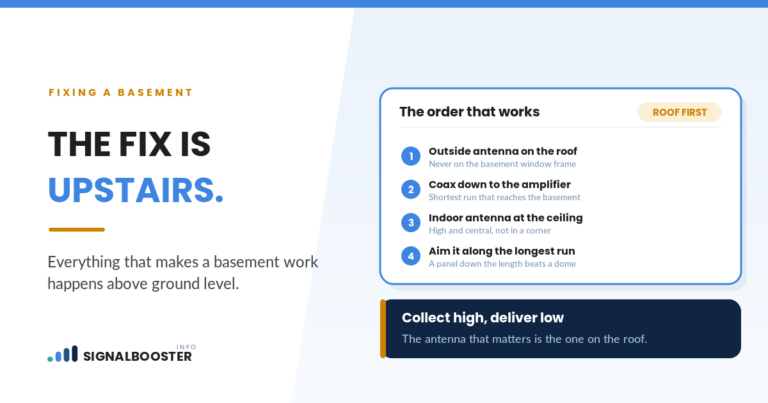
Decide early whether you are sizing for the basement alone or for the whole house, because a basement antenna does little for the level above it, and the reverse is also true.
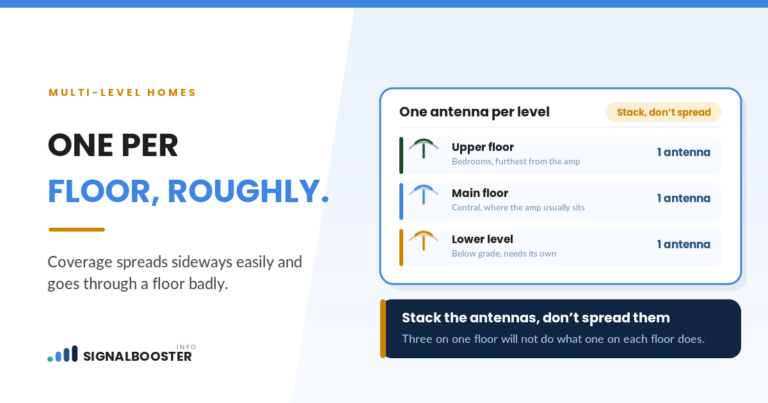
If a concrete slab separates the basement from the main floor, plan each level separately. If the floor between them is wood framing, one system with an antenna on each level may serve both. How many indoor antennas a booster needs explains how to judge whether one amplifier has enough output to share between levels.
Turning zones into antennas
| What your worksheet shows | A sensible starting point |
|---|---|
| One zone | One indoor antenna, placed centrally in it |
| One long zone | One panel antenna aimed down its length |
| Two zones, strong reading at the first antenna | Two antennas from one booster, through a splitter |
| Two zones, marginal reading at the first antenna | Improve the outdoor side before splitting |
| Zones on different levels separated by concrete | Treat each level as its own coverage problem |
Antenna type changes the shape of a zone more than people expect. A dome spreads signal around a central ceiling point, and a panel pushes it in one direction, which is what a long basement often needs. Dome vs. panel indoor antennas covers the choice.
If a room inside a zone still comes up weak, placement is the first suspect, not size. Why a booster works in one room but not others shows how to read that fall-off.
What a bigger kit buys, and what it does not
Higher tier kits generally bring more amplifier headroom and support for more indoor antennas. That is useful when your worksheet shows several zones and the signal outside is good.
It does not help when the outside reading is weak, because the booster can only amplify what its outdoor antenna captures. It does not get through a masonry wall that a smaller kit could not get through, and it does not justify coverage in rooms nobody uses. Size to your zones and your outside reading, not to the largest number on the shelf.
Confirm with readings, before and after
The worksheet gives you a plan. Readings prove it. Using the method in how to check your real signal strength in dBm:
- Before buying, take a reading outside where the outdoor antenna would go, and one in each zone.
- After installing, take readings in the same spots with the booster on.
- If one zone falls short, move the antenna serving it before you buy anything else.
Then register the booster. The FCC's consumer signal booster page (checked September 11, 2026) says only properly certified consumer boosters may be used and that each one has to be registered with your wireless provider before use, at no charge. Verizon's registration page (read September 11, 2026) states there is no fee to register or use a signal booster, and T-Mobile's is on its register a signal booster support page.
FAQ
What size signal booster do I need for my basement?
Count use zones rather than square feet. Work out where people use phones daily, group those areas where only open space or stud walls separate them, and size for that number of zones, checked against your outdoor signal reading.
Does a basement need its own booster?
Not necessarily. If wood framing separates it from the main floor, one system with an antenna on each level may be enough. A concrete slab between levels, or a basement that is the main priority, makes a dedicated setup more likely.
Will a booster in the basement also cover upstairs?
Rarely well. The floor and foundation that isolate a basement antenna also stop its signal going up. Plan upstairs coverage separately.
Should I buy a bigger booster to be safe?
Only if your zone count and your outside reading call for it. A larger kit cannot amplify signal that is not there outside, and it adds nothing in rooms nobody uses.
The short version
Basement coverage is a count of zones, not a figure in square feet. Map where people use their phones, let masonry walls and mechanical rooms split the zones, skip storage, and plan the floor above separately if concrete divides them. Then size the booster to that count and to the signal you measured outside, and confirm the result with readings.
Where this comes from. The limits on certified consumer boosters are from 47 CFR 20.21 as published by Cornell's Legal Information Institute, and the certification and registration points from the FCC's consumer signal booster page and the carriers' own registration pages; these apply in the United States. The example layout is an illustration. This site has not tested any booster, and no coverage area, gain or signal figure is given as a measurement here.