Because a basement is the one room where every obstacle stacks up at once. Below grade, the straight line to the tower runs through soil and a concrete foundation. The signal that does reach you mostly entered the house above ground and then had to come down through the floor. Steel reinforcing bar, ductwork and appliances take more along the way. And your phone has to answer the tower back through the same mass, at far lower power than the tower transmits. None of these is unusual on its own. A basement is where they all apply together.
You are below the horizon
Cell sites are usually a long way off, and their signal arrives at your house close to horizontal. Rooms above ground receive it through exterior walls and windows. A room below ground cannot, because the straight line from the tower to your phone now passes through earth and foundation.
So the signal a basement gets is mostly indirect. It came through the walls and windows of the floor above, and then down through the floor structure. Every stage costs something, and the losses add up.
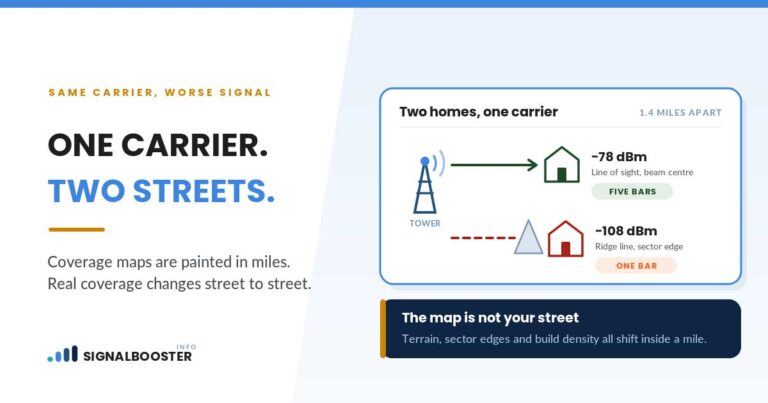
That is also why distance from the tower is often not the main story in a basement. A house close to a tower can still have a dead basement, because obstruction, not distance, is what the basement adds. Distance vs. obstruction explains how to tell which one is dominating for you.
Soil and the foundation
Earth and concrete both absorb radio energy, and water in them makes it worse, because water absorbs radio energy readily. A damp basement, wet soil after rain, or concrete that has not fully dried are all more lossy than their dry equivalents.
NIST measured this in the laboratory. Its study of signal attenuation through construction materials (NISTIR 6055, 1997, read September 11, 2026) tested brick, masonry block, several concrete mixes, reinforced concrete and steel reinforcing bar grids, with specimens of varying thickness to measure attenuation as a function of penetration distance. The point for a homeowner is simple: thickness matters, and foundation walls are the thickest walls in the house.
Rebar: a steel grid inside the wall
Poured foundations and slabs are usually reinforced with steel bar laid in a grid. Metal reflects radio waves rather than letting them pass, so the grid acts as a partial screen.
How much it screens depends on the size of the openings relative to the wavelength. Wavelength is the speed of light divided by frequency, which works out to about 17 inches at 700 MHz, about 6 inches at 1900 MHz, and about 3 inches at 3.7 GHz. A mesh with openings much smaller than the wavelength behaves much like a solid sheet, the same principle as the metal screen in a microwave oven door.
That produces a trade that surprises people. Longer waves, the low bands, are the ones a steel grid screens most. Shorter waves, the higher bands, slip through the openings more easily but lose more in the concrete itself. Neither gets through a reinforced foundation well, which is why a basement can be poor on every band your phone tries.
The whole house is overhead
The signal that reached the ground floor has already paid for the exterior walls, the windows and any interior walls. To reach the basement it then crosses the floor structure, and a basement ceiling is where a house keeps a lot of its metal: trunk ducts, the furnace, the water heater, plumbing, wiring, and often appliances directly overhead.
This is the other side of the pattern explained in why signal is weaker on some floors. Upper floors can lose out to the way towers aim their antennas. Lower floors lose out to building mass, and the basement is the far end of that scale.
Higher bands lose more on the way in
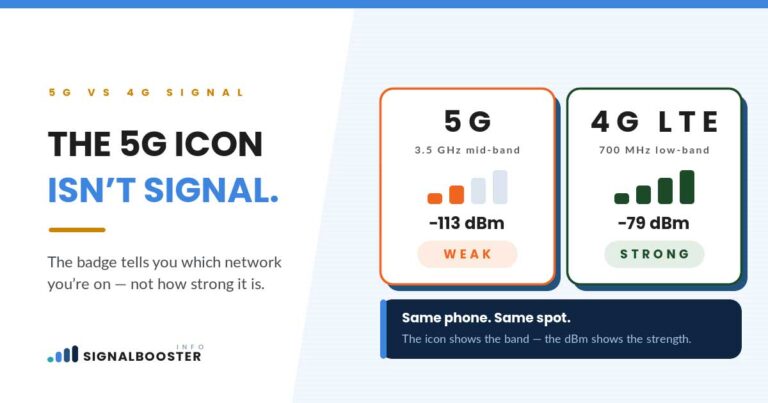
Phones today use a mix of low, mid and high frequency bands. Higher frequency signals generally lose more passing through walls and floors, and 5G often relies on mid-band spectrum for its speed. That is why a phone can show a 5G icon upstairs and drop to a lower band, or to nothing, downstairs. How 5G and 4G compare indoors covers what that means for your phone.
The half nobody mentions: your phone has to answer
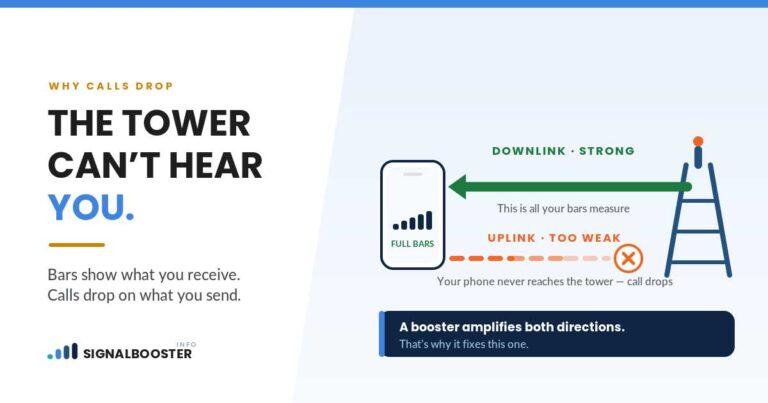
Signal is a two-way link. The tower has to reach your phone, and your phone has to reach the tower. A phone transmits at a small fraction of a cell site's power, and its signal has to leave the basement through the same soil, concrete and floor.
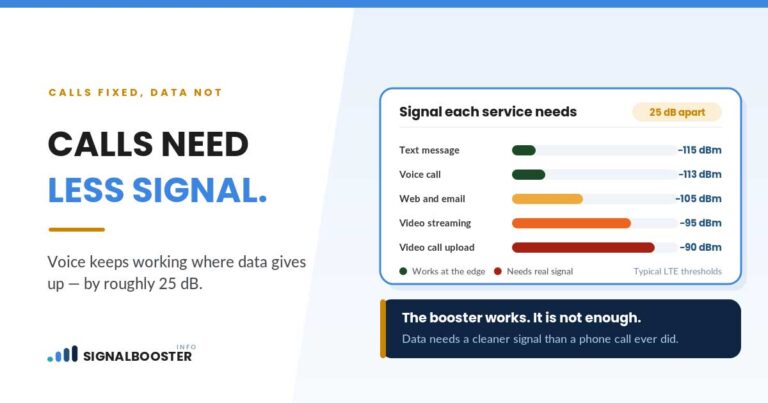
In a basement, that return path is often the one that fails first. The symptoms are distinctive: a text arrives but will not send, a call connects and then drops, a page starts loading and stalls. Your phone also raises its own transmit power to try to be heard, which is part of why a phone left in the basement runs down faster. Weak signal and battery drain explains that effect.
Why some basements are worse than others
Fully below grade vs. walkout or daylight. A basement with one wall exposed, at ground level with windows or a door, has a way in that a fully buried basement does not. If that wall faces the direction of the tower, the difference can be large.
Which side faces the tower. A foundation wall on the tower side, with less soil against it, lets more through than the wall buried deepest.
What is overhead. A basement with the mechanical room and main duct runs directly above the living space loses more than one with open wood framing above it.
How it was built. Construction methods and materials vary from house to house, and so do soil conditions and moisture.
How to see which one is hurting you
Readings tell you more than theory. Take them in dBm, not bars, using the method in how to check your real signal strength, at the same time of day:
| Where | What the result tells you |
|---|---|
| Outside, on the side facing the best signal | Your starting point. If this is poor, the basement never had a chance |
| Ground floor, central room | How much the walls and windows of the house cost |
| Basement, against the foundation wall facing the tower | Whether any signal is reaching you through the wall |
| Basement, interior, under the mechanical area | How much the floor structure and metal overhead cost |
If the outside reading is already poor, the problem is coverage, not the basement. If it is good outside, fair upstairs and gone downstairs, the basement itself is the obstacle. Carrier maps cannot show you this: AT&T's own map (att.com, read September 11, 2026) states that it displays approximate outdoor coverage and that actual coverage may vary.
What that means for fixing it
Once you know the obstacle is the basement itself, the fixes all work the same way: get the signal around the obstacle rather than through it.
Wi-Fi calling routes calls and texts over your home internet, which reaches the basement by cable or Wi-Fi rather than through the foundation.
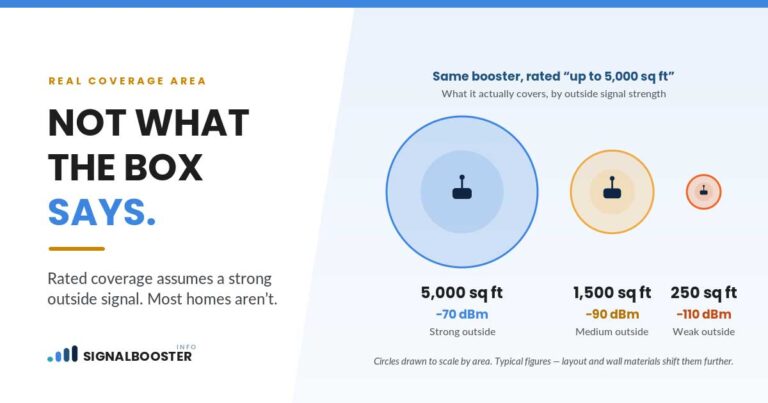
A signal booster captures the signal outside, above grade, and rebroadcasts it inside the basement. Only FCC-certified consumer boosters may be used, and each must be registered with your carrier before it is operated. The FCC's consumer signal booster page (checked September 11, 2026) sets out both conditions and notes that registration is free, and the rule itself is 47 CFR 20.21 (read September 11, 2026 via Cornell's Legal Information Institute).
A carrier network extender uses your internet connection to create a small cell of the carrier's own signal indoors.
Which of those fits depends on your readings, your internet and who needs coverage.
FAQ
Why do I lose cell signal in my basement?
Because the straight path to the tower runs through soil and a concrete foundation, and the signal that does arrive has already crossed the walls of the house and the floor structure above you. A basement combines all of those losses in one room.
Does concrete block cell signal?
It absorbs a significant share of it, more when it is thicker or damp. The steel reinforcing grid inside poured concrete reflects signal as well, so reinforced foundation walls are among the hardest barriers in a house.
Why can I receive texts in the basement but not send them?
Usually because your phone's return signal is the weaker half of the link. A phone transmits at far lower power than a tower, and its signal has to get out through the same soil, concrete and floor.
Is a walkout basement better for cell signal?
Often, yes. An exposed wall with windows or a door gives the signal a way in that a fully buried basement lacks, especially if that wall faces the tower.
The short version
A basement has the worst signal in the house because it stacks every loss together: it sits below the line to the tower, behind soil and thick, often damp concrete, behind a steel grid, and underneath the whole house and its metal. Your phone then has to send its reply back out through all of it. Measure outside, upstairs and downstairs to see which loss dominates, and fix it by going around the obstacle rather than through it.
Where this comes from. The construction materials study is NIST's NISTIR 6055 (1997). Wavelengths are calculated from frequency and the speed of light. Map limitations are from AT&T's own map page, the booster rule is 47 CFR 20.21 as published by Cornell's Legal Information Institute, and the certification and registration points are from the FCC's consumer signal booster page; these apply in the United States. No attenuation, dBm or coverage figure is stated as a measurement here, because the amounts vary by house and this site has not measured any.