It depends entirely on which 5G band you are connected to, not on 5G itself. Low-band 5G runs on frequencies close to the low-band spectrum carriers have used for LTE for years, and it gets indoors about as well. Mid-band 5G, the layer that delivers the headline speeds, sits much higher in the spectrum and loses considerably more of its strength passing through walls, roofs, and coated glass. Millimeter wave 5G, at 24 GHz and above, barely gets indoors at all without dedicated equipment inside the building. So “5G versus 4G indoors” is the wrong comparison. The real comparison is frequency versus frequency, and the higher the frequency, the harder the trip through your walls.
The Physics in One Paragraph
Radio waves lose energy when they pass through solid material, and higher-frequency waves lose more of it than lower-frequency waves do. This is not a 5G quirk; it is a property of radio that predates cellular networks entirely. It is why an AM radio station reaches into a basement where an FM station fades, and why your microwave oven’s door mesh blocks 2.4 GHz while visible light passes straight through the glass.
Cellular generations do not have frequencies. Bands do. A carrier can run 5G on a low band and LTE on a high band, and when it does, the 5G signal gets inside your house more easily than the LTE one. That single fact dissolves most of the confusion in this topic.
The Three Layers of 5G, and How Each Behaves Indoors
| 5G layer | Roughly where it sits | Indoor behavior | What it feels like |
|---|---|---|---|
| Low band | Hundreds of megahertz, near the LTE low bands carriers already used | Gets indoors well, similar to low-band LTE | Wide coverage, speeds often close to good LTE |
| Mid band | A few gigahertz | Noticeably weaker through walls, roofs, and coated glass than low band | Very fast outdoors and near windows, drops off deeper inside |
| Millimeter wave | 24 GHz and above | Effectively needs line of sight; walls stop it | Spectacular in a stadium concourse, absent one room away |
Low-band 5G and low-band LTE are close enough in frequency that the indoor difference between them is small. Mid-band is where the honest answer becomes “no, not as far.” Millimeter wave is a different product altogether: engineering coverage for it indoors normally means putting equipment inside the building, such as small cells or a distributed antenna system, rather than expecting the outdoor signal to arrive.
Why Your New 5G Phone Feels Worse Indoors Than the Old One
This is the complaint that brings most people to this question, and it usually is not imaginary.
A phone does not simply pick the strongest signal. It follows the network’s rules about which layer to camp on and which to prefer, and modern networks are configured to steer devices onto the higher-capacity layer whenever the signal there is good enough. Outdoors, mid-band is good enough almost everywhere, and it is genuinely faster. Indoors, that same preference can leave a phone hanging on to a mid-band connection that has just been cut down by a wall, when the low-band layer available in the same room would be slower on paper but far steadier in practice.
The result the user sees: a 5G icon, one or two bars, and worse real performance than the old phone gave on LTE in the same chair. Nothing is broken. The phone is doing what it was told to do, in a place where the instruction does not serve you well.
There is a second, less common version of the same effect. Some carriers deploy 5G by sharing spectrum with LTE on the same band, which means the coverage footprint is identical and the icon change tells you nothing at all about how much signal is arriving.
This is a different question from which network type needs a stronger signal to work acceptably in the first place, which this site covers separately in 5G versus 4G signal strength. That piece is about the numbers your phone needs. This one is about how far the signal gets before those numbers are taken.
What Your Building Does to Each Band
The higher the frequency, the more your own house matters. The materials that cost you the most are the ones that conduct, reflect, or hold water:
- Metal, in any form: metal siding, steel studs, foil-backed insulation, metal roofing, and the wire mesh under some stucco finishes
- Energy-efficient window coatings, which are thin metallic layers by design and are very effective at stopping radio as well as heat
- Dense masonry: concrete, brick, and stone, especially with reinforcement inside
- Water in any form, including foliage in full leaf outside the window
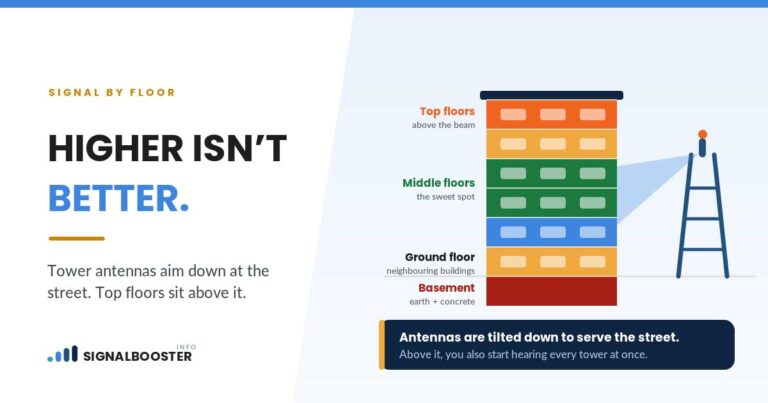
The same wall takes a bigger bite out of a mid-band signal than out of a low-band one. That is why two people in the same neighborhood, on the same carrier, can have completely different indoor experiences: not because one of them has better coverage outside, but because one of them has a wall that is selectively destroying the layer the network keeps steering them onto. If you suspect the building itself, does metal siding or stucco block cell signal goes through the materials individually, and why signal is weaker on some floors than others covers what changes as you move up or down inside a structure.
The Test That Settles It in Your Own Home
Bars will not answer this. You need two numbers and two positions.
- Read your actual signal strength in dBm from the phone’s own diagnostics, standing just outside the building. Note the network type shown at the same moment.
- Take the same reading in the room where the problem is worst, again noting the network type.
- Repeat both readings with 5G disabled in the phone’s network-mode setting, so the phone is forced onto LTE.
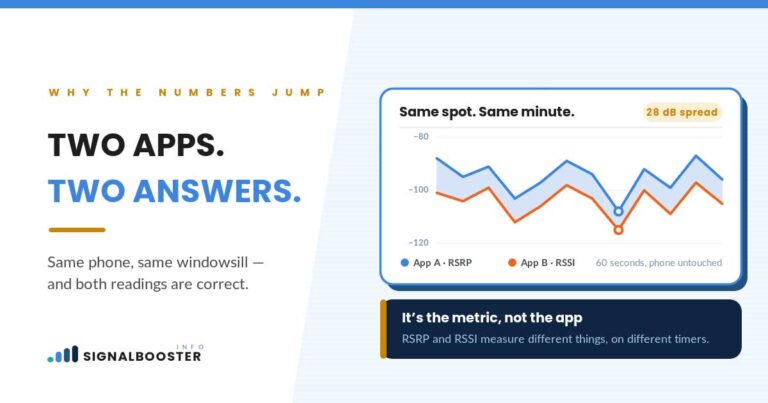
If the indoor reading improves substantially with 5G turned off, you have confirmed the band-steering effect described above, and you have also found a free workaround for that room. If both readings are equally poor, your problem is total signal arriving at the property, not which layer your phone chose, and the diagnosis moves to tower distance versus obstructions. Our guide to what counts as a good dBm reading explains how to interpret the numbers you get, because the raw figure means nothing without context.
What This Means Before You Buy Any Hardware
Here is the part the manufacturer blogs tend to leave vague, and it is the single most useful thing on this page if you are about to spend money.
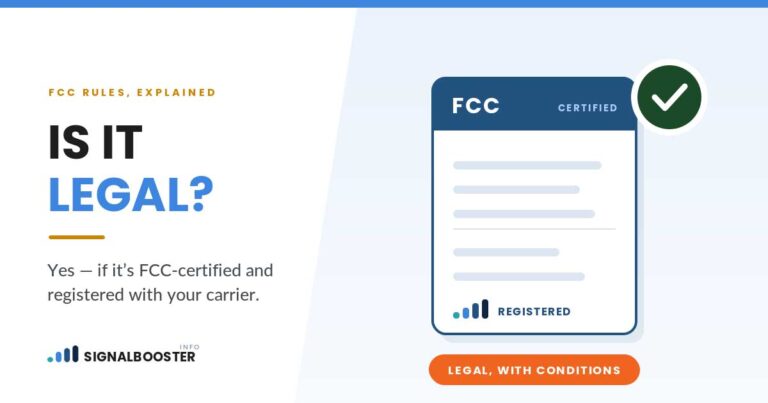
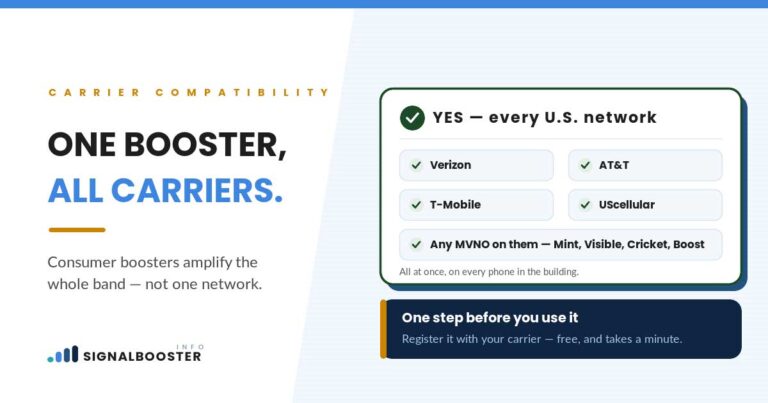
A booster helps only on the bands it is built and certified to amplify. Consumer signal boosters in the US are governed by the FCC’s rules at 47 CFR 20.21: the equipment must be FCC certified, and the user must register the unit with their wireless provider and operate it with that provider’s consent, which the provider can withdraw if the device causes harmful interference. Certification is granted for specific frequency ranges, not for “5G” as a marketing word. A unit that covers the low bands your carrier uses will do nothing for a mid-band layer outside its certified range, and no consumer booster brings millimeter wave into a house.
The practical consequence: before buying, work out which band is actually carrying your usable signal outdoors, and check that the unit is certified for that range. Buying on the strength of a “5G” label on the box is how people end up amplifying a band they were not struggling with in the first place. The legal and registration side of all this is covered in full on is a cell phone signal booster legal, and it is worth reading before you order, not after. Rules differ by country, and in some places operating a repeater without the network operator’s authorization is outright illegal.
The Honest Summary
5G is not worse at getting indoors than 4G. Higher frequencies are worse at getting indoors than lower frequencies, and 5G happens to be where most of the new high-frequency spectrum went. Where carriers put 5G on low band, it gets inside your house perfectly well. Where they put the fast layer on mid band, your walls will take a real bite out of it, and your phone’s preference for that layer can make matters worse before it makes them better.
If your indoor experience got worse after an upgrade, the odds favor band steering rather than a defective phone or a degraded network. Test it with the network mode toggle before you spend anything.
FAQ
Does 5G penetrate walls as well as 4G LTE?
It depends on the band. Low-band 5G penetrates about as well as low-band LTE because the frequencies are similar. Mid-band 5G penetrates noticeably less well, and millimeter wave 5G at 24 GHz and above is largely stopped by ordinary building materials.
Why did my signal get worse indoors after switching to a 5G phone?
Most often because the network steers the phone onto a higher-frequency layer that is faster outdoors but loses much more strength passing through your walls. Forcing the phone to LTE in the network-mode setting and re-reading the dBm figure will show you whether that is what is happening.
Should I turn off 5G to get better indoor signal?
In a specific problem room, it is worth testing. If the dBm reading and call reliability improve with 5G disabled, you have found a free fix for that location. It is a trade, though: you give up the higher speeds the mid-band layer provides where it is strong.
Does a signal booster work with 5G?
Only on the frequency ranges the individual unit is certified and built to amplify. Consumer boosters in the US are FCC certified for specific bands, and no consumer booster amplifies millimeter wave. Check the certified band list for the unit, not the marketing label on the box.
Is millimeter wave 5G usable indoors at all?
Rarely from an outdoor tower. Indoor millimeter wave coverage normally requires equipment placed inside the building, such as small cells or a distributed antenna system, which is why it appears in venues and offices rather than in ordinary homes.