A metal roof cell signal problem is real physics, not a coincidence. Continuous sheet metal reflects and absorbs the same radio frequencies your phone uses, so less signal reaches the rooms below. A basement under a metal roof stacks two attenuators: metal overhead, then soil, concrete and rebar on every side. That is why basement bars can disappear entirely while the yard outside still shows a full signal. The fix is getting signal past the roof, not through it, and that starts with understanding what the metal is actually doing to the radio wave.

How a Metal Roof Blocks Cell Signal
Cellular signal is a radio wave, and radio waves behave predictably when they hit a conductive surface. Standing seam panels, corrugated steel and metal shingles all act as one continuous conductor once they are fastened edge to edge. When the wave arrives, some energy reflects straight back off the surface and some gets absorbed and converted to heat in the metal itself. Very little passes through.
The comparison worth knowing is the Faraday cage: a fully enclosed metal shell blocks radio waves from entering or leaving. A metal roof is an incomplete version of that cage, open at the walls, so it does not block signal completely, but it removes a large share of what would otherwise reach the attic and the floors under it. Wilson Amplifiers, a manufacturer of cellular signal boosters, states on its own site (read 2026-09-18) that metal building materials can reduce incoming signal strength by roughly 32 to 50 dB compared to open air, enough on its own to turn a workable connection into a dead zone. Foil-backed insulation and a radiant barrier under the decking add to that loss, because they are metal too.
Not All Metal Roofing Blocks Signal the Same Way
Standing seam panels run in long, continuous sheets fastened together at raised seams, which makes the whole roof electrically continuous edge to edge, close to the worst case for RF absorption. Exposed-fastener corrugated panels behave similarly but have more seams and screw penetrations, which can leave small gaps that let a little more signal through than an unbroken standing-seam sheet. Stone-coated steel shingles and metal shake products are broken into smaller, overlapping pieces, so they are less electrically continuous than one large sheet, though still far more blocking than asphalt shingles or wood shakes.
None of these differences change the fix. Any metal roofing style can create a basement dead zone once it covers enough continuous area, and the mounting-location strategy described below works the same regardless of which metal roofing product is on the house. What changes is severity, not the underlying cause.
Basement Made It Worse: Two Attenuators, Not One
A basement is already the hardest room in a house for cell signal, metal roof or not. Signal has to travel down through every floor above it, and each floor of framing, drywall and flooring removes more of the wave before it reaches the basement ceiling. Add a metal roof at the very top of that stack and the basement is now fighting two separate attenuators in series: the roof first, then everything else in the building.
This is also why a basement can behave inconsistently room to room. A corner under a steel duct run or near the electrical panel loses more signal than a corner with a clear line up through wood framing. If your booster works fine in one room but not others, a metal roof overhead combined with uneven interior metal (ductwork, wiring bundles, a furnace) is one of the more common reasons, and it is worth mapping which rooms are worst before choosing where to run cable.
Diagnose Before You Assume the Roof Is the Whole Problem
Before spending money on equipment, confirm what is actually happening. Check signal strength in the field test menu on your phone (dial the carrier's field-test code or use the built-in diagnostics screen) at three points: outside in the open yard, in the attic just under the roof deck, and in the basement. A large drop between the yard and the attic points at the roof itself. A further large drop between the attic and the basement points at the building's interior construction, not the roof.
It also helps to know whether the outside signal at your address is strong to begin with. A metal roof makes a marginal outdoor signal into an indoor dead zone much faster than it makes a strong outdoor signal disappear completely. If you are not sure which tower you are even pulling from, that is worth settling first, since aiming a fix at the wrong direction wastes the gain a booster could otherwise deliver.
The Fix That Works With the Roof, Not Against It
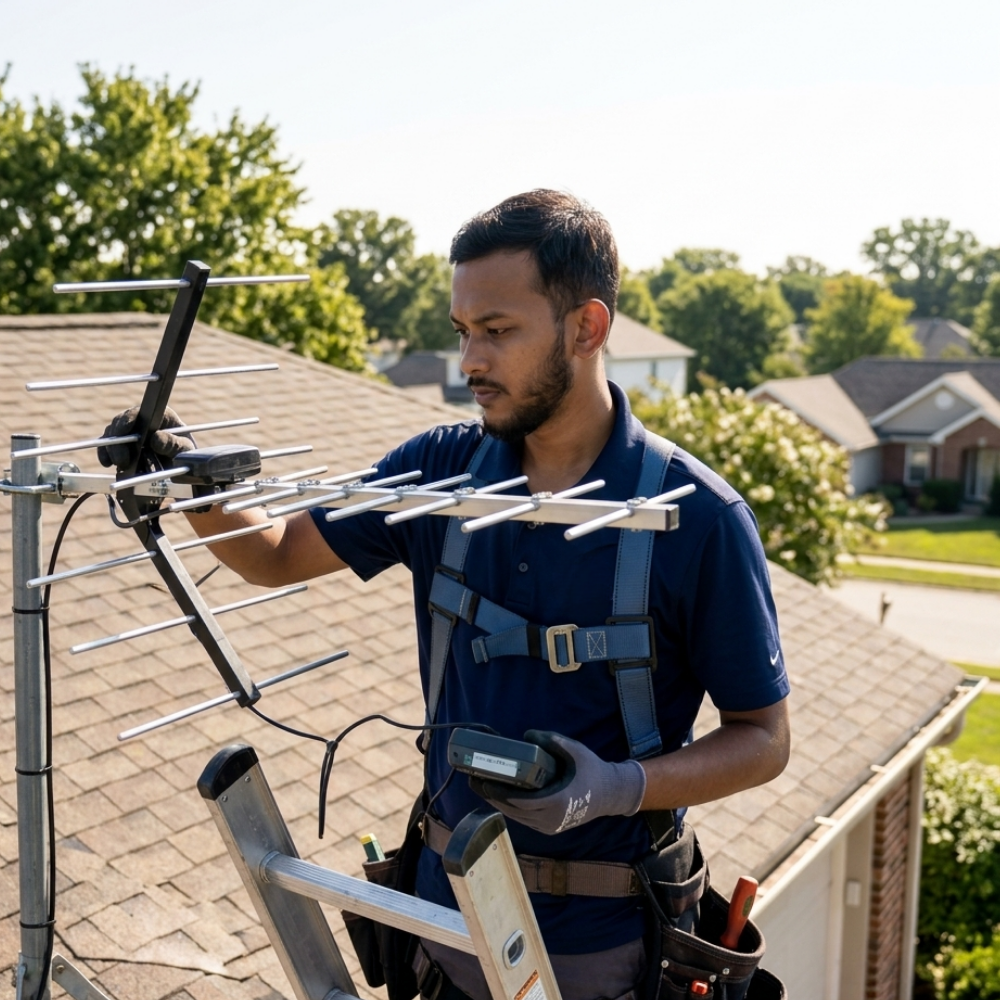
Because the roof is the obstruction, the practical fix is to capture signal before it hits the metal, not to try to push more power through the panels. That means an outdoor antenna mounted above the roofline, on a mast, cabled directly down to an indoor booster and then to an indoor antenna near the basement. Mounting the donor antenna inside the attic under a metal roof defeats the purpose, since it sits on the wrong side of the same obstruction you are trying to get past. The comparison of attic mounting versus roof mounting for the outdoor antenna is worth reading in full before you decide, because the mounting location matters more here than almost any other variable.
Once the antenna is above the roof, the cable run becomes the next thing that can quietly cost you signal. A donor antenna on the roof of a house with a basement often means fifty feet of cable or more between the antenna and the booster, and every foot of that cable has loss built into it. Cheap or undersized coax can give back a meaningful share of the gain the antenna just captured, so it is worth understanding how much a given coax cable loses per foot before you buy a fifty or hundred foot run based on price alone.
Confirm the Fix Actually Worked
Once an antenna and booster are installed, do not assume the basement is fixed just because a bar or two appeared on the phone. Bars are a rough, carrier-normalized display, not a measurement. Run the same field-test check you did during diagnosis, at the same basement location, before and after the install, so you are comparing measured dBm rather than guessing from bars. A full walkthrough of how to test a signal booster before and after installation covers the specific steps and what a meaningful improvement looks like versus a placebo change caused by walking to a different spot in the room.
What the FCC Requires Before You Install a Booster
Any consumer signal booster sold in the United States has to meet the FCC's Network Protection Standard, and the FCC's own Consumer Signal Boosters page (read 2026-09-18) explains that booster owners are expected to register the specific device with their wireless carrier before using it, and that boosters certified after February 20, 2013 must self-monitor and shut down automatically if they are not operating within the required limits. This applies regardless of what is causing the dead zone, metal roof or otherwise, and skipping registration is the kind of detail that gets missed when the focus is entirely on hardware.
FAQ
Does a metal roof block 5G more than 4G LTE?
Higher frequency signals generally lose more energy to reflection and absorption than lower frequency ones, so some 5G bands can be affected more than mid-band LTE through the same metal roof. The practical effect on a basement is similar either way: an outdoor antenna above the roofline captures both bands before the roof becomes a factor.
Can I fix this without an outdoor antenna, just with an indoor booster?
An indoor-only booster still needs an outdoor antenna to feed it, because it can only rebroadcast the signal it receives. Without a donor antenna above the metal roof, an indoor unit has almost nothing usable to amplify in a basement under that roof.
Will a metal roof also block my Wi-Fi router signal?
A metal roof mainly affects cellular signal coming from outside the building. A Wi-Fi router already sits inside the house, so its signal is not passing through the roof to reach your basement; router placement and interior walls are the bigger factors there, which is a separate diagnostic question from cellular reception.
Is a standing seam metal roof worse than metal shingles for cell signal?
Any continuous, electrically connected metal surface behaves similarly for RF purposes. What matters more than the panel style is whether there is foil-backed insulation, a radiant barrier, or a dense layer of interior metal ductwork adding to the total attenuation.
Should I mount the booster's outdoor antenna directly on the metal roof?
Mount it above the roofline on a mast rather than flat against the panels. The goal is to get the antenna's line of sight to the tower clear of the metal, not to attach it to the surface that is causing the problem.
Getting a basement back to a usable signal under a metal roof is a diagnosis-first job: confirm where the loss is actually happening, mount the donor antenna above the obstruction rather than under it, route cable that will not give the gain back, and measure before and after in dBm instead of bars. Skip any of those steps and a metal roof cell signal problem tends to come back in a different room a few months later.