No, a garage cell signal dead zone usually has a different root cause than a basement one, so the fix, while it uses the same equipment, is planned differently. A basement loses signal because soil and reinforced concrete surround it on every side. A garage most often loses signal because of a steel or metal-clad door and metal framing sitting directly between the phone and the nearest cell tower, not because it is buried below grade. The booster hardware is the same in both cases, but where the outdoor antenna goes, how much cable you need, and how much room you have for antenna separation all change once the obstruction is a door instead of dirt.
Why a Garage Cell Signal Dead Zone Isn't the Same Problem as a Basement
A basement is surrounded on most sides by earth and structural concrete, and that mass attenuates radio signal from every direction at once, which is why basements are consistently the worst rooms in a house for cell coverage. A garage, especially an attached one built at grade, does not have that problem. What it has instead is usually one specific obstruction: the garage door itself.
Most residential garage doors are steel, sometimes with a foam core sandwiched between steel skins, and some carry a reflective foil-faced insulation layer for energy efficiency. Steel is an effective RF reflector, and a large steel panel facing the street, exactly where the nearest tower's signal would otherwise enter, can turn an otherwise ordinary room into a dead zone while the rest of the house one wall over reads fine. That is the opposite pattern from a basement, where every direction is roughly as bad as every other, and it is also why a signal booster can work in one room and not the room next to it: the garage's problem is directional and material-specific, not depth-based.
Garage vs. Basement: What's Actually Blocking the Signal
| Garage (attached, at grade) | Basement (below grade) | |
|---|---|---|
| Main obstruction | Steel door, metal framing, sometimes foil-backed insulation | Soil plus reinforced concrete on most or all sides |
| Direction of the problem | Usually one wall or the door | Every direction at once |
| Outdoor antenna placement | Often needs to clear the door, not necessarily go higher | Must go above grade, outside the building envelope |
| Cable run | Can be short if the booster sits near the garage | Often longer, routed down from roofline or an exterior wall |
| Antenna separation | Tighter, since garage and living space share close quarters | Often easier, since a floor and a foundation naturally isolate the antennas |
Diagnose the Garage Before You Assume It's the Same Job
Do not skip straight to a booster kit designed for a basement and assume it transfers. Take a reading with the garage door open and a second one with it closed. If the reading drops sharply the moment the door shuts, the door is your obstruction, not depth or distance from the tower. If the reading is weak even with the door open, the garage may simply sit on the far side of the house from the tower, which is a different problem: distance and orientation rather than a single material blocking one wall. A quick check against a carrier coverage map helps confirm which situation you actually have before you plan an install around the wrong cause.
The Fix for a Garage Dead Zone
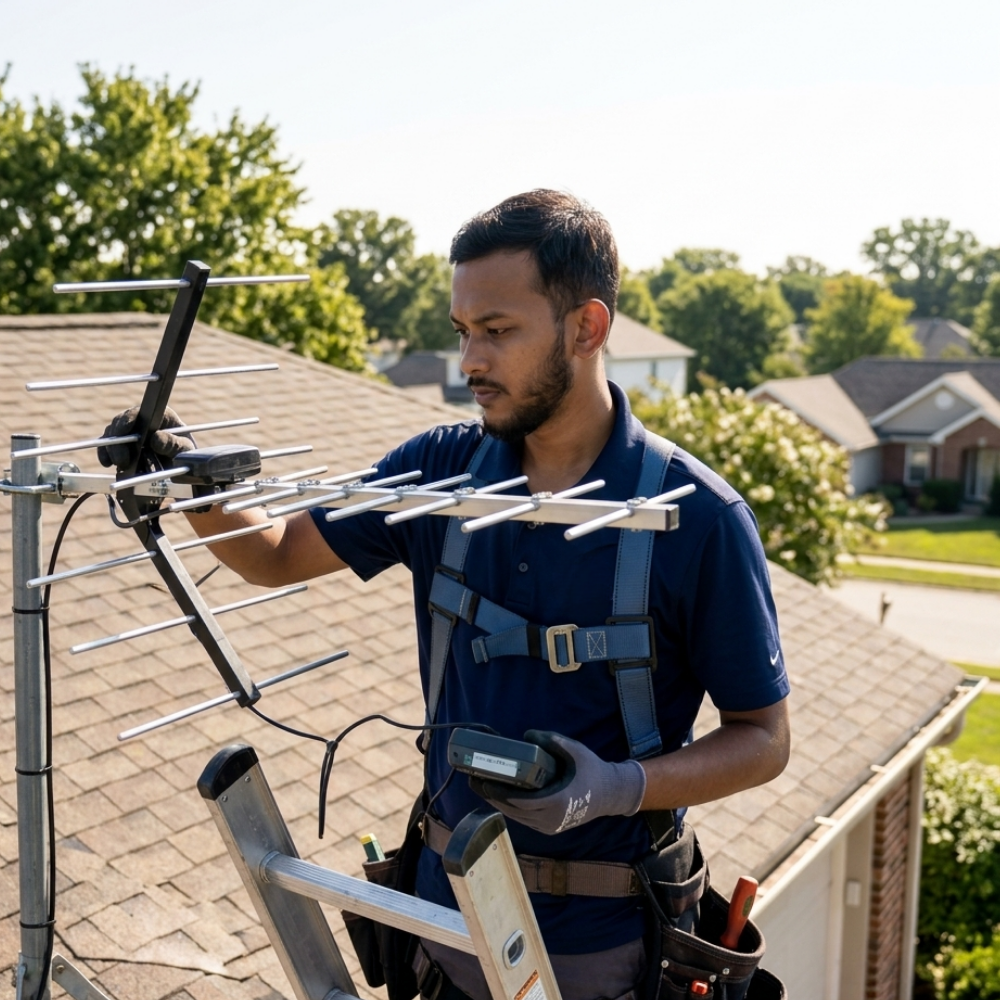
Once you know the door is the obstruction, the fix looks less like a basement install and more like fixing any single blocked room. The outdoor antenna needs a clear path to the tower from a spot that is not shadowed by the same steel door causing the problem, typically the roofline directly above the garage or an exterior wall on an adjacent side of the house. For an attached garage under the same roof as the house, the choice between mounting that antenna in the attic space above the garage or up on the roof itself follows the same attic-versus-roof mount trade-off used anywhere else in the house: the roof clears obstructions completely, the attic is easier and safer to access but has to transmit through whatever is directly overhead.
Because a garage is usually close to where the rest of the house's wiring and living space already sit, the cable run from an outdoor antenna to an indoor antenna placed in the garage is often shorter than a basement's cable run, which is a genuine advantage. It is still worth planning carefully, since every extra foot of coax quietly costs some signal, and a garage install that snakes cable through multiple walls to avoid a short, direct run gives some of that advantage back.
Attached vs. Detached Garage Changes the Job
An attached garage under the main roof is the simpler case: it shares structure, attic space, and often an easy path back to wherever the booster's amplifier will live. A detached garage is closer to running a second, separate install than an extension of the house's existing coverage. It may need its own outdoor antenna, its own cable run to its own amplifier, and its own registration, since a detached structure often sits far enough from the house's existing setup that extending one system to both buildings is impractical. Either way, the legal step does not change: the FCC's consumer signal booster page (read September 18, 2026) states that consumer boosters certified after February 20, 2013 must meet its current technical rules, and that every booster has to be registered with the wireless carrier before it is used, regardless of which building it sits in.
Why Antenna Separation Matters More in a Tight Garage
A garage sits close to living space, and that closeness cuts both ways. It shortens the cable run, but it also shrinks the physical distance available between the outdoor antenna and the indoor antenna, and too little separation is what causes a booster to detect its own re-amplified signal and throttle or shut itself down. weBoost's own installation support page (read September 18, 2026) describes this as a Minimum Required Separation Distance that varies by the booster's gain, and notes that a wall or roof between the two antennas, not just open-air distance, helps reduce how much separation is actually needed. That detail matters specifically for a garage, where a wall between the garage and the living space, or the garage's own roof, can do some of the isolation work that open distance would otherwise have to provide. The mechanism behind why this happens, and why the booster's own protection circuitry is the thing reacting to it, is covered in how automatic gain control protects a signal booster from its own feedback.
When the Garage Fix Actually Matches the Basement Playbook
There are garages where the basement approach is the right one after all: a garage built into a hillside or partially below grade, a garage under a living space with concrete on multiple sides, or a garage in a home where the door is not the limiting factor and depth or surrounding mass genuinely is. In those cases, treat it as you would a below-grade room: prioritize an outdoor antenna placed well above grade with a clear path out, and expect the surrounding structure to help isolate your antennas from each other the same way a basement's floor and foundation do. The test that tells you which situation you actually have is the same door-open, door-closed comparison described above; a sharp drop when the door closes points to the door, not the ground, as your obstruction.
FAQ
Is a garage dead zone the same as a basement dead zone?
Usually not. A basement is blocked by soil and concrete from every direction. A garage is most often blocked by one specific obstruction, typically a steel door, which is why the fix targets that one wall rather than treating the whole room as buried.
Does a steel garage door really block cell signal?
Yes, in general terms; steel is an effective reflector of radio energy, and a large steel panel between a phone and the nearest tower can meaningfully weaken the signal that reaches a garage. The exact amount depends on the door's construction and is not something to estimate without testing your own space.
Where should the outdoor antenna go for a garage dead zone?
Somewhere with a clear path to the tower that is not shadowed by the same door or wall causing the problem, often the roofline above the garage or an exterior wall on an adjacent side of the house.
Do I need to register a signal booster for a detached garage separately?
The registration requirement is the same regardless of which building the booster is in: every consumer signal booster has to be registered with your wireless carrier before use, per the FCC's current rules.
Why does antenna separation feel harder in a garage than in a basement?
A garage sits closer to the rest of the living space than a basement typically does, which shrinks the open distance available between the outdoor and indoor antennas. A wall or roof between the two antennas can help make up some of that difference.