For a typical home kit with an outside antenna, the hands-on mounting work is commonly quoted at two to five hours, and the whole project realistically fills a day. The mounting is the part everyone times. The parts that decide your actual finish time are the signal survey you do before buying anything, the carrier registration that federal rules require before the unit is switched on, and the grounding of the outside antenna, which is electrical work and may not be yours to do at all.
That gap between the quoted figure and the real one is why so many people start a booster install on a Saturday morning and finish it the following weekend.
What the published time figures actually measure
Retailers do publish installation times, and they are useful as long as you know what they cover. SignalBooster.com, a booster retailer, publishes the following figures on its own site:
| Configuration | Their published time |
|---|---|
| Plug and play unit, no outside antenna | About 5 minutes |
| Booster with a built-in interior antenna plus a rooftop exterior antenna | 1 to 2 hours |
| Booster with a separate interior antenna plus a rooftop exterior antenna | 2 to 3 hours |
| Multiple interior antennas plus a rooftop antenna | 3 to 5 hours |
| Commercial systems, multiple internal and external antennas | 8 hours or more |
Two things are worth saying about numbers like these. First, they come from companies that sell boosters, so they describe the job at its most cooperative: a mounting point that is reachable, a cable route that exists, and a first power-up that behaves. Second, and more importantly, they are timing the assembly. They are not timing the survey, the registration, the grounding, or the re-do that follows a first attempt that oscillated.
Treat them as the floor of your estimate rather than the estimate.
The four blocks a booster install really splits into
The clock is easier to plan if you stop thinking of this as one job. It is four, and they run on different timescales.
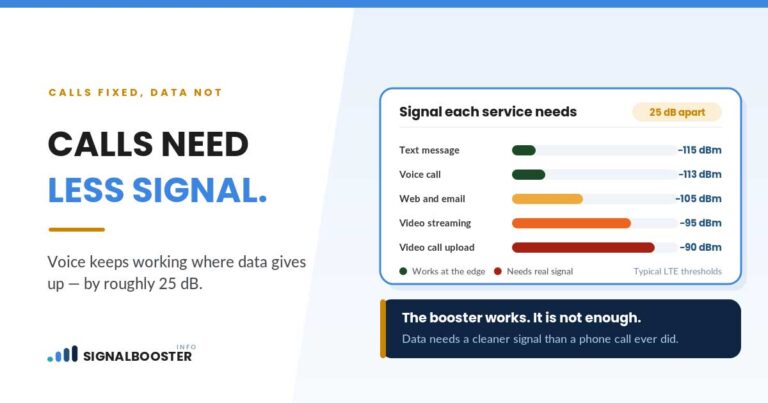
Block one: the signal survey, and it happens before you buy. You are measuring the outside signal in dBm at each candidate mounting position, because a booster amplifies what reaches the donor antenna and cannot create signal that is not there. This is an hour or two of walking around with your phone in field test mode, and it is the block people skip. Our guide to checking your real dBm signal strength covers the method. Skipping it does not save you an hour, it just moves that hour to the end of the project, where it costs more.
Block two: registration, and it is federal rules rather than paperwork. Under the FCC’s consumer signal booster rules at 47 CFR 20.21, a subscriber may operate a certified consumer booster under their provider’s authorization only if they have the provider’s consent and have registered the device before operating it. The registration record includes the owner’s name, the make, model and serial number of the unit, its location, and the date it goes into operation. Boosters marketed since March 1, 2014 carry a label saying exactly that. This is minutes of your time, and the full legal picture is on our page on whether a signal booster is legal. These rules are United States rules. If you are outside the US, your national regulator sets a different set, and in several countries operating a repeater without the network operator’s permission is not allowed at all.
Block three: the physical install. Mounting the outside antenna, running the coax, siting the amplifier, placing the indoor antenna. This is where the two to five hours actually lives.
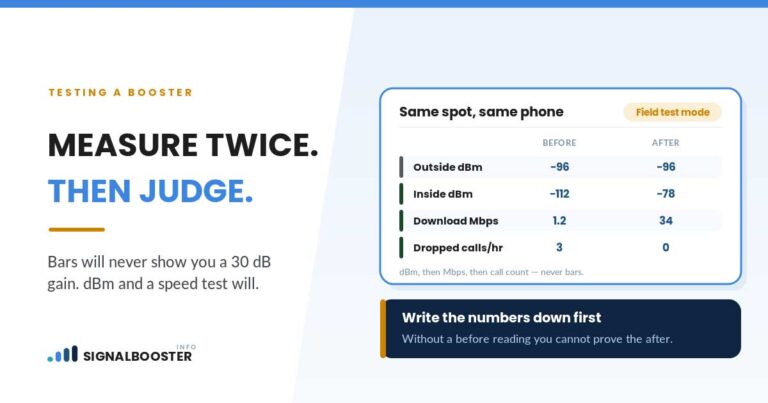
Block four: testing and tuning. Before and after readings, checking for feedback, adjusting gain, and moving the indoor antenna if the coverage lands in the wrong room. Budget an hour and be pleased if it takes twenty minutes. Our walkthrough on how to test whether the install actually worked is the block-four method.
The part of the job that is not yours to time
This is the section that changes the answer for a lot of readers, so it comes before the scheduling table rather than after it.
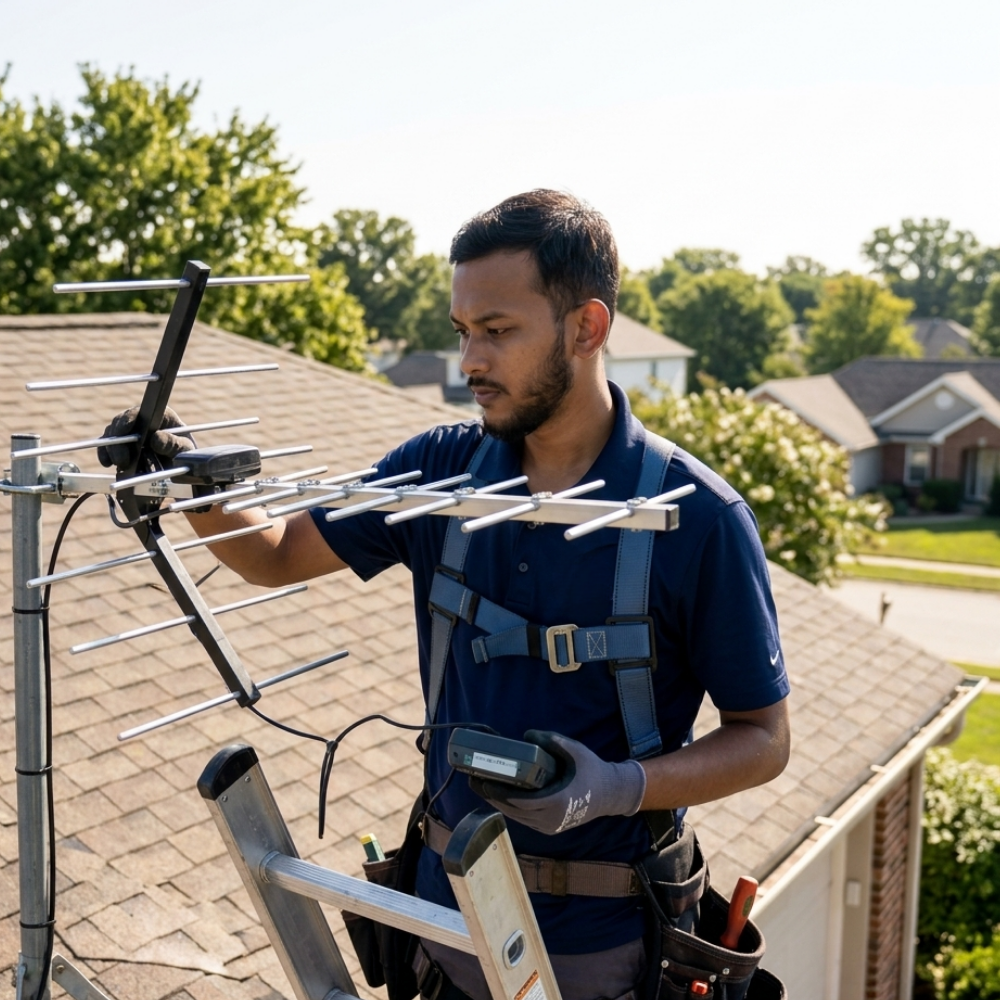
An outside antenna means height. Most home installs put the donor antenna on a gable end, a fascia, a mast or a roof. Falls from height are among the most serious home improvement injuries there are, and there is no reception benefit that justifies one. If the mounting point requires you to be standing on a pitched roof surface rather than working from a ladder set on level ground against a wall, hire that part out to a roofer or an aerial and satellite installer. This site does not publish ladder or roof technique, because reading about it is not the same as being trained on it.
An outside antenna also means grounding, and grounding is electrical work. The moment an antenna and its lead-in are outside, the installation falls under the electrical code. In the United States that is NEC Article 810, which calls for a listed antenna discharge unit on the lead-in near the point of entry, a grounded mast or supporting structure, and a bonding conductor run as straight as practicable to the building’s grounding electrode system, terminating at the intersystem bonding termination. Codes are adopted and amended locally and the authority having jurisdiction has the final say. If the work involves connecting at your service equipment, that is a licensed electrician, and in many jurisdictions it is not work a homeowner may lawfully do on their own service. The detail is in our page on signal booster grounding requirements.
Neither of those blocks belongs on your Saturday timeline as a number of minutes. They belong on it as a decision about who is doing them, made before the kit arrives. The trade-offs are laid out in DIY versus professional booster installation.
What turns a three-hour install into a three-weekend one
None of these are exotic. All of them are ordinary, and each one is worth an extra session.
- The discharge unit was not in the box. Most consumer kits ship with an antenna, cable, amplifier and brackets, and no discharge unit. Discovering that on the day means ordering a part and stopping.
- There is no cable route. A run that looked obvious from the driveway meets a firestop, a finished ceiling, or a wall with no cavity. Routing coax through an attic without wrecking your gain is its own planning job.
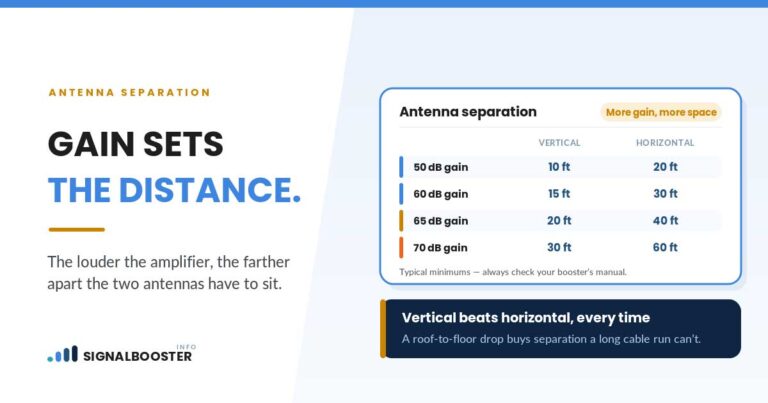
- The system oscillates on first power-up. The amplifier hears its own indoor antenna through the roof, detects the loop, and reduces power or shuts down. The fix is usually relocation, not a setting, which means going back up. Plan the geometry first using antenna separation distance for a signal booster rather than discovering it afterward.
- The weather turns. Nothing outside gets mounted in wind, rain or ice. This is the single most common reason a one-day project becomes a two-weekend one.
- The donor signal was weaker than assumed. Block one, arriving late and expensive.
A realistic schedule you can actually plan around
| Your setup | Survey | Install | Grounding | Test | Honest total |
|---|---|---|---|---|---|
| Indoor-only plug in unit | 15 minutes | Minutes | Not applicable | 15 minutes | Under an hour |
| Outside antenna reachable from a ladder, single indoor antenna, existing cable route | 1 to 2 hours | 2 to 3 hours | Separate visit or a trade | 1 hour | One full day plus the grounding |
| Outside antenna, new wall penetration, attic cable run | 1 to 2 hours | 3 to 5 hours | Separate visit or a trade | 1 hour | Two sessions, realistically |
| Multiple indoor antennas, multi story home | 2 hours plus | 3 to 5 hours plus | Trade | 1 to 2 hours | A weekend, and expect a return trip |
| Roof mount on a pitched surface | Yours | Hire the mounting | Trade | Yours | Split job, book the trade first |
The pattern in that table is the real answer to the question. The install time you control is fairly predictable. The install time you do not control, meaning the trade visits and the weather, is what sets your finish date.
The honest summary
If someone tells you a booster install is a quick afternoon, they are describing block three of four and assuming everything cooperates. Two to five hours of assembly is a fair figure for the mounting work on a home kit. Add the survey before it, the registration around it, the grounding beside it, and one contingency session after it, and you have a plan that survives contact with your actual house.
FAQ
How long does a signal booster installation take for a normal house?
For a home kit with an outside antenna, retailer guidance puts the assembly at two to three hours for a single indoor antenna and three to five hours for multiple indoor antennas. Add a signal survey beforehand, carrier registration, testing afterward, and separate arrangements for grounding, and a realistic total is a full day or more.
Can I install a cell signal booster in an hour?
An indoor only plug in unit, yes. A kit with an outside antenna, almost never, because the mounting, the cable run and the separation geometry all have to be right before the system runs at useful gain.
Does the carrier registration slow the install down?
No. Registration itself takes minutes. It is a requirement rather than a delay: 47 CFR 20.21 requires the provider’s consent and registration of the device before you operate it, and the major carriers run free registration for their subscribers.
Why did my install take two weekends?
The most common reasons are a missing antenna discharge unit, a cable route that did not exist, feedback on first power-up that required moving an antenna, or weather that stopped outdoor work. All four are planning problems rather than skill problems.
Should I hire someone just for the antenna mounting?
That is a reasonable and common split. Pay a trade for the work at height and the grounding, do the survey, the indoor half, the testing and the registration yourself.
Where these figures come from. The installation time ranges are published by SignalBooster.com, a booster retailer, on its own installation timing page, and are quoted here as that company’s estimates for the assembly work. The regulatory points are from 47 CFR 20.21 as published in the Code of Federal Regulations, and apply in the United States. The grounding points are from NEC Article 810 as described on our own grounding page, and are general information rather than a code interpretation for your building. This site has not timed an installation of its own, and no figure here is presented as a measurement we made.