Yes, but usually less than you would guess from how often it gets blamed, and often not through the mechanism people assume.
This question almost always arrives attached to a bigger one: is my signal actually bad, or was yesterday just a bad day? That distinction is worth getting right before you spend anything, because a weather-driven problem is not a problem you buy your way out of. It ends when the weather does.
The Short Answer, and Why It Comes With a Caveat
Weather affects cellular signal. It is genuinely a real phenomenon and not a myth people invented to explain a bad afternoon.
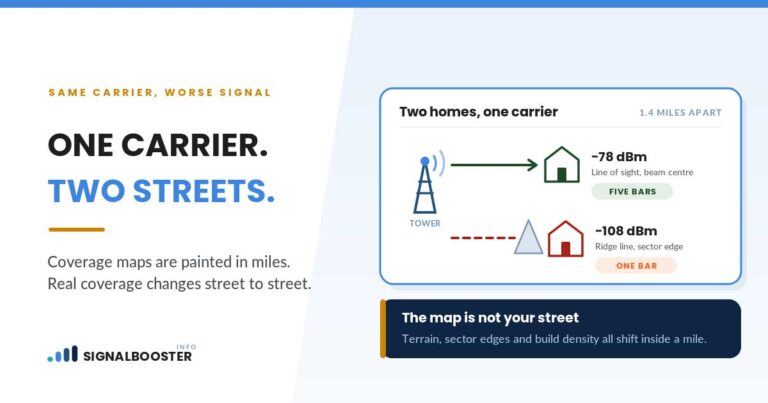
But the size of the effect matters. Compared with the things that dominate your signal (how far the nearest tower is, and how much building material stands between you and it) weather is a small contributor most of the time. A house that is marginal on a clear day may become unusable in a storm, which is why weather feels decisive. What has actually happened is that a signal already sitting near the edge got pushed over it. The weather did not create the problem; it exposed one that was already there.
That reframing matters for the decision you are trying to make. If bad weather reliably tips you over, you have a marginal signal, and that is a real thing to address. If your signal is only bad in bad weather and fine otherwise, you have weather.
Rain: What Actually Happens to the Signal
Water absorbs radio energy. That is the mechanism, and it works in a few different ways at once.
Rain in the air between you and the tower absorbs a little of the signal passing through it. Water sitting on surfaces (soaked walls, a wet roof, standing water) absorbs more than the same surfaces dry. And wet vegetation is a bigger factor than most people expect: a tree line between you and a tower attenuates more when every leaf is carrying water than when it is dry. If your signal degrades noticeably in rain and you have trees in the direction of your tower, that is very likely where it is happening.
One correction worth making, because it is the most common error on this topic. You will see cellular rain effects described using the same language as satellite television dropouts. Those are not the same situation. Satellite services operate at much higher frequencies and over a path that runs all the way up through the atmosphere, where water absorption is far more consequential. The frequency bands most consumer phones use most of the time, and the short ground-level path to a tower a few miles away, are considerably less affected. Borrowing satellite intuition here will make you overestimate the effect substantially.
Snow, Fog and Humidity Are Not the Same Thing
They get lumped together as “wet weather” and they behave differently.
Snow is far less dense than liquid water, and falling snow contains a great deal of air. Its effect on the signal path is generally smaller than rain’s. Accumulated snow is a separate question, a thick layer of wet snow sitting on a roof, or packed against an outdoor antenna, is a more substantial mass of water than snow falling through the air.
Fog consists of very fine suspended droplets. As an obstacle to radio energy at these frequencies it is minor.
Humidity on a clear day is a modest effect. If your signal is bad on a humid afternoon, humidity is unlikely to be the whole explanation.
The general ordering: heavy rain has the largest direct effect, wet surfaces and vegetation add to it, snow is lesser, and fog and humidity are minor. None of these is on the same scale as a metal-lath wall or five extra miles to the tower.
Wind, Heat and Lightning: Indirect but Real
The weather effects people notice most are often not the ones acting on the signal path at all.
Wind moves things. Trees sway in and out of the line between you and the tower, which is why signal can fluctuate in a way that feels random on a gusty day. Wind can also shift a mounted outdoor antenna out of alignment over time, and a directional antenna that has moved is a real, permanent degradation rather than a weather event.
Lightning and electrical storms generate broadband electrical noise. This shows up as a quality problem rather than a strength problem, your dBm reading may look unchanged while the connection struggles, because the interference is riding alongside the signal rather than reducing it. Our explanation of signal strength versus signal quality covers why those two things move independently.
Extreme heat and cold act mostly on equipment rather than on propagation. Very hot conditions affect how equipment performs and how it manages its own temperature, at the tower and in your hand.
Storm damage and power interruptions are the biggest weather-related cause of genuinely lost service, and they are not a propagation effect at all. A site running on backup power or knocked off its backhaul connection produces an outage, not a weak signal.
The Cause Most People Miss: Everyone Else Is Indoors Too
This one deserves its own section because it explains a great deal of what gets blamed on rain.
When the weather turns, people go inside and get on their phones. Demand at the local cell site rises, sometimes sharply. Capacity is finite and shared, so the network gets slower and calls become harder to place, at exactly the moment it started raining.
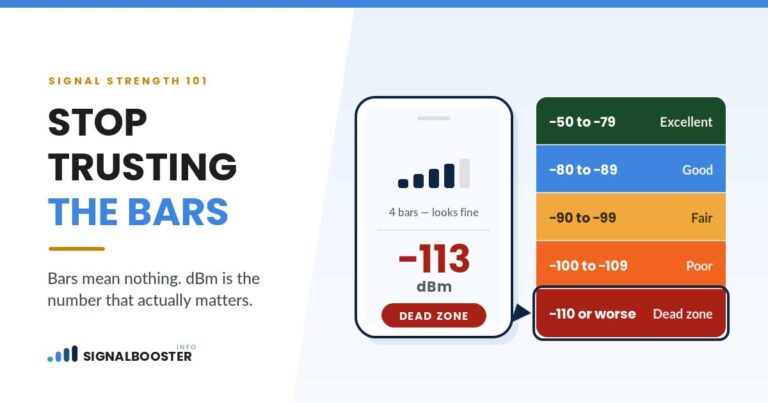
The experience is indistinguishable from weather-induced signal loss unless you are measuring. And the measurement gives it away immediately: congestion leaves your strength reading unchanged. If your dBm number looks completely normal during a bad episode, water in the air is not what is hurting you.
This matters commercially, and it is worth being blunt about. No equipment you install at your property increases a tower’s capacity. If your bad-weather problem is actually a busy-network problem, there is nothing to buy that addresses it.
How to Tell Weather From a Real Problem
The test is a log, and it needs to span more than one kind of day. The method is in our guide to checking your real signal strength in dBm, and what counts as a good number explains how to read the results.
- Pick two or three fixed indoor spots plus one outdoor spot, and use the same ones every time.
- Record a dBm reading at each spot, noting the date, the time and the weather.
- Do this on at least two clear days and two wet ones, at similar times of day so you are not accidentally measuring the evening rush instead of the rain.
- Compare like with like.
Three outcomes, three conclusions:
Readings are poor on clear days too. Weather is not your problem. It is making a bad situation worse, but the bad situation exists independently and is what you should be addressing. Our walkthrough of why signal is weak at home is the place to start.
Readings are good on clear days and clearly worse in rain. You have a genuinely marginal signal. Worth knowing, but also worth being realistic about. This is an occasional inconvenience rather than a daily condition.
Readings look identical in both conditions but service still feels worse when it rains. Congestion, most likely. Everyone else came indoors. Nothing installed at your house changes that.
When Weather Is Not Your Answer
The most useful thing this article can do is give you permission to stop investigating. If you have logged readings across a few days and your numbers are stable regardless of conditions, weather is ruled out and you can spend your attention on causes that are actually load-bearing: distance to the tower, what your walls are made of, which floor you are on, and how busy your local site is.
And if weather genuinely is your answer, the honest recommendation is to do nothing. A problem that appears in heavy rain and disappears afterwards is not a problem worth several hundred dollars of hardware. This site carries no affiliate links, so there is no reason for us to tell you otherwise.
FAQ
Does rain affect cell phone signal?
Yes, mainly because water absorbs radio energy, in the air, on wet surfaces, and especially in wet vegetation between you and the tower. The effect is real but generally small next to distance and building materials.
Does snow affect cell signal as much as rain?
Generally less. Falling snow is much less dense than liquid water. Accumulated wet snow on a roof or an outdoor antenna is a more significant mass of water than snow in the air.
Why is my signal always bad during storms?
Several things happen at once: rain absorbs some signal, lightning generates electrical noise that degrades quality without changing strength, wind moves vegetation and antennas, and more people are indoors using the network.
Does fog or humidity affect cell reception?
Both are minor effects at the frequencies phones typically use. If your signal is poor on a foggy morning, something else is more likely to be responsible.
Will a signal booster fix weather-related signal loss?
Only if the underlying signal is genuinely weak and weather is pushing an already-marginal reading over the edge. If your dBm readings are normal during bad weather, the cause is congestion or interference, and amplification does not address either.