Short answer: RV, truck and home boosters do the same basic job with the same three parts: an outside antenna, an amplifier and an inside antenna. What differs is the rulebook and the setting. The FCC treats boosters built for a building and boosters built for a moving vehicle as two separate classes, and the vehicle class is held to a lower gain ceiling. Antennas, power supply and the space each one covers differ too. So the best signal booster for RV use is not one product. It depends first on one question: do you need signal while driving, or only while parked?
This article walks through what is identical, what is genuinely different, and how those differences decide which class of booster fits the way you actually use your RV or truck. It does not rank models. This site does not recommend hardware it has not examined, and the class decision comes before any model decision anyway.
The Part That Is Identical
Strip the housing off any consumer booster and the idea is the same. An outside (donor) antenna picks up the carrier’s signal, the amplifier raises it, and an inside antenna rebroadcasts it to the phones nearby. The same path runs in reverse for your phone’s transmission back to the tower. Our overview of what a signal booster is and how it works covers that loop in detail.
Several things carry over unchanged between a house, an RV and a pickup:
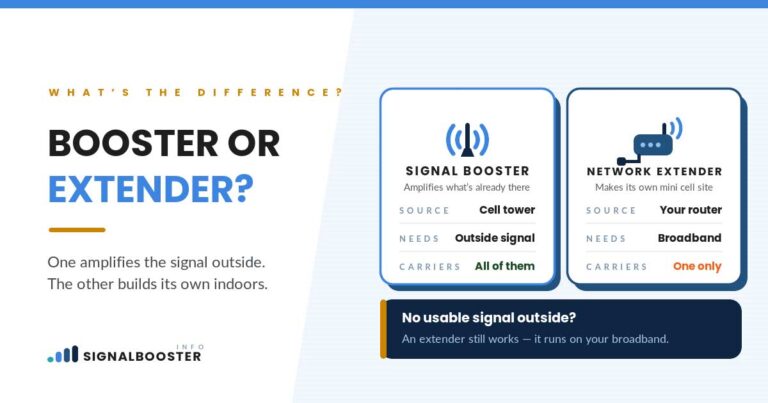
- A booster needs some signal to start with. It amplifies an existing signal. At a campsite or on a road with no usable signal outside, there is nothing to boost.
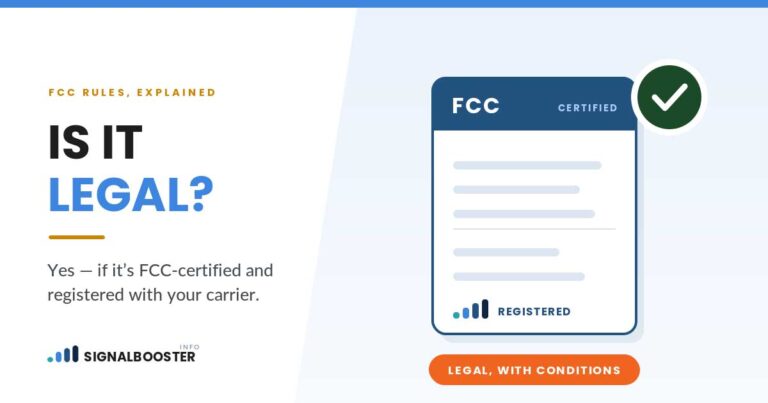
- Certification and registration apply everywhere. A booster sold to consumers in the US has to be FCC-certified, and the FCC’s rule requires you to register it with your carrier. Our explainer on whether a signal booster is legal goes through what registration involves.
- Both classes manage their own power. Consumer boosters watch the signal they receive and turn themselves down when they get close to overloading or feeding back on themselves.
If the home unit and the RV unit share all that, why are they sold as different products? Because the setting is different, and the federal rules follow the setting.
Difference One: The FCC Puts Them in Separate Classes
The FCC’s definitions in 47 CFR 20.3 split consumer boosters by where they are designed to run:
- A Fixed Consumer Signal Booster is “designed to be operated in a fixed location in a building.”
- A Mobile Consumer Signal Booster is “designed to operate in a moving vehicle where both uplink and downlink transmitting antennas are at least 20 cm from the user or any other person.”
The technical limits in 47 CFR 20.21 then set different gain ceilings for the two. For wideband consumer boosters, the multi-carrier kind most people buy:
| Booster class and setup | Maximum gain under 47 CFR 20.21 |
|---|---|
| Fixed (in a building) | 6.5 dB + 20 log10 of the frequency, so it varies by band |
| Mobile, with an inside antenna | 50 dB |
| Mobile, phone in a direct-contact cradle | 23 dB |
| Mobile, phone connected by cable | 15 dB |
The fixed limit is a formula rather than a single number. Worked through with frequency in MHz, it comes to roughly 63 dB at 700 MHz and roughly 72 dB near 1900 MHz. That is why you see home kits quoted anywhere from the low 60s to the low 70s in dB, while vehicle kits with an inside antenna stop at 50 dB.
Gain is not the whole story of performance, but a ceiling 13 to 22 dB lower is a real difference. Each 10 dB is a tenfold change in power, so a vehicle unit is working with far less amplification headroom than a home unit on the same band.
Why the Rules Are Tighter Inside a Vehicle
The regulation states the limits; it does not need to explain them for the physics to be clear. Three things make a vehicle a harder place to run an amplifier.
The antennas sit close together. In a house, the outside antenna can be on the roof and the inside antenna several rooms away. In a pickup cab or even a large motorhome, they are separated by a few feet and a metal roof. A booster whose inside antenna’s output leaks back into its outside antenna is feeding on itself, which is oscillation. Our guides on antenna separation distance and what oscillation does to a booster explain why less separation means less usable gain.
The signal keeps changing. A parked home booster faces the same towers all day. A moving vehicle passes from strong signal to weak and back within minutes, and the booster has to keep adjusting without ever overdriving the network near a tower.
People are right next to the antennas. The mobile definition itself builds in the 20 cm distance from the user or any other person. In a cab, that space is tight.
Difference Two: The Antennas
Antenna choice follows from whether the vehicle is moving.
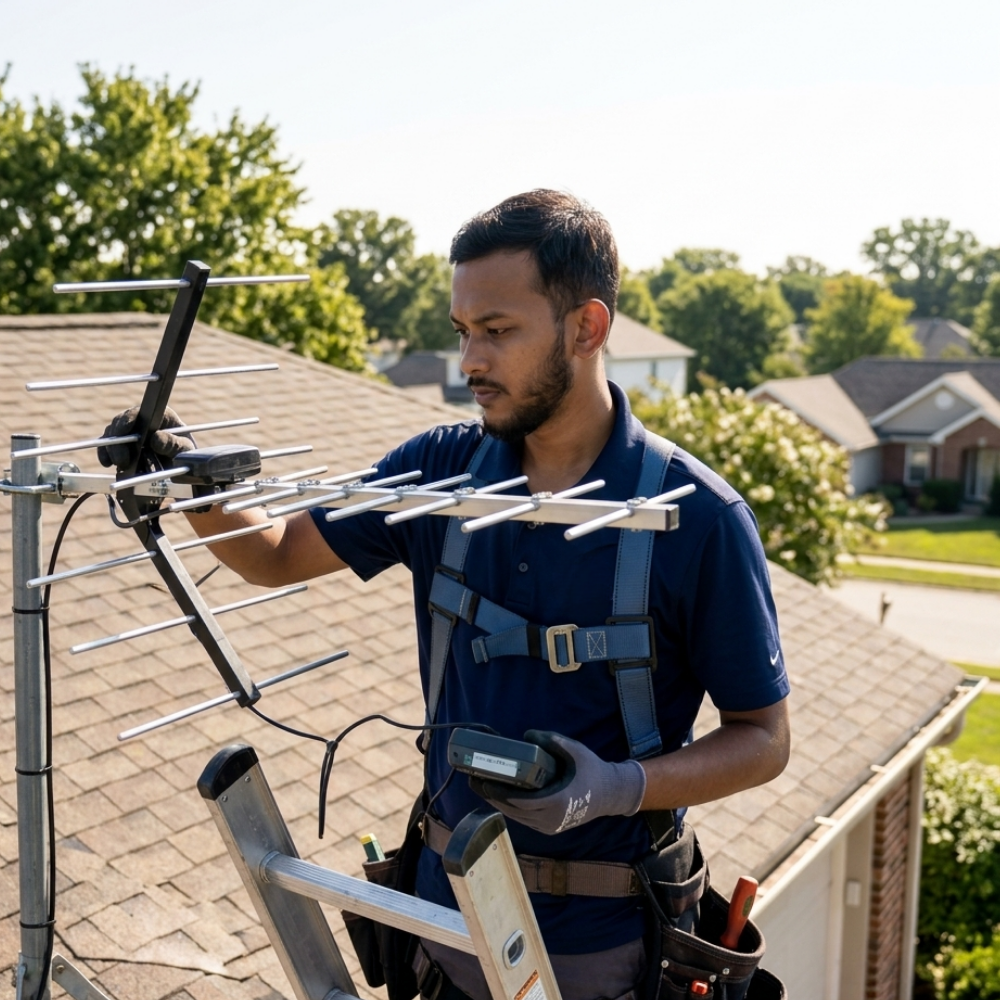
A home donor antenna is often directional. It is aimed once at the serving tower and left there, because neither the house nor the tower moves.
A vehicle donor antenna is normally omnidirectional. While you drive, the tower you need is ahead, then beside you, then behind, and a directional antenna would spend most of the trip pointed the wrong way.
RVs sit in between, which is where the class choice gets interesting. weBoost, one booster manufacturer, describes its two RV lines plainly on its RV booster page: one is “for stationary RV use ONLY,” uses “an outside directional antenna that mounts on a 25-foot telescoping pole,” and lists a maximum gain of up to 65 dB. The other “improves cell phone signal whether you’re parked at a campground or driving,” uses “a powerful omni-directional RV antenna,” and lists up to 50 dB. That split is the fixed and mobile classes showing up as two products from the same maker. We cite it to show the pattern, not as a recommendation of either kit.
Difference Three: Power and Mounting
A home booster plugs into a wall outlet and sits on a shelf or in an attic. Vehicle boosters are built to run from the vehicle’s 12-volt system, to tolerate vibration, heat and cold, and to stay put during hard braking.
Mounting differs the same way. A home antenna goes on a mast, a gable or a roof bracket. A vehicle antenna goes on the roof or a mirror bracket, often held by a magnet, and has to survive highway speeds, low branches and car washes. An RV adds a third option, the telescoping pole raised at camp, which only makes sense when the vehicle is parked and has to come down before you drive.
If you are drawn toward using an existing home unit in a parked RV, power and mounting are where the practical friction starts, alongside antenna spacing. Whatever you do, follow the manufacturer’s stated power supply and mounting method rather than improvising wiring.
Difference Four: How Much Space Gets Covered
Home booster boxes advertise coverage in square feet. Vehicle boosters mostly do not, and for good reason: their useful zone is close to the inside antenna. weBoost’s own vehicle installation guide says “the internal antenna should be placed between 18 and 36 inches from the cell phone’s location.”
That is a very different expectation from “covers the house.” In a truck cab, it covers the people in the cab. In a long motorhome or fifth wheel, a mobile-class unit may serve the cockpit or the dinette well and the back bedroom poorly. A fixed-class RV kit has more gain to work with, but only while parked.
What Actually Decides the Best Signal Booster for RV Use
Put the differences together and the “best” question turns into a short set of decisions about how you travel. This table is about booster class, not brands:
| How you use the RV or truck | Class that fits | Why |
|---|---|---|
| You need calls and data while driving | Mobile | Only the mobile class is designed for a moving vehicle |
| You mostly stay parked for days or weeks | Fixed-class kit sold for parked RV use | Higher gain ceiling and a directional antenna you can aim at camp |
| You need both | Mobile, or a mobile unit plus a parked-only setup | A fixed-class unit cannot cover the driving half |
| Pickup or work truck, with or without a trailer | Mobile | The cab is a moving vehicle; antenna placement matters more than gain |
| Usually no signal at all outside the campsite | Neither yet | Nothing to amplify; check coverage before spending money |
A few second-order questions then narrow it further: which carriers your household uses, how many phones need to be served at once, and where on the rig the outside antenna can realistically go. None of those can be answered by a “best of” list that has never seen your rig or your routes.
Measure Before You Choose
Bars are a poor guide to any of this. They are a rough, manufacturer-specific scale, and two phones parked side by side can show different bars for the same signal. Before choosing a class, take real readings in dBm (RSRP) at the places you actually park and along the stretches where you actually lose calls. Our guide on how to check your phone’s real signal strength in dBm shows where to find the number on iPhone and Android.
Take readings parked, not while driving, and note where you were. If your readings are usable outside the RV but poor inside, a booster of the right class has something to work with. If readings are poor everywhere at a site, no booster class will fix that site.
FAQ
Is an RV booster just a home booster in a different box?
No. They share the same basic design, but the FCC regulates fixed (in-building) and mobile (moving vehicle) boosters as separate classes with different gain limits. Some RV kits are fixed-class units meant for parked use only, and others are mobile-class units that work while driving.
Why do mobile boosters have less gain than home boosters?
Under 47 CFR 20.21, a mobile wideband booster with an inside antenna is capped at 50 dB, while the fixed limit is set by a formula that reaches roughly 72 dB near 1900 MHz. A vehicle puts the antennas close together, near people, and moves through constantly changing signal, all of which make high gain harder to run safely.
Can I use one booster in both my RV and my truck?
A mobile-class unit can move between vehicles if it is reinstalled properly in each and registered with your carrier. A fixed-class unit should only run while parked, so it cannot serve the truck while driving.
What is the best signal booster for RV travel?
It depends on whether you need signal while driving or only at camp, which carriers you use, and where your outside antenna can go. Settle the class first using measured dBm readings, then compare models within that class.
Do RV boosters work with no signal at all?
No. Every consumer booster amplifies an existing signal. If there is no usable signal outside the RV, there is nothing for it to boost.