In a multi-level home the antenna count is set by what sits between your floors, not by how many square feet you have. Wood joists with carpet over them let one well placed indoor antenna serve two levels. A poured concrete floor between the basement and the main level almost always means an antenna on each side of that concrete, because concrete stops cellular signal rather than slowing it. Tile and stone flooring sit in between and often push a two level house to two antennas.
That is the whole decision in one paragraph. What follows is how to work out which case you are in before you buy a kit, and the two rules from single story installs that stop being true the moment the house goes vertical.
Why square footage is the wrong starting number here
A booster kit's box figure is an area, and area is a flat measurement. A 2,000 square foot ranch and a 2,000 square foot three level townhouse present completely different problems to the same amplifier, because the townhouse asks the signal to pass through two floor assemblies that the ranch does not have.
Our general sizing rules, meaning how coverage from one antenna behaves and when a second is worth buying, are in how many indoor antennas you actually need, and the reason box coverage claims read optimistically at all is in how much coverage a signal booster really gives you. This page is the vertical case, which those two treat only briefly.
The variable that matters is attenuation per floor assembly. A floor is not one material. It is the floor covering, the subfloor, the joists, whatever is in the cavity, and the ceiling finish below, and the signal loses something in every layer. That loss happens once between level one and level two, and again between level two and level three, so the shortfall compounds as you go down or up from the antenna.
What is between your floors, ranked
Powerful Signal, a booster supplier and installer, publishes guidance on multi floor houses that matches the pattern any installer will describe. It is worth quoting the shape of it, because it is a decision tree rather than a number.
| What is between the levels | Likely antenna count for two levels | Why |
|---|---|---|
| Wood joists, carpeted floor above | Often one, placed on the upper level so it radiates down | Wood, air and carpet are poor blockers, so a ceiling mounted antenna's pattern can reach the level below |
| Wood joists, tile or stone flooring above | Often two | Dense floor coverings reduce what passes downward |
| Poured concrete or a concrete slab between levels | Almost always one per level | Concrete, and especially concrete with rebar in it, blocks cellular signal rather than attenuating it gently |
| Concrete slab plus a below grade basement | One per level, and the basement one is not optional | The basement is losing signal through earth on the sides as well as concrete above |
Powerful Signal's own worked example describes a two story home with a nine foot upper ceiling and a ten foot lower ceiling, roughly twenty feet from top to bottom, where a single ceiling antenna on the upper level could serve both floors because the construction between them was cooperative. That is the best case, and it is a real one. It is also the case that most readers with a basement complaint do not have.
If you want the underlying physics of why one floor of a house reads several dBm worse than another, we cover it separately in why signal is weaker on some floors.
The two rules that reverse in a vertical house
This is the part most sizing guides do not say, and it is the reason multi level installs surprise people.
Rule one that reverses: the structure that makes your install stable is the structure that makes it need more antennas. In a single story home, the hardest problem is keeping the outside antenna and the inside antenna from hearing each other, and you buy that isolation with distance. In a multi level home, the roof, attic and ceilings sit in that leakage path and give you isolation almost for free, which is why a two story house is often a more stable install than a large ranch. The same layers then stand between your indoor antenna and the floor you are trying to cover. You cannot have the benefit without the cost. A house that is easy to keep out of feedback is a house that distributes indoor signal poorly.
Rule two that reverses: adding an antenna does not add coverage in the way people assume. Splitting one amplifier's output between two antennas divides the available power between them, and the splitter itself introduces loss. Two antennas on a system sized for one do not each deliver what the single one delivered. On a vertical layout this matters more than on a flat one, because the second antenna is usually the one covering the difficult level, which is exactly where you want power rather than a share of it. This is why the honest upgrade path for a stubborn basement is often a second, properly sized system rather than a splitter.
Where the antennas actually go
Start from the worst level, not the middle one. The instinct is to put the antenna in the center of the house and hope it reaches both ways. In practice the level with the worst readings should get its own antenna position chosen first, and the easier level should be served by whatever is left over.
Aim through the smallest amount of material. A ceiling mounted dome on the upper level radiating downward through a wood floor is a short path through cooperative material. The same dome one level up from a concrete slab is radiating into a wall. Which antenna type suits which situation is covered in dome antennas versus panel antennas, and the short version is that a dome spreads coverage around and below itself while a panel pushes it in a direction.
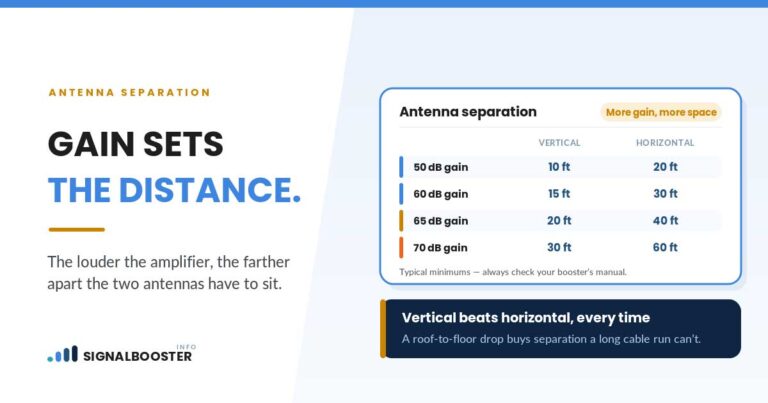
Do not put the indoor antenna directly under the outdoor one. Vertical separation is your isolation, and stacking them on the same axis is the fastest way to spend it.
Expect the coverage boundary, and plan where you want it. A booster does not fill a house evenly. There will be a room that reads well and a room down the hall that does not, and if that surprises you afterward, why a booster works in one room but not others explains the shape of the problem.
Before you drill through a floor
Running coax between levels is the part of a multi level install where the risks are physical rather than electronic, and it deserves plain treatment.
Know what is behind the surface before the bit goes in. Floors and ceilings carry wiring, water lines, drain lines and sometimes gas lines, and a drop from an upper level frequently passes right through the zone where they run. Use a detector, work out the service routes from what is visible in the basement or attic, and stop if you do not know what is on the other side.
Joists are structure. Drilling through a joist, notching one, or cutting a member to make a cable route work is not a cable decision, it is a structural one. A joist can be bored within limits set by the building code, and those limits vary by member size and location. If your route needs anything cut or notched, that question stops at a builder or a structural engineer, not at a booster guide. Running the cable around the obstacle is nearly always available and nearly always cheaper.
Attic runs have their own rules, including keeping the coax away from heat sources and supporting it properly rather than laying it across insulation and joists. We cover that route in running booster coax through an attic.
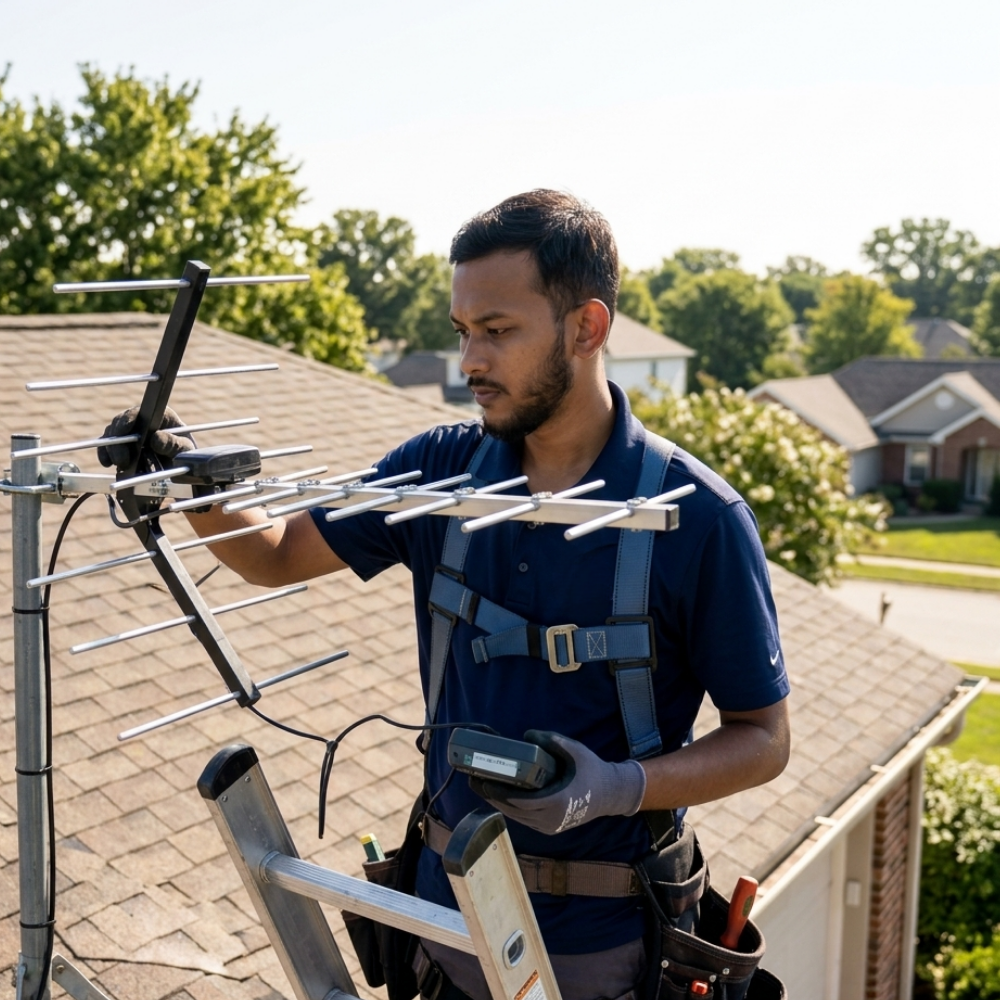
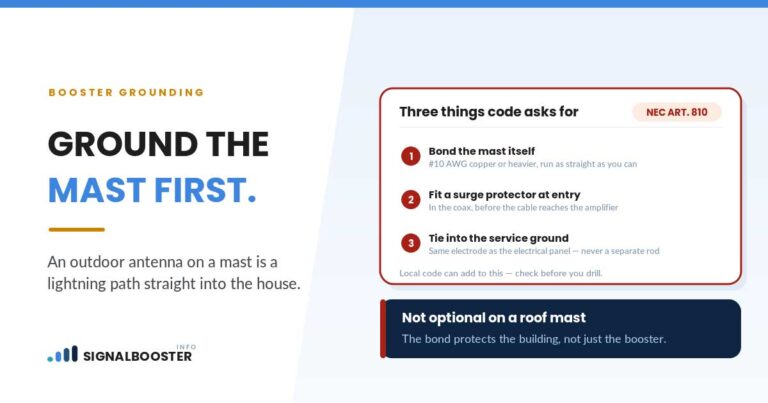
Anything that puts you at height, or that touches the building's grounding system, is a different job. An outside antenna needs bonding and grounding to the building's grounding electrode system under the electrical code, and that is electrical work. If it involves connecting at your service equipment, it is a licensed electrician's work, and in many jurisdictions a homeowner may not do it on their own service.
What the FCC rules mean for a multi antenna setup
One point specific to adding antennas, and it is easy to get wrong with the best intentions. The consumer signal booster rules at 47 CFR 20.21 require the operator to use only the antennas, cables and coupling devices approved by the manufacturer for that unit, and not to disable the network protection features built into it. In practice that means a second antenna, a splitter, or a longer cable should come from what the maker lists as compatible with your specific kit. Assembling a two antenna system out of parts from three suppliers can take the installation outside the configuration the unit was certified with. Registration with your carrier, also required by that rule before the unit is operated, covers the system, so adding an antenna does not create a second registration but moving the system to a different address does change the location on record.
These are United States rules. If your home is elsewhere, your national regulator sets the equivalent requirements, and they differ.
FAQ
Do I need one antenna per floor in a two story house?
Not necessarily. If the floor between the levels is wood joists with carpet, one well placed antenna on the upper level often serves both. If there is concrete between the levels, or dense tile and stone flooring, plan on one per level.
Will one booster with two indoor antennas cover a basement and an upstairs?
It can, with the caveat that splitting the output divides the available power between the two antennas and the splitter adds loss of its own. A single system with two antennas is a real option for a moderate house. A large house with a fully below grade basement often needs more than that.
Where should the indoor antenna go in a two level home?
Choose the position for the level with the worst readings first, put the antenna where it radiates through the least material, and keep it off the vertical axis directly below the outdoor antenna so you do not spend your isolation.
Does a basement always need its own antenna?
A below grade basement under a concrete slab usually does. Concrete blocks cellular signal, and the basement is also losing signal through the surrounding earth, so it is the level least likely to be reached from above.
Can I add a second indoor antenna to a kit I already own?
Only with parts the manufacturer lists for that unit. The FCC's consumer booster rules require manufacturer approved antennas, cables and coupling devices, and mixed parts can take the system outside its certified configuration.
Where this comes from. The floor construction guidance and the two story worked example are published by Powerful Signal, a signal booster supplier and installer, in its knowledge base. The regulatory points are from 47 CFR 20.21 as published in the Code of Federal Regulations and apply in the United States. The structural and electrical cautions are general information rather than a code interpretation for your building, and local codes and the authority having jurisdiction govern. No antenna count, coverage area or attenuation figure here was measured by this site.