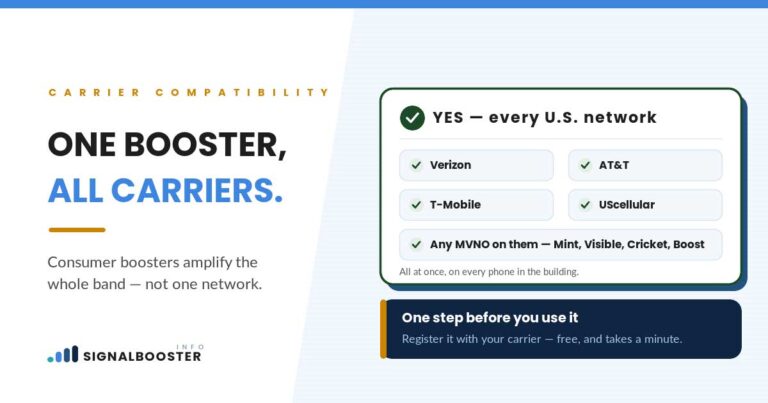
Short answer: signal booster carrier registration happens with your own wireless provider, not with the FCC, and it has to be done before you switch the booster on. The rule also requires your provider's consent. Registration must be free, and a provider's system has to collect at least four things: the owner or operator's name, the make, model and serial number, the location and the date of initial operation. Providers can design their own forms, and the three we compared ask for more than that.
This applies in the United States. We read the current rule, the FCC's 2013 order behind it, and provider pages on November 26, 2026. We read the forms without submitting any of them. This is our reading of those documents, not legal advice.
What the FCC actually requires
The current text of 47 CFR 20.21 lets a "subscriber in good standing" run a consumer booster under the provider's license, with conditions. Two of them come first, and both say "Prior to operation": the subscriber obtains the consent of the provider, and the subscriber registers the booster with that provider. The section also says that failing to comply with the applicable rules voids the authority to operate the booster.
On the provider's side, each licensee that consents has to run a free registration mechanism and collect, at a minimum:
- The name of the booster owner and/or operator, if different individuals
- The make, model and serial number of the device
- The location of the device
- The date of initial operation
The same paragraph says consent "is voluntary and may be withdrawn at the licensee's discretion."
On consent, the 2013 order (FCC 13-21) records that the four nationwide providers of that time (Verizon Wireless, T-Mobile, Sprint and AT&T) and the member companies of RTG, a rural carrier group, had committed to allow properly certificated consumer boosters. For those boosters, their subscribers "need only register" before operation and "generally need not seek further consent". The order also says a completed registration provides evidence of consent. If your provider is not on that list, ask about consent as well as registration. Our reading: because consent can be withdrawn, a 2013 commitment is a starting point, so heed anything your provider has published since. For certification and the wider legal picture, see whether a signal booster is legal.
The order also leaves room for forms to differ. Beyond the four minimum items, providers may develop their own registration processes. The FCC's effective-date notice says providers "should collect only such information that is reasonably related" to provider control and interference resolution, and that they "may determine how to collect such information and how to keep it up-to-date."
Signal booster carrier registration forms, compared
We took three registration forms that can be read without signing in: Google Fi's form (linked from its help page), Appalachian Wireless and Inland Cellular. "Required" below means the form itself marks the field that way.
| Item | In the FCC minimum? | Google Fi | Appalachian Wireless | Inland Cellular |
|---|---|---|---|---|
| Owner name | Yes | Required | Required | Required |
| Operator name | Yes, if a different person | Required | Required, filled in as "Same as owner" | Optional |
| Phone number | No | Required | Required | Optional |
| Email address | No | Not on the form | Required | Not on the form |
| Booster location (street, city, state, ZIP) | Yes | Required | Required | Required |
| Fixed or mobile | No | Required | Asked, "Fixed" pre-selected | Required |
| Date of initial operation | Yes | Required | Required | Required |
| Make | Yes | Required | Required | Required |
| Model | Yes | Required | Required | Required |
| Serial number | Yes | Required | Required | Required |
| FCC ID | No | Optional | Not on the form | Required |
| Update question or notes box | No | Optional | Not on the form | Optional |
Four things stand out:
- Each of the three requires something beyond the minimum. Google Fi requires a Fi phone number and the installation type. Appalachian requires a phone number and an email address. Inland requires the installation type and the FCC ID.
- The FCC ID is treated three ways. Inland requires it, Google Fi leaves it optional on the form (though its help page lists it among the details collected) and Appalachian does not ask. It is not one of the four minimum items.
- A phone number is not part of the minimum. Google Fi's form asks for the Fi number tied to the registration. Our reading: have your service set up before you fill it in.
- Appalachian limits its consent. Its page says consent to operate a booster on its network is limited to boosters certified by the FCC under 47 CFR 20.21(a).
This is a comparison of three forms, not of the industry. Verizon's signal booster page describes registering after you log in and does not show its fields there. AT&T, T-Mobile and other providers are not in the table, so check their own pages and do not assume they ask the same things.
Fill this in before you open the form
Our reading: collect everything these three forms ask for once, and you will have those details ready if your own provider asks for them. Its form may ask for something else. These eleven lines cover every field on the three forms except Google Fi's update question and Inland's notes box.
| Record this | Your answer |
|---|---|
| Owner name | |
| Operator name, if someone else runs it | |
| Phone number (Google Fi and Inland ask for your number on their service) | |
| Email address | |
| Full address where the booster will be | |
| Fixed (in a building) or mobile (vehicle or boat) | |
| Date of initial operation | |
| Make | |
| Model | |
| Serial number | |
| FCC ID |
The date line causes an obvious puzzle: registration comes before operation, yet all three forms ask for the date of initial operation. Our reading: for a new booster, enter the day you plan to switch it on, complete the registration before you switch it on, and ask the provider if the form will not accept a future date.
Who has to register: answers from the order and providers
Paragraph numbers and footnotes below refer to the 2013 order. The current rule text speaks of "the licensee providing service to the subscriber" and does not mention resellers.
You buy service from a reseller. Paragraph 104 says consumers who purchase wireless service from resellers "must also register their boosters." Providers must set up a way for those customers to register either directly with the underlying network provider or with the reseller. Our reading: buying through a reseller brand is not a reason to skip the step, so ask the brand which of the two it uses. Which bands your phone needs is a separate question, covered in does a signal booster work with all carriers.
Someone at home uses a different provider. The same paragraph says that where subscribers of several providers will use the booster regularly, "each such subscriber must register the device with their provider." Paragraph 48 adds that the FCC did not expect its occasional-use allowance to extend to routine, continued use, with housemates or family members on different providers as the example, and that a third party planning regular, sustained use must seek its own provider's consent. Covering multiple carriers with one booster looks at the hardware side.
A visitor or passenger uses it now and then. Paragraph 48 treats occasional, incidental use by a third party, such as a visitor in a home or a guest in a vehicle, as authorized under that person's own provider. The current rule keeps the incidental-use clause.
You change providers. Footnote 232 says a consumer who switches must obtain consent from and register with the new provider "or else cease operations."
You run two boosters. Verizon's FAQ says each one has to be registered, at the location where it will be used. Google Fi's form asks for a separate entry per booster.
The booster lives in a vehicle. Verizon says to use the address where the car, RV or boat will be stored or parked. That is Verizon's instruction, so ask your own provider if it is a different one. Equipment class matters too, as explained in using a home booster in an RV.
Moving, replacing or removing a booster
A replacement unit is the clearer case: the rule requires registration before operation, and the record includes the serial number. Our reading: register a replacement before you switch it on. For a move or a removal, we found no wording about updating a registration in the current text of section 20.21. The order leaves how records are kept up to date to each provider, and the answers differ:
- Verizon: its FAQ says to log in and update the booster's information, including the location, if you move it, and to delete it if you stop using it.
- Google Fi: submit the form again and mark it as an update to a previous registration.
- Appalachian Wireless and Inland Cellular: the registration pages we read do not describe an update step. Ask the provider.
Two things that get confused with this registration
A warranty registration with the maker. weBoost's registration guide, for example, is about registering the product with weBoost for warranty and support. The order chose registration directly with the serving provider, "rather than a third-party or the Commission". Registering with the maker may still be worth doing, but it is a different record.
A network extender. Verizon says its Network Extender is not the same as a signal booster and does not require this registration. The difference is covered in signal booster vs network extender.
FAQ
Is there a fee to register a signal booster? No. The rule requires a free registration mechanism, and the order says providers may not charge a registration fee.
Will the booster refuse to run until it is registered? Do not count on it. The order declined to require boosters to be built that way, so our reading is that a booster powering on tells you nothing about whether you are registered or authorized.
Do existing, older boosters need registration? The order says the requirement applies to operators of all consumer boosters, new and existing, fixed and mobile. It also says people may keep using existing boosters that do not meet the 2013 technical requirements, provided they have their provider's consent and register. The 2013 commitments described above were for certificated boosters, and the order says providers are not required to consent to the use of an existing older one, so ask yours.
Who can see my registration details? The order says only those with a legitimate need may have access. A provider may share registration information with another licensed provider solely to mitigate interference caused by consumer boosters, and has to protect its confidentiality when doing so. The order also requires providers to share registration information with the FCC on request.