Short answer: no maker guide or FCC rule we read gives a number of phones for a vehicle booster. The figures you see are marketing numbers, and they disagree: "up to four simultaneous cellular devices" on a Wilson listing for the weBoost Drive Reach, "up to 5 devices" in SureCall's launch post for the Fusion2Go Max, and just "multiple" on weBoost's own Drive Reach page. What the install guides do give is a placement distance: the inside antenna goes a set distance from where the phone is used. Our reading: the working question is how many seats in your vehicle fall inside that distance, not how many phones the box can handle. The same marketing text also says the Drive Reach covers "an entire vehicle's cabin" and "every device and network in your car", which the guides do not quantify.
This article reads those guides, works out where the two makers' ranges overlap, and shows how to check your own seats with a tape measure. That check is our method, not a maker instruction. We did not test any booster, and the guides say nothing about what happens to a phone outside the stated range.
What the number claims say
Sources checked on 2026-11-14:
| Source | What it says | Type |
|---|---|---|
| Wilson Amplifiers listing, weBoost Drive Reach | "covers an entire vehicle's cabin, and can boost up to four simultaneous cellular devices" | Retail listing |
| weBoost Drive Reach product page | "Boosts multiple users/devices", with no count; the same page says it "covers every device and network in your car, truck, SUV, or van" | Maker product page |
| SureCall Fusion2Go Max launch post (2019) | "Supports up to 5 devices on the same network" | Maker marketing post |
| SureCall Fusion2Go 3.0 RV product page | "Support all devices and users in your RV", with no count | Maker product page |
| 47 CFR 20.21 (2025 edition text) | No device or user limit found in the saved text | Federal rule |
Our reading: three different statements for two products, with one number in a listing and one in a launch post. None comes from the install guide or the rule, so we treat 4 and 5 as marketing descriptions, not as engineering limits.
What the install guides measure instead
The guides specify where the inside antenna goes relative to the phone.
- weBoost Drive Reach and Drive Reach Fleet: the inside antenna goes on the side of the seat or on the dash, "at least 18 inches but no more than 36 inches from where the cellular device will be used".
- SureCall Fusion2Go 5G, Max and OTR: the inside patch antenna goes on or near the front dashboard, "Within 2-3 feet of the typical cell phone location" and at least 8 inches (20 cm) from cellular devices. The guides give no lower limit other than the 8 inches, and "2-3 feet" does not say whether 2 or 3 feet is the cutoff.
- FCC label text in 47 CFR 20.21: "Antennas MUST be installed at least 20 cm (8 inches) from any person."
Where the two makers' wording overlaps, the arithmetic is as follows. weBoost's window is 18 to 36 inches (about 46 to 91 centimeters). SureCall's "2-3 feet" is 24 to 36 inches (about 61 to 91 centimeters), and it reads as an upper limit, with only the 8 inch (20 cm) minimum below it. A phone 18 to 24 inches (about 46 to 61 centimeters) from the inside antenna is inside weBoost's range and inside SureCall's under either reading of "2-3 feet". A phone 24 to 36 inches away is inside weBoost's range, and inside SureCall's only if "2-3 feet" means up to 3 feet. A phone under 18 inches is outside weBoost's range but, if it is at least 8 inches away, not outside SureCall's wording. Past 36 inches, it is outside both.
Our reading: both makers describe a single zone around one inside antenna, and the SureCall text puts that antenna at the front dash. The guides do not say whether rear-seat phones are covered. They simply do not describe them.
A worked example (synthetic, for the logic only)
This layout is invented to show the method. It is not a measurement of any real vehicle and it says nothing about how any booster performs. Suppose an inside antenna sits on top of the center dash, and a tape measure gives these distances to where each person's phone usually sits:
| Phone position | Distance to inside antenna | Inside weBoost 18 to 36 in? | Inside SureCall "2-3 feet"? |
|---|---|---|---|
| Driver | 30 in | Yes | Only if the limit is 3 ft |
| Front passenger | 22 in | Yes | Yes |
| Rear seat, left | 62 in | No | No |
| Rear seat, right | 62 in | No | No |
| Phone in a dash mount | 12 in | No, under 18 in | Yes, over the 8 in minimum and under 2 ft |
In this invented case, one position (22 in) is inside both stated ranges under any reading, the driver at 30 in is inside weBoost's range and inside SureCall's only on the 3 foot reading, the dash-mount phone is inside SureCall's wording but under weBoost's 18 inch minimum, and the two rear positions are outside both. The point is the method: the count comes from your seats and your antenna spot, not from a number on a box. The 20 cm rule also matters, because an antenna on the side of a seat sits close to a person, so check that separation before the distance to the phone.
Check your own vehicle in five steps
The guides do not describe this check. It is our way of applying their distance rule.
- Find the guide for your exact kit and write down its inside antenna rule.
- Pick a spot your kit's guide allows (weBoost: the side of the seat or the dash; SureCall: on or near the front dashboard), and keep it at least 20 cm (8 inches) from any person.
- With a tape measure, record the distance from that spot to each place a phone is usually held or mounted.
- Mark each one inside or outside the guide's range. The overlap that fits both makers' wording under any reading is 18 to 24 inches.
- Count the inside positions. That is the number of positions that meet your guide's placement distance. It is not a capacity figure from any maker, and the guides do not say what happens outside the distance.
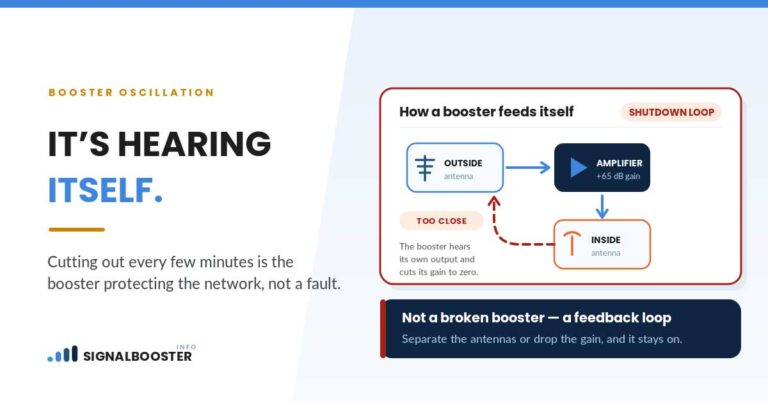
If one rear seat matters more than the front, move the antenna and measure again. Note that moving the inside antenna also changes its distance from the outside antenna, and the weBoost guides warn that antennas placed too close together cause oscillation (a feedback loop that makes the booster reduce power or shut a band off). Our guides on antenna separation distance and booster oscillation explain how to handle that.
What the guides do not say
- They give no count of phones, tablets or hotspots a booster can serve at once.
- They give no range for positions outside the stated distance, such as a rear row or a trailer. Our guide on a booster in a truck cab while towing looks at the trailer question.
- weBoost's product page lists tablets and mobile hotspots among the devices it boosts. This article treats a hotspot as one cellular device. How many other devices connect to a hotspot is outside this article.
FAQ
Does the FCC limit how many phones a vehicle booster can serve? We found no device or user limit in the text of 47 CFR 20.21. The rule sets technical limits such as gain and noise power.
Is the "up to 4" figure reliable? It appears in Wilson Amplifiers listings for the Drive Reach, while weBoost's own product page says "multiple" and gives no number. Treat it as a marketing description, not a tested limit, because no install guide gives a count.
Can rear-seat passengers use the boosted signal? The guides we read do not say. Measure from your inside antenna spot to the rear seat and compare it with your kit's range, as in the steps above.