Short answer: yes. A vehicle signal booster built for mobile use is designed to run in a moving vehicle, and towing does not change how its electronics work. What towing changes is geometry. A tall trailer, camper or fifth wheel behind the cab is a large object, often metal-sided, sitting right behind your outside antenna, and the cab itself is a small space where the inside antenna sits close to people and to the outside antenna. Mount the outside antenna high and toward the front of the roof, keep the two antennas well apart, and keep the inside antenna near where the phones actually are.
The rest of this article covers what a trailer does to reception, where the antenna should and should not go, how the cramped cab affects the system, and why a booster in the truck usually does not cover the trailer.
Why Towing Does Not Break the Booster Itself
The FCC’s definition in 47 CFR 20.3 describes a mobile consumer booster as one “designed to operate in a moving vehicle where both uplink and downlink transmitting antennas are at least 20 cm from the user or any other person.” A truck towing a trailer is still a moving vehicle. Nothing about a hitched load changes the booster’s class, its certification or its gain limit.
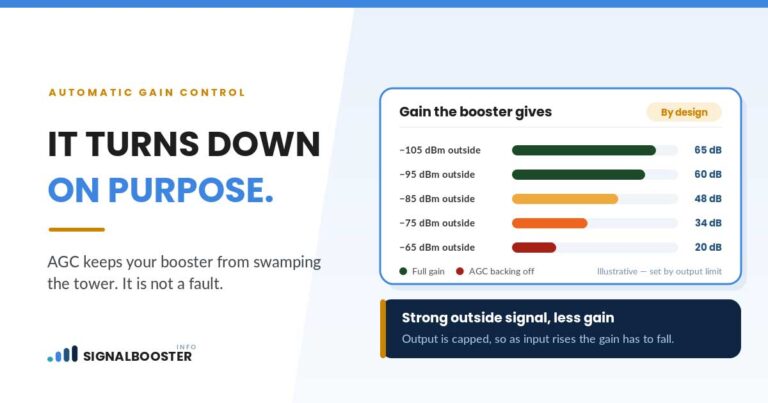
The booster’s own behavior does not change either. It still watches the signal arriving at the outside antenna and adjusts its gain as you drive toward and away from towers. If the signal reaching that antenna gets worse, the booster has less to work with, and that is where the trailer comes in.
One thing does matter before any of this: the class of booster. Only a unit certified for mobile use is meant to run while the truck moves. A home booster carried into the cab is the wrong tool, however much gain it lists.
What the Trailer Does to Reception
A cargo trailer, toy hauler or fifth wheel is a tall box. When it is metal-sided or metal-framed, it blocks and reflects radio signal much as a metal building does. Our article on distance vs. obstruction explains why something large and close to the antenna can matter more than a long distance to the tower.
The important detail is direction. A trailer only shadows the outside antenna from the signal arriving from behind you. A vehicle booster normally uses an omnidirectional antenna, which listens in every direction at once. As you drive, the serving tower is sometimes ahead, sometimes to the side and sometimes behind. So the trailer’s effect comes and goes:
- Tower ahead or to the side: the trailer is mostly irrelevant.
- Tower behind you: a trailer that rises above your antenna can sit squarely in the path.
That gives towing drivers a distinctive symptom: reception that is fine on some stretches and noticeably worse on others when hitched, even on a road where signal was steady with the trailer unhooked. If that matches what you notice, the antenna’s position relative to the trailer is the first thing to look at.
The cab adds its own loss. A truck cab is a metal enclosure with glass openings, and a phone sitting low in the cab receives less than one near the windshield. Our guide on why signal gets worse inside a car shows how to measure that loss while parked. A booster with an outside antenna gets around it, which is much of the point of fitting one.
Signal Booster in a Truck Cab While Towing: Where the Antenna Goes
weBoost’s vehicle installation guide says to “place the antenna around the center of the roof, ensuring a minimum 12-inch distance from windows and other antennas,” and to make sure “the antenna stands vertically for the best results.” On a pickup that is towing, those basics still apply, with one adjustment: favor the front half of the cab roof over anything at the rear of the truck.
| Outside antenna position | When towing | Notes |
|---|---|---|
| Center or front of the cab roof | Usually the best compromise | Highest point on most pickups, though still below a tall trailer’s roofline |
| Mirror mount | Depends on the trailer | Common on larger trucks; a trailer wider than the truck can still block it from behind; follow the kit’s mounting method |
| Rear of the bed, headache rack or toolbox | Worst choice when towing | Directly in front of the trailer’s face, and close to the hitch area |
| Inside the cab, on the dash or glass | Not a substitute | Defeats the purpose of an outside antenna |
A trailer that stands taller than your truck will block some of the rear view wherever you mount the antenna, because you cannot practically get the antenna above it. The goal is not to eliminate the shadow but to make it as narrow as possible, which means mounting the antenna as far forward and as high as the kit allows.
Two practical cautions. A taller antenna that clears more of the horizon also clears less overhead: check parking garages, drive-through canopies and low branches before you rely on it. And if the kit’s roof mounting involves drilling, the hole has to be sealed properly against leaks, and you should know what is behind the headliner before you drill. If you are not sure, have an installer do it.
Inside the Cab: Small Space, Close Quarters
The inside antenna has a much smaller job in a truck than in a house. weBoost’s guide says “the internal antenna should be placed between 18 and 36 inches from the cell phone’s location,” so in a cab it serves the people in the cab, not a wide area.
Three constraints shape where it goes:
- Airbags. The same guide says to choose a location for the internal antenna “that does not interfere with airbags, such as the side of a seat or the dashboard.” Never mount anything in an airbag deployment path, including side curtain areas along the headliner.
- Distance from people. The FCC’s required booster label says “Antennas MUST be installed at least 20 cm (8 inches) from any person,” per 47 CFR 20.21.
- Distance from the outside antenna. In a cab, the two antennas are separated by little more than the roof. The weBoost guide adds that with a sunroof, you should “ensure a minimum distance of five feet between the antennas.” Too little separation lets the booster hear its own output, and it responds by cutting its gain. Our guides to antenna separation distance and booster oscillation explain that tradeoff.
Mount the booster unit itself so it cannot shift under hard braking, and route cables where they cannot snag on feet, seat rails or door hinges. For trucks, weBoost’s instruction is to “Route the cord through a side door.”
Does a Booster in the Truck Cover the Trailer?
Usually not. A cab booster’s inside antenna covers a few feet around the phones in the cab. A camper trailer or fifth wheel behind it is a separate metal box several feet away, with its own walls, and the cab’s inside antenna is not aimed at it.
That matters for people who tow a camper. While driving, everyone is in the cab anyway, so cab coverage is what counts. Once you are parked at a site, the trailer is where you spend time, and it needs its own solution. Parked use is also where different rules come into play, because a booster that only runs while parked can be a different class from the one in your truck.
Power, Cable and Wear on a Working Truck
Vehicle boosters run from the 12-volt system, usually through a power adapter. Follow the manufacturer’s power method exactly; weBoost’s guide also says to “always disconnect the power cord from the outlet before connecting it to the booster.” If you want a hardwired connection instead of a plug, have it done by someone who knows the truck’s electrical system.
Keep the cable run as short as the mounting allows. Every foot of coax costs some signal before it reaches the amplifier, as our explainer on coax cable loss shows. On a work truck, also check the cable where it passes through door seals and around hinges every so often. A crushed or chafed cable can quietly degrade a booster that otherwise works.
Test It Parked, Then Compare
Do not read signal numbers while driving. The CDC’s distracted driving guidance lists talking on a cell phone and using a navigation system among the activities that take a driver’s attention from the road. Diagnose with the truck parked, or let a passenger take notes.
A simple comparison:
- Hitched, parked facing away from the tower, so the trailer sits between the antenna and the tower. Take a reading with the booster on and off.
- Same spot, turned around, so the tower is ahead. Take the same readings.
- Unhitched, if practical, in the original position.
A large difference between positions 1 and 2 tells you the trailer’s shadow is real at that spot, and that moving the antenna forward or higher may help. Our guide to testing a signal booster before and after explains how to take readings you can trust.
FAQ
Does a vehicle signal booster work while towing a trailer?
Yes. A mobile booster is designed for moving vehicles, and towing does not change its operation. A tall trailer can block the outside antenna from signal arriving from behind, so mount the antenna as high and as far forward as the kit allows.
Where should the booster antenna go on a truck that tows?
On the cab roof toward the front, or on a mirror mount if the kit supports one, rather than at the rear of the bed. Follow the kit’s guidance on distance from windows and other antennas, and keep it vertical.
Will a booster in my truck cab give signal in my camper trailer?
Usually not. The inside antenna in a cab covers a few feet around the phones in the cab. A trailer parked behind it needs its own solution.
Can I use a home booster in my truck?
Not while driving. Home boosters are certified as fixed, in-building devices. A truck that moves needs a booster certified for mobile use.
Why is my signal worse only when I am hitched?
The trailer is likely shadowing the outside antenna from towers behind you. Test parked, facing toward and away from the tower, to confirm it.