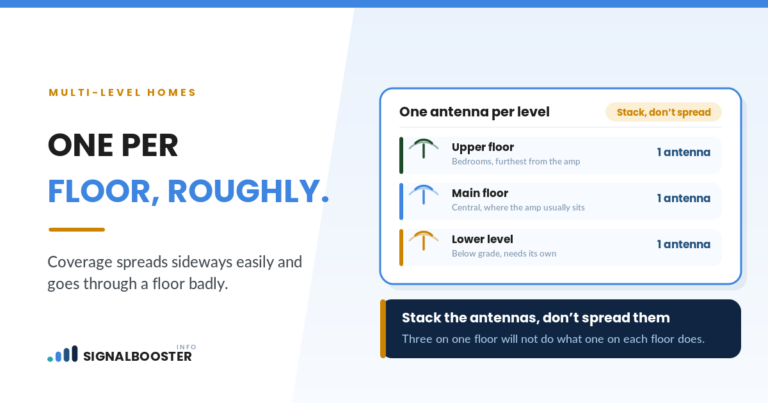
Most homes need one, placed where the people are. A second antenna is worth adding only when the reading at your existing indoor antenna is strong enough that dividing it still leaves both locations usable.
The number is not set by the size of your house. It is set by how much signal the amplifier has to give away, because every antenna you add is another share of the same fixed output, not another source of it. That reframing decides the whole question, and it is the reason a bigger house does not automatically need more antennas. Sometimes it needs a better outdoor antenna instead.
The Arithmetic That Decides It
A splitter takes the amplifier's output and divides it between two or more paths. Dividing power in two is a 3 dB reduction, because 3 dB is what a factor of two means in decibels. A four way split divides it again. Real splitters also add insertion loss of their own, and the figure for that is printed on the splitter's datasheet.
Then you pay a second time in cable. The runs to the additional antennas are longer than the run to the first one, and every foot of coax costs signal, with the loss rising at higher frequencies.
So the practical picture is this. The first indoor antenna gets the full output through a short cable. Add a second and both get roughly half, minus the splitter's loss, minus the extra cable to reach the far one. The far antenna is always the worst position in the system, and it is usually the one you added the whole splitter for.
None of this makes splitting wrong. It makes it a trade, and the trade only pays when you have surplus.
The Test That Answers It for Your House
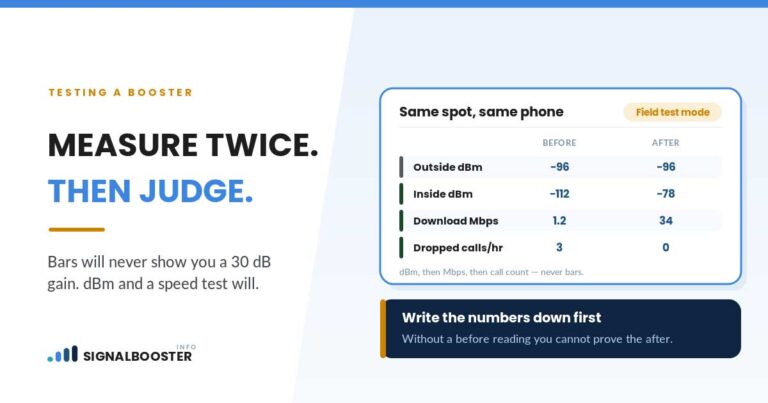
Do this before you buy anything, using the method in our guide to checking real signal strength in dBm.
- Read the dBm standing next to your existing indoor antenna, booster on.
- Read it again in the room you want to add coverage to, booster on.
- Read it in that same room with the booster off.
Now compare.
Strong at the antenna, and the far room is unusable with the booster on or off. You have signal to distribute and somewhere that needs it. This is the case where a second antenna makes sense.
Marginal at the antenna itself. Do not split. You will turn one marginal location into two useless ones. The work to do is upstream: outdoor antenna aiming, position, or cable, not indoor distribution.
The far room is already acceptable with the booster on. You do not need a second antenna. You need to stop reading buying guides.
The far room is fine with the booster off. It never needed covering. Spend the coverage where the dead zone actually is.
When One Antenna Is Genuinely Enough
More often than the expansion kit pages suggest.
A single indoor antenna, placed in the room where you actually use your phone, covers a real area around itself. The reason people conclude they need more is usually that the first antenna went where the cable was easy to run, in a utility room, a closet, or the corner of a basement, rather than where they live.
Moving the one antenna you have is free, and it is a bigger change than most people expect. Getting it out of a cabinet, off the floor, away from a metal duct, and into the room that matters routinely does more than a splitter would. Our walkthrough of why a booster works in one room but not others goes through how to read the fall-off pattern and decide.
Antenna type is part of this too. A single panel aimed down a hallway can cover a run of rooms that a single dome in the same spot would not, which is the whole subject of dome versus panel indoor antennas. Changing the shape of the coverage is often the cheaper alternative to splitting it.
When a Second Antenna Really Is the Answer
There are honest cases, and they share a pattern: the areas are separated by something the signal will not cross, and there is enough output to divide.
Two floors with a concrete slab or a lot of ductwork between them. One antenna will not serve both, and no placement fixes that.
A detached or far end space, a garage, a workshop, a converted attic, where a wall or a distance simply ends the coverage.
A long building. Mobile homes, ranch layouts, and shops are longer than one antenna's useful reach even when the reach is good.
A commercial-style layout with hard partitions. Individual offices with full height walls block a lot more than an open plan floor.
In every one of these, the prerequisite is the same: a strong reading at the existing antenna first. If you have that, a two way split is the sensible next step. Going straight to a four way split on a residential system is where people get into trouble, because the arithmetic is unforgiving and the far antennas end up contributing nothing.
Two Things That Get Worse With More Antennas
Feedback risk rises. Every indoor antenna is re-broadcasting the frequencies the outdoor antenna is listening on. More radiating points inside the building means more chances for some of that to find its way back outside, and the amplifier will reduce its gain or shut down when it hears itself. The separation rules in your manual apply to every indoor antenna you add, not just the first, and antenna separation distance for a signal booster covers why.
The system gets harder to diagnose. With one antenna, a weak reading has a short list of causes. With three antennas, a splitter, and four cable runs, a single bad connector somewhere can produce a symptom that looks like a booster problem. Every joint you add is a place for the install to go quietly wrong.
What This Does Not Change
Adding antennas does not add power. A consumer booster has a maximum output and a maximum gain fixed by its FCC certification, and those limits do not move because you connected more antennas to it. If you are short of signal, distribution is not the lever. The outdoor side is.
And the coverage figure on the box was never a promise about your building. How much area a signal booster really covers explains why a best case number measured in favorable conditions and your actual house are two different measurements.
We carry no affiliate links here, so there is nothing in it for us either way: for a typical single family home with a decent outdoor signal, one well placed indoor antenna is the answer far more often than two.
FAQ
How many indoor antennas can one signal booster support?
It depends on the booster and on how much output it has to divide. Splitters are commonly sold in two, three, and four way configurations, but the limit that matters is whether every antenna still delivers a usable reading after the split.
Does a splitter reduce signal?
Yes. Dividing power between two paths is a 3 dB reduction by definition, and the splitter adds its own insertion loss on top, which its datasheet states.
Do I need one antenna per room?
No. One antenna covers an area, not a room, and in most homes that area spans several rooms. Measure the fall-off before assuming a room needs its own.
Is it better to add an antenna or move the one I have?
Move it first. Placement is free, it is the largest single variable in most homes, and you cannot judge whether a split is affordable until you know what a well placed single antenna delivers.
Will more antennas help if my signal is weak at the antenna I already have?
No, and it will make things worse. Splitting a marginal signal produces two marginal signals. Fix the outdoor side first.