A home signal booster has no legally required maintenance schedule, and the useful answer is not a number of months. Rechecks are triggered by events. A storm, a roof or siding job, a tree that grew, a coverage change you can feel, or a booster that starts behaving differently are all reasons to look. A calendar reminder once a year is a sensible habit on top of that, but the annual visual check is the cheap part. The events are what actually change your system.
The one continuing obligation that is written into the rules is different from maintenance, and it is worth separating from the start.
What the rules require, and what they do not
The FCC's consumer signal booster rules at 47 CFR 20.21 set conditions on how a booster is operated, not on how often it is serviced. The conditions that continue for as long as the unit runs are these:
- The unit's network protection features stay active. You may not disable the self monitoring, the oscillation detection and mitigation, or the automatic power reduction near a base station.
- You use only the antennas, cables and coupling devices the manufacturer approved for that unit.
- On request from an FCC representative, or from a licensee experiencing harmful interference, you deactivate the booster immediately or as soon as practicable.
- The registration you made with your provider before operating the unit reflects reality, including its location.
There is no inspection interval in there. If you have seen "boosters must be inspected annually" in search results, it is worth knowing where that comes from: in the United States, in-building public safety radio enhancement systems in commercial buildings are subject to periodic testing and inspection requirements set by fire codes and the local authority having jurisdiction. Those are life safety systems in commercial buildings, inspected by qualified technicians under a code regime. They are not the rules for a consumer booster in a house, and importing the schedule does not make your home installation more compliant.
What your kit's own manual says about care and inspection is the authority that actually applies to your unit. Read that first.
The events that should send you outside
This is the real maintenance list, ordered by how often it catches something.
After any significant weather. High wind moves mounts. Ice loads them. A mast that has shifted a few degrees has changed both what the antenna is aimed at and how much isolation you have from the indoor antenna. Weather also affects readings for ordinary reasons that have nothing to do with damage, which we cover in does weather affect your outdoor booster antenna.
After any work on the roof, siding, gutters or trees. Roofers move antennas and rarely put them back on the same bearing. Siding work disturbs cable entries. A tree crew changes the path between your antenna and the tower, sometimes for the better.
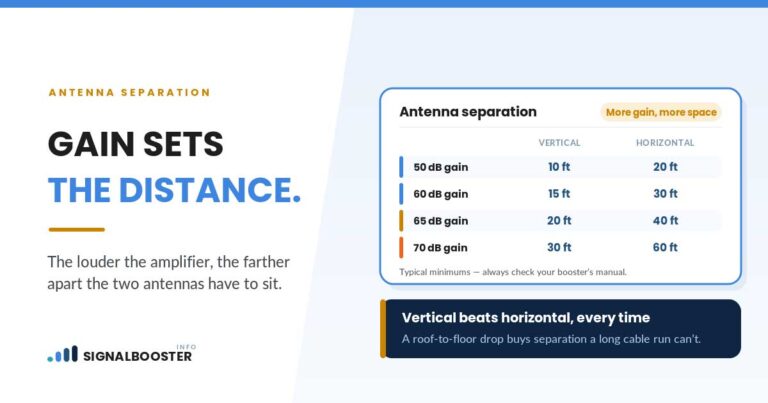
After anything changes indoors near the antennas. A new appliance, a metal shelving unit, a remodeled room, or an indoor antenna that got moved during decorating. Small changes to the leakage path between the indoor and outdoor antennas can be enough to push a marginal install into feedback.
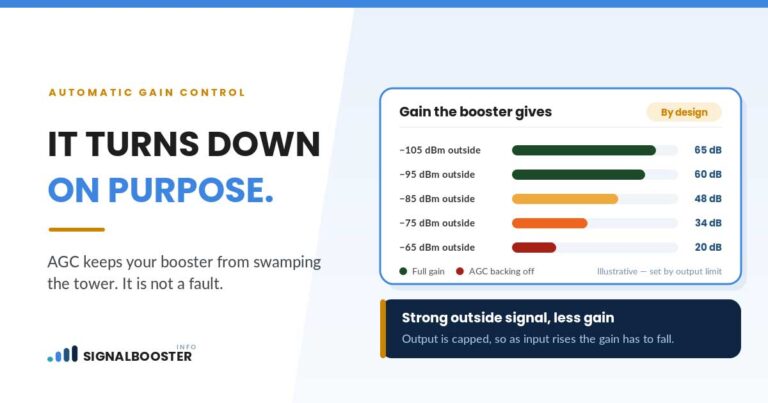
When the system's behavior changes. Coverage that shrinks over an hour, a status light that changes color, calls that hold up in one room and not another. A booster reducing its own power is doing what it is certified to do, and the reason is usually either a strong incoming signal or the beginnings of a feedback loop. Our pages on automatic gain control and on oscillation and the feedback loop explain how to tell those two apart, and the fixes are opposite.
When your carrier's network changes. Boosters amplify what arrives. If a serving site is retuned, relocated or decommissioned, your donor signal changes and nothing on your roof is at fault.
Once a year, on the calendar, as the backstop. Not because the hardware degrades on a schedule, but because the four events above are easy to miss individually.
What the annual check actually consists of
Keep this short, and keep it from the ground.
| What to check | How | What you are looking for |
|---|---|---|
| Mount and mast | Look from the ground, binoculars help | A changed angle, a loose bracket, movement in wind |
| Outdoor antenna | Same | Physical damage, a bird nest, an obstruction that has grown |
| Cable entry and exterior connectors | From the ground or a safe reachable position | Weatherproofing that has cracked, split or gone chalky under UV, water tracking down the cable |
| Visible coax runs | Walk the route you can see | Cuts, abrasion, animal damage, cable pulled tight over an edge |
| Indoor amplifier | At the unit | Status indicators, ventilation not blocked, connectors finger tight and no more |
| Grounding hardware | Visual only | The discharge unit still in place, bonding conductor still secured and continuous |
| Performance | Your phone, in field test mode | dBm readings compared against your baseline |
The last row is the one that turns this from a look into a measurement. If you recorded before and after readings when the system went in, using the method in how to test whether your booster install worked, you can compare like with like. If you did not, take a full set now and make it the baseline. Readings in dBm from the same spots at the same time of day are the only maintenance record that tells you anything, and how to check your real dBm signal strength is the method.
Bars are not a record. A phone showing the same number of bars at two very different signal levels is normal behavior, not a fault.
Where the check stops and a trade starts
Everything in the table above is done from the ground or from inside the house, deliberately.
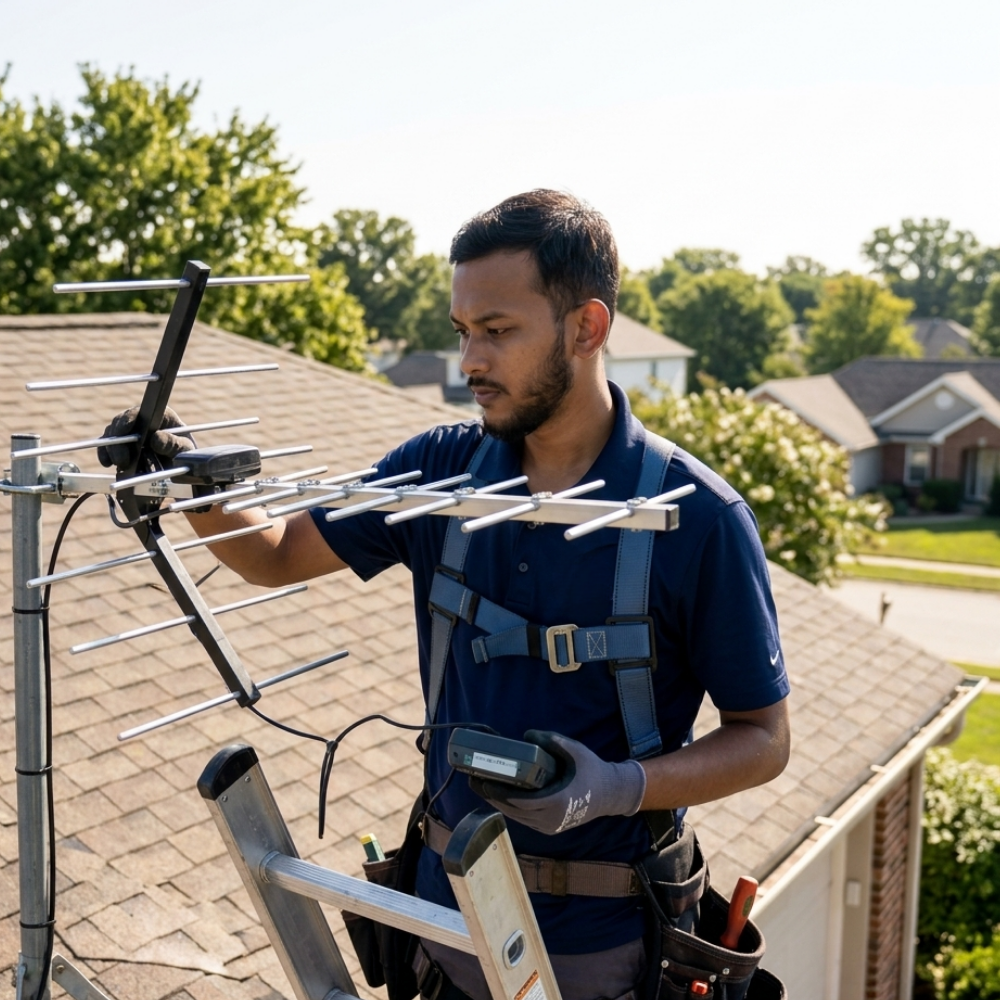
Do not climb to inspect. The entire benefit of an annual look is finding a problem before it becomes a failure, and none of that benefit survives a fall. Falls from height are among the most serious home improvement injuries there are. If something on the roof or the mast needs hands on it, that is a visit from a roofer or an aerial and satellite installer, and it is a small job for someone who does it daily with the right ladder and the right anchors. This site does not publish ladder or roof technique.
Anything involving the grounding or bonding is electrical work. The discharge unit on the lead-in, the bonding conductor, and its termination at the building's grounding electrode system are covered by the electrical code, and inspection is where a problem with them shows up: a conductor that has come loose, corrosion at a clamp, or hardware that a roofer removed and did not replace. You can look. Correcting anything that connects at the service equipment is a licensed electrician, and in many jurisdictions it is not homeowner work at all. What the code asks for is set out in our page on signal booster grounding requirements. Codes are adopted locally, and the authority having jurisdiction decides.
Never modify the unit to make a problem go away. Substituting a higher gain antenna, adding a splitter that is not listed for the kit, or defeating a feature that keeps shutting the system down all take the installation outside the configuration it was certified with, and the last one is prohibited outright by the rule.
The maintenance items people get wrong
Overtightening connectors. Coax connectors are made up finger tight and then a fraction more with a wrench where the manufacturer specifies it. Cranking them deforms the interface and creates the intermittent fault you were trying to prevent.
Resealing over damaged weatherproofing. Wrapping fresh tape over cracked tape traps water against the connector. The old material comes off, the connection gets inspected, and the seal gets rebuilt.
Treating a status light as the whole diagnosis. The light tells you the amplifier's opinion. Your readings tell you what the house is actually getting.
Assuming a drop in performance means the booster failed. Boosters are simple devices. A change is more often the donor signal, a moved antenna, or something new in the leakage path than the amplifier itself.
Cleaning contacts with the wrong thing. Use a contact cleaner intended for the purpose, not a household solvent that can attack the dielectric or the connector plating.
The honest summary
For a home booster, once a year from the ground plus a look after every storm, roof job or noticeable change in behavior is a proportionate routine. What makes it worth doing is the baseline: readings in dBm from fixed spots, written down, so that next year's check is a comparison rather than a guess. The hardware rarely fails on its own. The world around the antenna changes constantly.
FAQ
How often should I check my signal booster antennas?
There is no required interval for a consumer booster. A yearly visual check from the ground, plus a check after storms, roof or tree work, and any noticeable change in coverage, is a proportionate routine for a home system.
Do signal boosters need annual inspections by a technician?
Not consumer boosters in homes. The annual inspection requirements you see online generally apply to in-building public safety radio systems in commercial buildings under fire codes and the local authority having jurisdiction.
Do booster antennas wear out?
The antenna itself has no moving parts, but its mounting hardware, connectors and weatherproofing are exposed to weather and ultraviolet light, and those are what fail. Water in a connector and a shifted mount are the two most common findings.
Should I climb up to inspect the outdoor antenna?
No. Do the inspection from the ground, with binoculars if you need them. If something needs to be handled on the roof or mast, hire a roofer or an aerial installer for that visit.
My booster suddenly covers less than it used to. What changed?
Check for a moved or shifted antenna, damaged cable or weatherproofing, a new obstruction, and anything that changed indoors near the antennas. If the system is shutting itself down or cycling, that points to a feedback loop or a strong input rather than a failure.
Where this comes from. The continuing operating conditions, the ban on disabling network protection features, the manufacturer approved components requirement and the deactivation on request are from 47 CFR 20.21 as published in the Code of Federal Regulations, and apply in the United States. The grounding points reference NEC Article 810 and are general information, not a code interpretation for your building. No inspection interval, weatherproofing lifespan or performance degradation figure is stated here, because none could be attributed to a manufacturer or a regulator for consumer home boosters, and this site has not tested one.