A concrete block basement affects cell signal differently than a poured concrete one, but construction type is rarely the deciding factor on its own. Concrete block, also called CMU, is built from individual hollow units stacked with mortar joints, while poured concrete is a single continuous mass. What actually drives a concrete block basement cell signal problem is depth below grade, how much steel reinforcement is packed into the walls and footings, and distance from the nearest cell tower. A signal booster solves all three at once by capturing signal outside the basement and carrying it in, rather than asking the signal to pass through the wall unassisted.
Why Any Basement Fights Signal Before You Even Get to Wall Type
Every basement starts at a disadvantage that has nothing to do with block versus poured concrete. It sits below grade, so the earth around the foundation itself absorbs and scatters radio frequency energy before it ever reaches a wall. It typically has fewer windows, and windows are usually the easiest path for a cell signal to enter a room, since glass and standard framing attenuate far less than masonry. Basements also tend to sit closest to a home's electrical panel, HVAC equipment and water lines, all of which add local RF noise near the phone even when the signal reaching the building is decent outdoors.
Add distance from the tower into that mix and a basement that would be a mild dead spot on an upper floor can become a full no-bars room below grade, regardless of what the foundation is made of.
Poured Concrete vs. Concrete Block: What Actually Differs for RF
Poured concrete is a monolithic pour: one continuous mass of concrete and embedded rebar, with density that is fairly uniform across the wall once it cures. Concrete block construction stacks individual hollow units with mortar joints between them, and depending on the structural design, some of those hollow cores are filled with grout and vertical rebar (typically at reinforced cells and bond beams) while others are left as air-filled cavities.
That difference matters for radio waves in principle: a hollow, ungrouted block cavity is mostly air and mortar, which passes signal more easily than a solid concrete mass of similar thickness. But in practice, a block basement wall is not uniformly hollow. The grouted and reinforced cells, which every foundation needs for structural strength, behave more like poured concrete at those specific points, dense and metal-laden. The result is a wall that is inconsistent point to point rather than reliably better or worse than a poured wall overall, and which cells are filled is a structural decision made by a builder or engineer, not something a homeowner can see or verify by looking at a finished basement.
This is the practical answer to whether construction type matters: it changes the pattern of where signal loss happens, but it does not reliably make a block basement better or worse than a poured one for a booster install. Depth, total wall thickness, rebar density and distance to a usable outdoor signal source still do most of the work in determining how bad the dead zone actually is.
How a Signal Booster Gets Around Either Wall Type
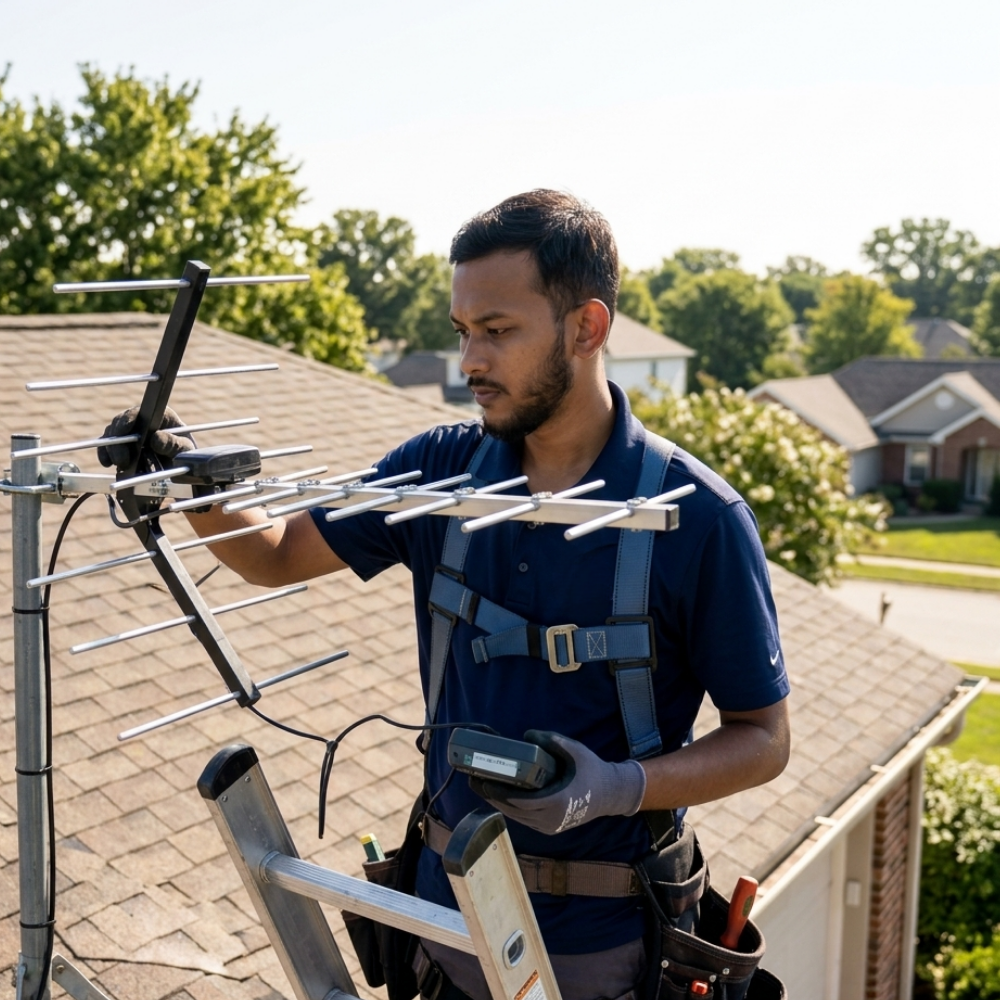
A booster kit does not try to push more power through a concrete block basement wall. Instead, it moves the reception point entirely outside the problem: an outdoor antenna, mounted where it has a clear view toward the nearest usable tower, captures signal before it has to pass through any wall, block or poured. That signal travels down a coaxial cable to an amplifier, and from there to an indoor antenna placed inside the basement itself. The wall's construction only matters for the small stretch of cable that has to cross it, not for the signal path as a whole.
Getting that cable from an outdoor antenna down into a finished basement is its own project, and weBoost's own guide on running booster cable into a home, read September 18, 2026, walks through the common routes: through a window using flat, low-profile cable, alongside a vent pipe penetration, or through a drilled entry point that is then sealed against weather and pests. Which route makes sense for a block basement depends on where the block wall sits relative to the home's existing penetrations, not on whether the wall is block or poured.
Cable Loss Matters More in a Basement Install Than the Wall Does
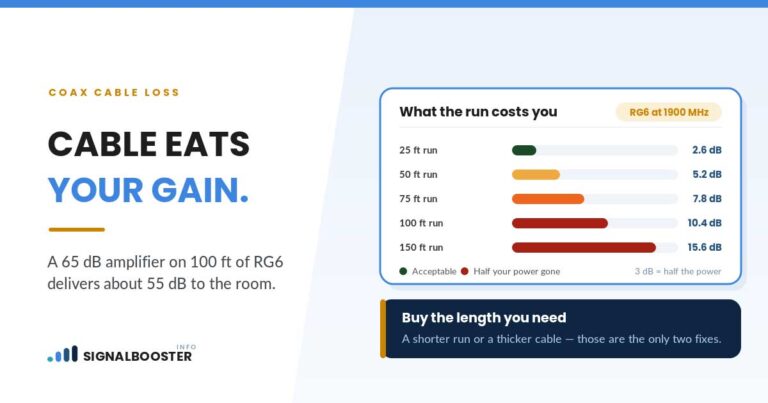
Because a block basement is below grade, the cable run from a roof or high exterior mount down to the indoor antenna is almost always longer than a comparable single-story install. That length has a real, measurable cost that has nothing to do with concrete at all. Every foot of coaxial cable absorbs some of the signal traveling through it, and the total lost over a long basement run can meaningfully cut into what the booster is rated to deliver. If a basement install is underperforming after the antenna is mounted correctly, coax cable loss is one of the first places to check the actual numbers rather than assuming the wall itself is the problem. For longer basement runs specifically, comparing cable types head to head, such as in RG6 versus LMR400 signal loss, often matters more to the final result than which concrete the basement was built from.
Antenna Placement Still Matters More Than the Basement Wall
Where the outdoor antenna is mounted decides how strong a signal it hands off in the first place, and that decision happens well before the signal reaches the basement. A poorly placed outdoor antenna, blocked by trees, a neighboring structure, or the wrong side of the roofline, can cost more usable signal than any difference between block and poured concrete ever would. The tradeoffs between mounting locations, including how each affects cable run length into a basement, are covered in attic mount versus roof mount for a signal booster antenna. Getting that first step right does more for a block basement's result than any wall-material choice could.
Fixing a Concrete Block Basement Cell Signal Problem That Won't Go Away
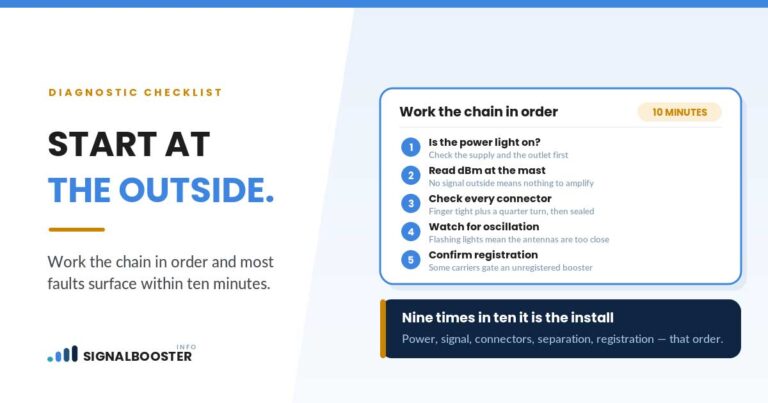
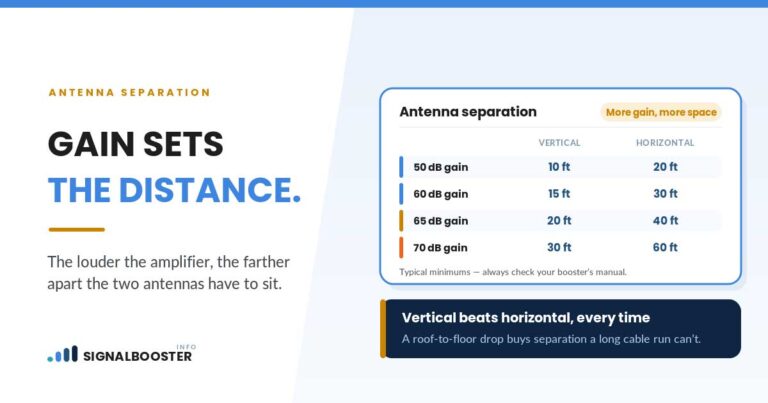
When a booster is installed correctly and a block basement is still weak, the cause is usually one of the same handful of issues that show up in any basement install: insufficient outdoor signal to begin with, a cable run longer than the kit's amplifier can compensate for, or an indoor antenna placed too close to the outdoor one, causing the system to reduce its own output to avoid feedback. A structured signal booster troubleshooting checklist walks through these in order, and working through it before assuming the concrete block itself is unbeatable usually finds the actual fix.
Registration and Legality Apply the Same Way Regardless of Wall Type
Whether a basement is poured concrete or concrete block has no bearing on whether a booster is allowed. The FCC's Consumer Signal Boosters page, read September 18, 2026, confirms that any consumer booster used in the United States must be a properly certified device, and the user is required to get approval from their wireless provider and register that specific booster with them before use. Every major US carrier has committed to allowing certified consumer boosters that meet the FCC's technical rules, so this step is a formality rather than an obstacle, but it applies to a block basement install exactly the same way it applies to any other room in the house.
The Bottom Line
Construction type is not nothing, a hollow, ungrouted block cavity does pass signal more easily than a solid poured wall of the same thickness, but it is rarely the variable that decides whether a basement is usable. Depth below grade, how much of the wall is reinforced with grout and rebar, distance to the nearest usable tower signal, and cable run length to the amplifier all do more of the work. A properly sized, properly mounted booster addresses those factors directly, which is why the same basic install approach works in a block basement and a poured one alike.
FAQ
Does concrete block block cell signal more than poured concrete?
Not reliably. A hollow, ungrouted block cavity can pass signal more easily than a solid poured wall of similar thickness, but the grouted, rebar-filled cells that every block foundation needs for strength behave more like poured concrete at those points. The result varies by wall rather than favoring one material outright.
Why is my basement signal bad even though the walls seem thin?
Depth below grade, distance from the nearest cell tower, and a lack of windows usually matter more than wall thickness alone. A basement can be a serious dead zone even with an unremarkable wall if it sits far below ground and far from a strong outdoor signal.
Do I need a stronger booster kit for a concrete block basement specifically?
Size the kit to the space and the outdoor signal you actually measure, not to the wall material. A larger, deeper basement, or one with a longer cable run from the outdoor antenna, needs more capacity regardless of whether the walls are block or poured.
Is it legal to install a signal booster in a basement?
Yes, as long as it is a properly FCC-certified consumer booster, registered with your wireless carrier as required. That requirement applies to every room in a home, basements included, and has nothing to do with the basement's construction type.
Does running cable through a block wall cause extra signal loss?
The cable penetration itself, if sealed cleanly, adds negligible loss. What costs signal is the total length of cable between the outdoor antenna and the indoor unit, which tends to be longer for a basement install simply because of the vertical distance involved, not because of the block wall specifically.