What the Icon Is Actually Telling You (Not Signal Strength)
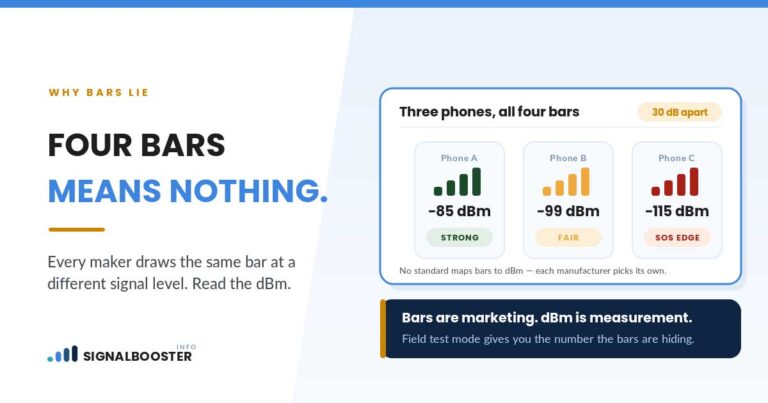
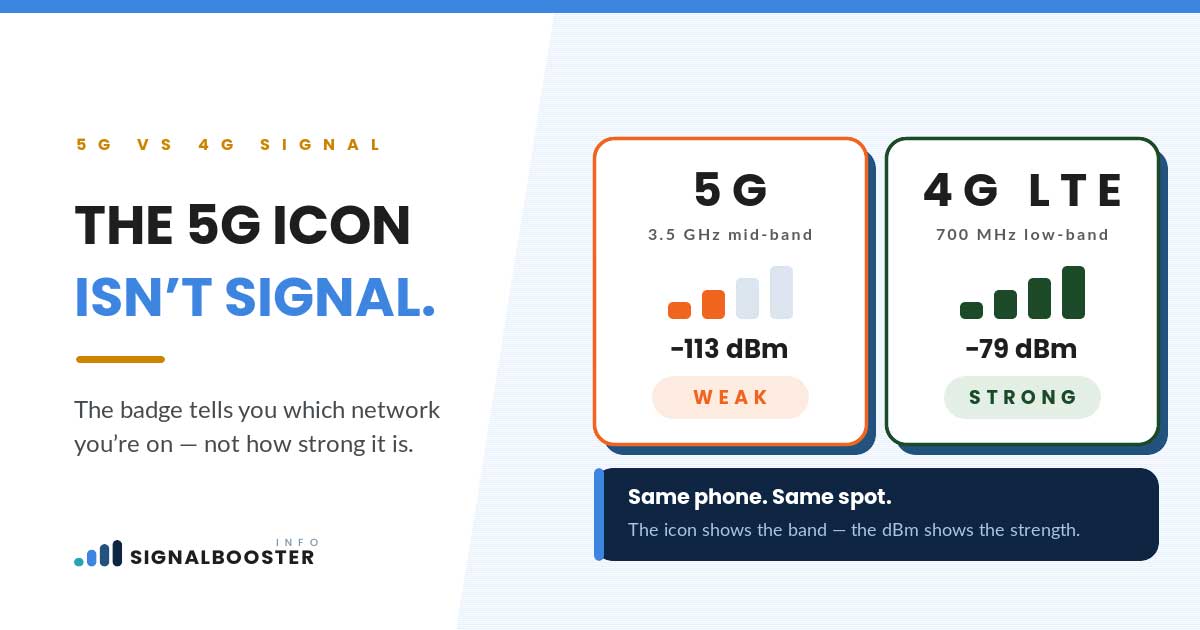
That small letter next to your bars (5G, LTE, sometimes 4G or 3G) and the bars themselves are two separate readouts, not one. The letter tells you which generation of network technology your phone negotiated with the nearest tower at that moment. The bars, or better, the actual dBm reading behind them, tell you how strong that particular connection is. A phone can show “5G” with a weak connection and “LTE” with a strong one, or the reverse, because the letter is a category and the strength number is a measurement, and the two move independently.
This is the same trap this site has covered before with bars themselves: a display that looks like a measurement but is not one. The network-type letter deserves the same skepticism. It answers “what kind of connection,” not “how good is it.”
LTE vs. 4G: Same Thing, Different Name
If you have ever wondered why your phone shows “4G LTE” as one label instead of choosing between the two, it is because the industry blurred a real distinction for marketing reasons.
The International Telecommunication Union (ITU) is the body that defines what counts as a new generation of mobile network technology, under a standard it calls IMT-Advanced for the fourth generation. LTE, the technology carriers rolled out through the early 2010s, did not initially meet that strict definition. Carriers marketed it as “4G LTE” anyway, and the ITU eventually acknowledged that LTE and a few comparable technologies could be called 4G in general use, even though the fully compliant standard is technically LTE-Advanced.
Practically, for a reader trying to diagnose a signal problem, this history does not matter. LTE and 4G are the same connection on your phone today. Seeing one label instead of the other is not a sign that anything changed about your signal.
What Makes 5G Different, Structurally
5G is not one thing wearing one label. Carriers deploy it across several different tiers of frequency, and the icon does not distinguish which tier you actually landed on.
At the low end, 5G runs on spectrum that behaves a lot like LTE: it covers wide areas and gets through walls reasonably well, but the speed gain over LTE is modest. At the high end, 5G runs on spectrum built for capacity and peak speed in dense areas, at the cost of range and building penetration. A phone connected to either one shows the same “5G” on the icon. That single letter is doing the work of describing at least two very different real-world experiences, and your phone does not tell you which one you got.
| LTE / 4G | Low-tier 5G | High-tier 5G | |
|---|---|---|---|
| What it optimizes for | Broad, stable coverage | Coverage close to LTE, a modest speed step up | Peak speed and capacity in dense areas |
| Range and wall penetration | Travels farther, gets through walls reasonably well | Similar to LTE | Shortest range, most easily blocked by walls and glass |
| What the icon shows | “LTE” or “4G” | “5G” | “5G” (same label as low-tier) |
| What that tells you about strength | Nothing on its own | Nothing on its own | Nothing on its own |
This matters for a diagnosis: “I have 5G but my signal is still bad” is not a contradiction. It may simply mean you connected to the wrong tier of 5G for your situation, and the icon has no way to say so.
Why Higher-Frequency Signals Struggle More With Distance and Walls
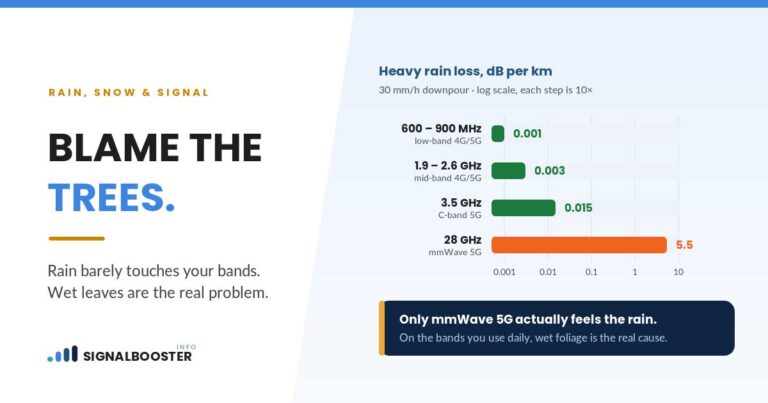
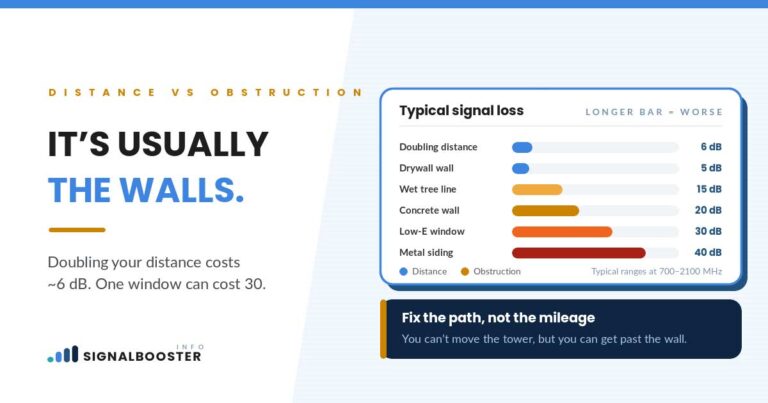
The general rule behind all of this, without attaching a specific number to it: higher-frequency radio signals travel shorter distances and are absorbed or reflected more easily by walls, glass, foliage and even bodies than lower-frequency signals are. That is a property of the physics, not a quirk of any one carrier’s network.
It is the same mechanism this site has already covered for building materials and floor level. Certain wall materials block cell signal more than others regardless of which generation of network is trying to get through them, and some floors in the same building read consistently weaker than others for the same reason: more material, more distance, or a worse angle to the tower.
The practical takeaway is that a high-tier 5G connection is more exposed to this problem than LTE or low-tier 5G. Step into a basement, an interior room, or a building with heavy stucco or concrete, and a high-tier 5G signal is the first one to degrade or drop back to something more stable. That is not a defect. It is the tradeoff that tier of 5G was built with.
Does Switching Network Type Change Your Signal, or Just Your Speed?
Most phones let you manually restrict which network type they connect to, forcing LTE-only instead of letting the phone pick automatically. It is worth knowing this option exists, but it is a diagnostic tool, not a reliable fix.
Here is what it actually does: forcing LTE-only removes a variable. If your connection improves noticeably once you are off 5G, the problem may genuinely be that a high-tier 5G connection is struggling to reach you where 4G’s lower-frequency signal reaches you fine. If nothing changes, the network type was never the issue, and the real cause is distance from the tower, the building itself, or network congestion, none of which forcing a network type fixes.
Either way, a subjective “it feels better” is not enough to act on. Take an actual dBm reading in both states before and after you force the change. Our guide to checking your real signal strength in dBm covers how, on both iPhone and Android, and forcing network type is exactly the kind of before-and-after comparison that method is built for.
When a Weak 5G Reading Is Actually a Good Sign
It sounds backward, but a phone that drops from 5G to LTE on its own, or shows a weak 5G reading, is sometimes doing exactly what it should.
Phones and networks are designed to hand a connection off to whichever available option is currently more stable. If the local 5G signal at your specific spot is weak, an automatic step down to LTE is often the network protecting your call or data session from a connection that was about to get worse, not a sign that something is broken. Fighting that by forcing 5G in a spot where it is genuinely weak can leave you worse off than letting the phone choose.
This is also where the strength-versus-quality distinction from elsewhere on this site applies directly. A weak-but-clean LTE connection can outperform a “stronger-looking” but unstable 5G one in actual usability. If you want the fuller version of that idea, signal strength and signal quality are measured differently, and network type sits on top of both of them as a third, separate variable.
How to Check Which Standard You’re Actually Connected To
The icon is a reasonable starting point, but if you are trying to actually diagnose a problem rather than glance at your phone, go one step further.
Most phones show the current network type in the same settings screens that expose the underlying strength numbers, so checking one costs you almost nothing extra once you are already looking. iPhone’s Field Test Mode and Android’s network status or SIM status screens display both together. If you are testing whether network type is the culprit, write down the type and the dBm reading together, in the same spot, at the same time, rather than trusting a memory of “it seemed better.”
From there, what counts as a good dBm reading tells you whether the number you found is actually a problem worth addressing at all, on either network type. A weak reading on LTE and a weak reading on 5G point to the same underlying cause: distance, obstruction, or tower load, not the label next to your bars. If both readings come back genuinely weak regardless of network type, that is the point where what a signal booster actually does becomes the relevant next question, not before.
FAQ
Does 5G mean stronger signal than 4G or LTE?
No. 5G is a generation of network technology, not a strength measurement. A 5G connection can be weaker than an LTE connection in the same spot, especially if the available 5G is a high-tier band that struggles more with distance and walls.
Why does my phone keep switching between 5G and LTE?
Phones automatically hand off to whichever connection is currently more stable. A weak local 5G signal often triggers an automatic step down to LTE, which is the network protecting your connection rather than a sign of malfunction.
Should I force my phone to stay on LTE only?
It is a useful diagnostic step for isolating whether network type is the source of a problem, not a permanent fix. Compare actual dBm readings with it on and off before deciding it helped.
Is LTE the same as 4G?
Functionally, yes, for everyday purposes. LTE did not originally meet the strict technical definition of 4G set by the ITU, but the two labels are used interchangeably today and describe the same connection on a modern phone.
Will a signal booster fix a weak 5G connection?
It depends on why the signal is weak, not on which network type is involved. If the underlying dBm reading is genuinely weak because of distance or building obstruction, bringing outdoor signal inside can help regardless of network type. If the reading is fine and the complaint is speed or stability, network type or tower congestion is the more likely cause, not weak signal.