Yes, and it does it for a reason worth understanding: a wideband booster amplifies frequency bands, not accounts. It has no idea which carrier a phone is on. It takes in everything present on the bands it is built and certified for, amplifies it, and rebroadcasts it, so every phone in the house that is using one of those bands benefits at the same time. A household with one person on each of three carriers can be served by one unit, simultaneously, with no per phone setup at all.
The limits are real but they are not the ones people expect. The question is never "does it support my carrier". It is "does it support the bands my carrier uses here, and is the outside antenna hearing that carrier's tower".
The mechanism, stated properly
A cellular signal booster is a repeater. An outside antenna collects signal, an amplifier increases it, and an inside antenna rebroadcasts it, with the same thing happening in reverse for what your phone transmits back. Our overview of what a signal booster is covers the component chain.
Nothing in that chain reads a SIM card. The amplifier is a radio frequency device that operates on ranges of spectrum. Carriers hold licenses to specific ranges, so amplifying a range amplifies whichever licensee is using it in your area. That is why "multi carrier" and "carrier agnostic" describe the same physical behavior, and why they are the default rather than a premium feature on consumer equipment.
The regulatory design reflects this directly. The FCC's consumer signal booster rules at 47 CFR 20.21 recognize two consumer classes: Wideband Consumer Signal Boosters, which amplify across a broad set of bands, and Provider-Specific Consumer Signal Boosters, which are frequency selective and intended for a single provider's spectrum. If you buy a consumer kit off a shelf and it does not carry a single carrier's branding, it is almost certainly the wideband kind, and the wideband kind is the one that serves a mixed household.
For the pre-purchase version of this question, meaning "will this work with the carrier I personally have", we cover it separately in does a signal booster work with every carrier. This page is about running one system for several carriers at once.
Where the promise actually stops
Three limits, in the order they bite.
Limit one: bands the unit does not cover. This is the honest ceiling on the whole idea. As published in the Code of Federal Regulations, consumer signal boosters under 47 CFR 20.21 operate on frequencies in Part 22 (Cellular), Part 24 (Broadband PCS), Part 27 (which includes AWS-1 and the 700 MHz bands) and Part 90 (Specialized Mobile Radio). Spectrum outside those parts is outside what a consumer booster is authorized to amplify, and a given unit covers only a subset of what is authorized. If one member of your household is relying on a band your kit does not support, their phone gets nothing from the system while everyone else's improves.
Do not accept "works with all carriers" as a specification. Check the band list in the manufacturer's own documentation for the exact model, then check which bands your carriers actually use at your location. A phrase on a box is marketing. A band list in a manual is a specification.
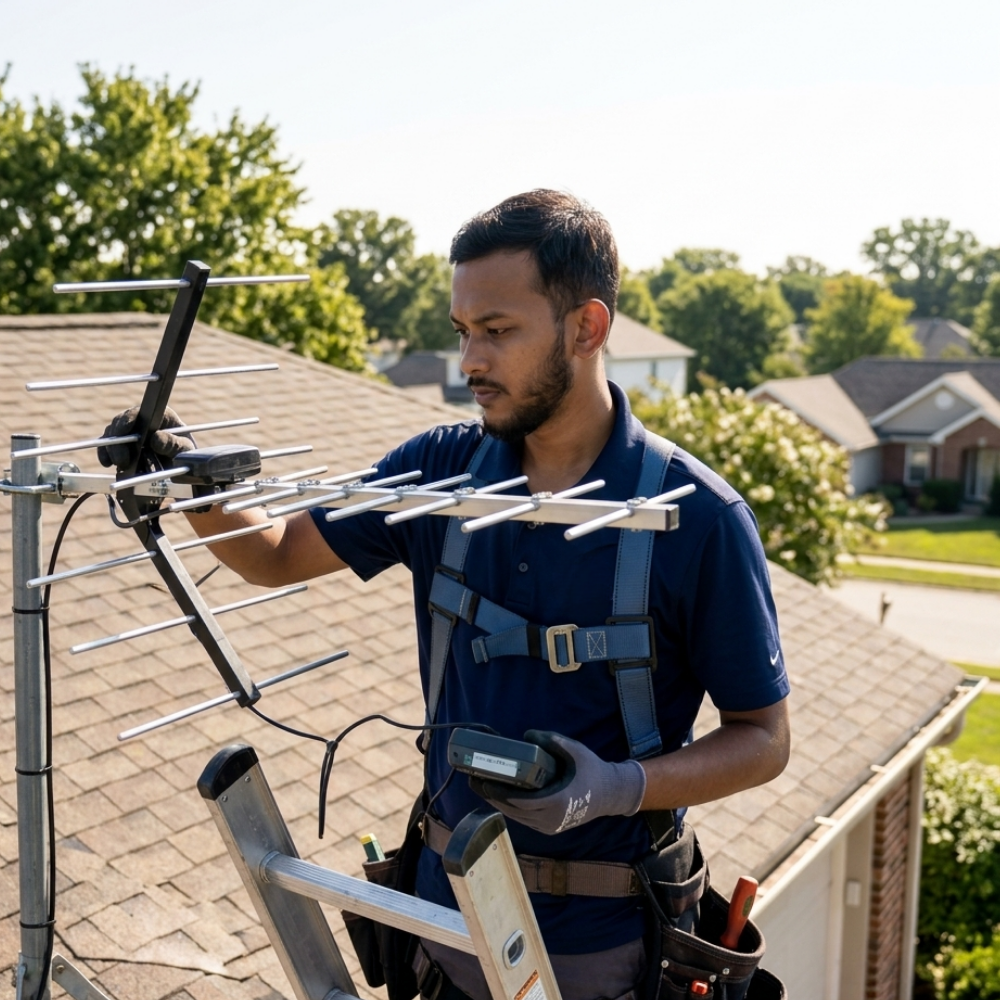
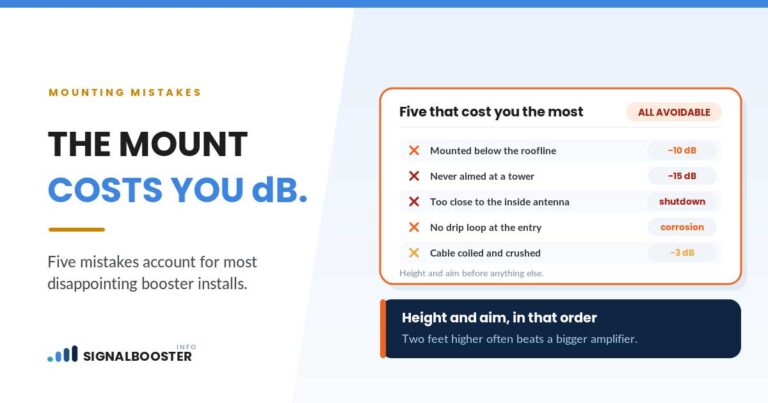
Limit two: the donor antenna is aimed somewhere. This one catches mixed households more than any other. A directional outdoor antenna has to point at a tower, and carriers do not share tower sites everywhere. If the best signal for one carrier comes from the north and the best for another comes from the southwest, aiming for one can leave the other with a weak donor signal, and the booster cannot amplify what it barely receives. Finding out where each carrier's serving site actually is, using the methods in how to find your nearest cell tower, is what turns this from a surprise into a design decision. Sometimes the answer is a compromise aim. Sometimes it is an omnidirectional outdoor antenna, which hears all directions at lower gain.
Limit three: a strong carrier can crowd a weak one. Boosters have automatic gain control, and the unit reduces gain when an input is strong to stay within its noise and power limits. A very strong donor signal from one carrier can cause the system to turn itself down on that band. The unit is protecting the network, which is exactly what it is certified to do, but the practical effect is that the carrier you were trying to help may see less improvement than expected.
What each carrier's users will and will not notice
| Situation | What the mixed household sees |
|---|---|
| All carriers' bands supported, one tower direction | Everyone improves together, no per phone setup |
| Bands supported, towers in different directions | Whoever the antenna is aimed at improves most, the others improve less |
| One carrier using a band the kit does not cover | That carrier's users get no benefit at all, and nothing is wrong with the kit |
| Voice improves, data does not, for one carrier | Usually band specific, since voice and data may ride on different bands |
| Outside signal already strong for one carrier | Automatic gain control may reduce output on that band |
The fourth row is common enough to have its own page: when a booster helps calls but not data explains why a partial improvement is a band story rather than a fault. And if only some people in your area have the problem in the first place, why a neighborhood can have weak signal on one carrier is the diagnostic that comes before buying anything.
The registration question a mixed household has to answer
This is the part that genuinely differs from a single carrier install, and most pages skip it.
Under 47 CFR 20.21, a subscriber in good standing may operate a certified consumer booster under their provider's authorization, having obtained the provider's consent and registered the device before operating it. The registration record covers the owner's name, the make, model and serial number, the location and the date the unit goes into operation. Boosters marketed since March 1, 2014 carry a label that states the requirement in plain terms: register with your wireless provider and have your provider's consent before use.
In a household with three carriers, the unit is amplifying three licensees' spectrum. The consistent reading of that rule is to register the unit with each carrier whose subscribers it serves, rather than only the one whose name is on your own bill. Registration is free and takes minutes, and it costs nothing to be thorough. The full legal picture, including what the major carriers have consented to, is on our page on whether a signal booster is legal, which is the page to read before you buy rather than after.
Two other conditions in the same rule matter here. A wideband consumer booster must be operated for personal use only, and it may only be sold to the general public on that basis. And on request from an FCC representative or a licensee experiencing harmful interference, the operator must switch the unit off immediately or as soon as practicable. If you are running one system for a household, you are the operator for all of it.
All of this is United States law. If your home is in another country, the equivalent rules come from your national regulator, and in several countries operating a repeater without the network operator's authorization is not permitted at all. Do not carry a US answer across a border.
When one booster is the wrong answer for multiple carriers
There is a class of installation where the answer changes, and it is worth naming so nobody buys the wrong thing.
A large building serving many users across several carriers is not a consumer booster problem. 47 CFR 20.21 also provides for Industrial Signal Boosters, which an individual or organization may operate if they hold an FCC license or have obtained express consent from the licensees affected. That is a different device class, a different consent process, and a professionally designed and installed system rather than a retail kit. If a supplier is quoting you a multi carrier system for an office building or a large property, that is what you are being quoted, and the professional installation is part of the product rather than an upsell.
For a house, a consumer wideband kit is the right category. For a commercial building, it is not, and buying several consumer kits to cover one is not a substitute.
The honest summary
One booster covering several carriers is normal, expected and designed in, because the amplifier works on spectrum rather than on subscriptions. Your two real questions are whether the bands your carriers use at your address are on the unit's own band list, and whether one outdoor antenna position and aim can hear all of those carriers well enough to be worth amplifying. Answer those before you buy, register the unit with each carrier it serves, and the mixed household case takes care of itself.
FAQ
Will one signal booster work for AT&T, Verizon and T-Mobile at the same time?
A wideband consumer booster amplifies the bands it supports regardless of which carrier is using them, so several carriers can benefit at once. The condition is that the bands each carrier uses at your location are on that specific unit's band list.
Do I need a separate booster for each carrier in the house?
Usually not. A separate unit only makes sense if one carrier depends on a band your kit does not support, or if the carriers' towers are in directions that no single outdoor antenna position can serve.
Does everyone in the house have to register the booster?
The rule requires the provider's consent and registration of the device before it is operated. Because the unit amplifies each carrier's licensed spectrum, the consistent course in a mixed household is to register it with each carrier whose subscribers it serves.
Why does the booster help one carrier much more than another?
The usual reasons are band coverage, antenna aim, and automatic gain control. A directional outdoor antenna aimed at one carrier's tower will collect that carrier's signal best, and the unit may reduce gain on a band where the incoming signal is already strong.
Is a multi carrier booster more expensive than a single carrier one?
This site does not publish prices, since they date immediately. What is worth knowing is that wideband multi carrier operation is the standard behavior of consumer kits rather than a premium feature, so it is not usually the thing you are paying extra for.
Where this comes from. The device classes, the covered frequency parts, the personal use condition, the registration and consent requirements, the shutdown obligation and the industrial booster provision are all from 47 CFR 20.21 as published in the Code of Federal Regulations, and apply in the United States. No band numbers, coverage figures or carrier specific claims beyond that rule are stated here, because they vary by model and by location and this site has not tested any unit.