Yes, antenna mounting height usually matters more for a rural signal booster than for a suburban one, but not for the reason most people assume. Height does not add range. It buys clearance: it lifts the outdoor antenna over the tree lines, barns and rolling ground that sit between a farmhouse and a distant tower. In a suburb the tower is often closer and the obstructions are smaller, so a few feet change less. On a farm, a few feet can decide whether the antenna sees a usable signal at all. The only way to know is to measure in dBm at each candidate height before you mount anything.
This guide explains what height actually fixes, where it stops helping, and where the job stops being a do-it-yourself task.
Why Height Pays Off More on a Farm
A signal booster can only amplify what its outdoor antenna receives. If the antenna sits in a weak or cluttered spot, the booster amplifies weak, cluttered signal. That is the same on every property. What differs between a farm and a suburb is what stands in the way.
In a typical suburb, the nearest tower tends to be closer, and the things between you and it are houses and street trees of similar height. Moving the antenna from the eave to the roof peak may change very little because the path was already short and fairly open.
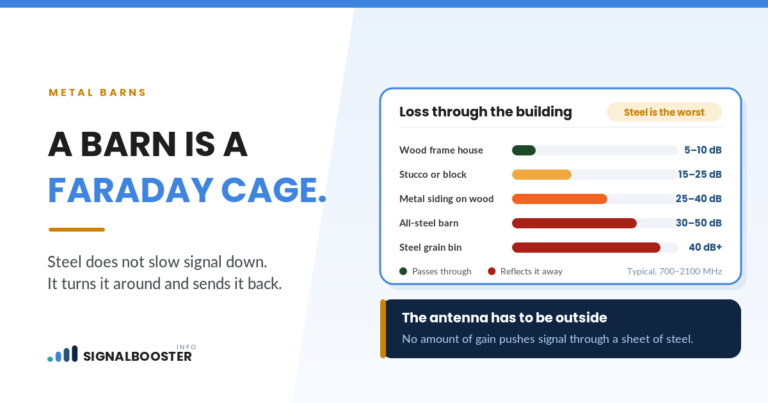
On a farm, the path to the tower is usually longer, and it crosses whatever the land holds: windbreaks, a wooded creek bottom, a hill, a grain bin, a metal machine shed. Each of those can block or weaken the signal before it reaches your antenna. Raising the antenna above them can turn a blocked path into a clear one. That is why the same added height can mean a large improvement on one rural property and almost none on a suburban lot.
What Height Fixes, and What It Cannot
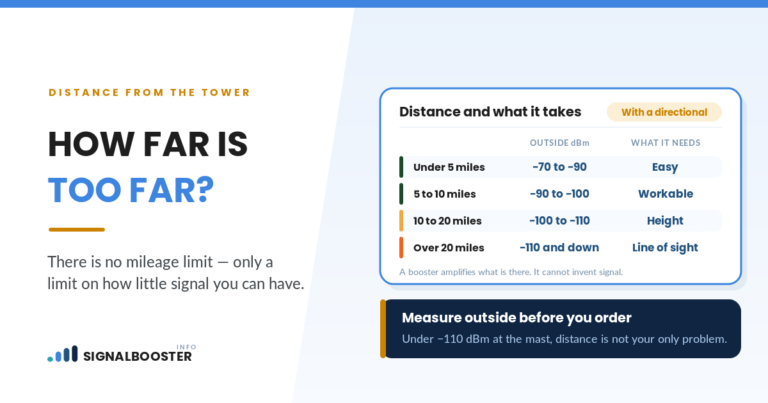
Height solves an obstruction problem. It does not solve a distance problem on its own.
Height helps when:
- A tree line, outbuilding or nearby rise sits between the antenna and the tower, and the antenna can be raised above it.
- The signal at your roofline is present but noisy, and a higher spot gives a cleaner reading.
- You need more vertical separation between the outdoor and indoor antennas (more on that below).
Height does little when:
- A large hill or ridge blocks the tower. A few more feet of mast will not see over a hill that rises well above your house.
- The ground between you and the tower is already flat and open. If the path is clear at the eave, going higher may add almost nothing.
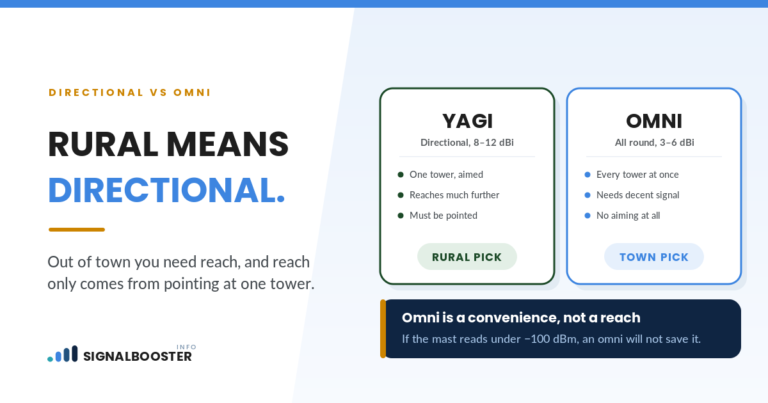
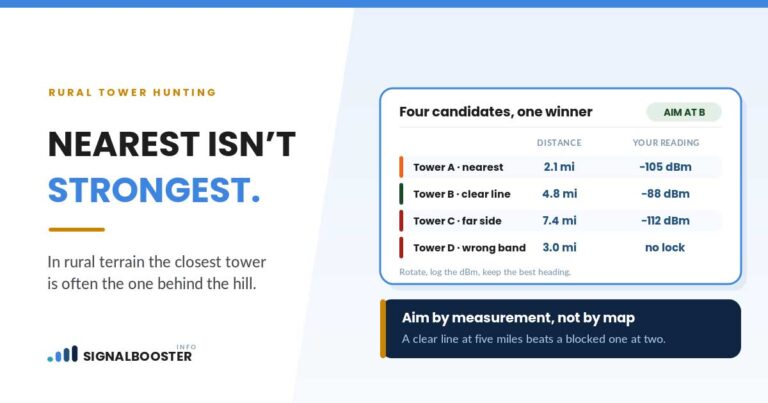
- The real problem is aim. A directional antenna pointed at the wrong tower will not be rescued by height. Start by working out which cell tower to aim at from a rural property, then think about height.
Seasons matter too. Leaves add loss in summer that bare branches do not in winter, so a test done in January can look better than the same spot in July.
Farm vs. Suburb: Where Height Moves the Needle
| Factor | Typical suburb | Typical farm or rural property |
|---|---|---|
| Distance to serving tower | Often shorter | Often longer |
| Main obstructions | Neighboring houses, street trees | Tree lines, hills, metal barns, grain bins |
| What extra height usually buys | Small change once above the roofline | Can be the difference between blocked and clear |
| When height will not help | Signal already strong at the eave | A hill or ridge far taller than any practical mast |
| Space for antenna separation | Tight lot, limited options | More room, but long cable runs |
| Lightning and wind exposure | Surrounded by similar structures | Antenna may be the tallest object around |
These are general patterns, not rules. Your own measurements decide which column you are really in.
Antenna Mounting Height for a Rural Signal Booster: Find It With dBm
The honest way to choose a height is to measure signal at each spot you could safely mount the antenna, then compare. Bars are not a measurement. Your phone’s field test or status screen shows signal strength in dBm (often labeled RSRP on LTE and 5G), and many phones also show a quality figure such as SINR or RSRQ.
A practical sequence:
- Take a baseline at ground level outside, on the side of the house that faces the tower you plan to use. Write down the dBm reading and the band if your phone shows it.
- Repeat at each candidate mounting spot you can reach safely: a second-floor window facing the tower, the gable end, the attic. Let each reading settle for a minute, then record it.
- Compare the numbers, not the feel. A reading closer to zero is stronger. Also watch the quality figure: a slightly weaker but cleaner signal can outperform a stronger, noisier one.
- Look for the point where readings stop improving. If the attic and the gable read about the same, the extra height is not buying you anything.
- Only then decide whether a mast is worth it, and if it is, who should put it up.
The manufacturer’s own installation guide follows the same logic. The weBoost Metal Building 100 installation guide, which we read on September 23, 2026, tells installers to walk the building testing signal and to check “higher points like the roofline,” noting that this “will often provide the best results as it clears obstructions.”
Where More Height Stops Helping
This is the part booster sellers rarely spell out. Higher is not automatically better, and several limits arrive at once.
The manufacturer may set a ceiling. The same weBoost guide states: “The Outside Antenna must be installed no higher than 10 meters (31 feet 9 inches) above ground.” Not every kit carries the same wording, so read the manual for your booster before you plan a tall mast. A consumer booster is certified as a kit, and the kit’s instructions are part of how it is meant to be used.
Longer cable costs signal. A taller mast usually means a longer coaxial cable run, and every foot of coax loses some signal. Past a certain point, the cable loss can cancel the gain from the extra height. The FCC’s required consumer booster label also says you must operate the device “with approved antennas and cables as specified by the manufacturer,” so swapping in a longer or different cable to reach a taller mast is not a free choice.
Tall and exposed means more risk. On open land, a mast-mounted antenna may be the tallest thing around. That raises wind load and lightning exposure, which is why a tall rural install should include lightning protection for the outdoor antenna and a properly grounded mast.
Height and Separation Work Together
Height has a second benefit that has nothing to do with the tower: it helps keep the outdoor antenna away from the indoor antenna. If the two are too close, the booster picks up its own output, a feedback loop called oscillation, and it reduces its gain or shuts down to protect the network.
Vertical distance is often easier to gain than horizontal distance, because floors and roofs between the antennas add isolation. The weBoost Metal Building 100 guide, for example, asks for “a minimum of 60 ft horizontal or 25 ft vertical separation between the outside and inside antennas.” Other kits list different figures, and higher-gain boosters generally need more room. Our guide to antenna separation distance for a signal booster covers how to measure it and what to do when your house is too small to hit the number.
On a farm, this is a real reason to go up rather than out: a gable or roof pole puts a floor and a ceiling between the two antennas without a long horizontal cable run.
Roof, Attic or Mast?
Most rural installs end up in one of three places.
- Attic. Easiest and safest, and it keeps the antenna out of the weather. The roof material costs you signal, and metal roofing or foil-backed insulation can cost you a lot. Measure in the attic before you rule it in or out.
- Gable end or roof pole. The common middle ground. It usually clears the house itself and gives decent vertical separation.
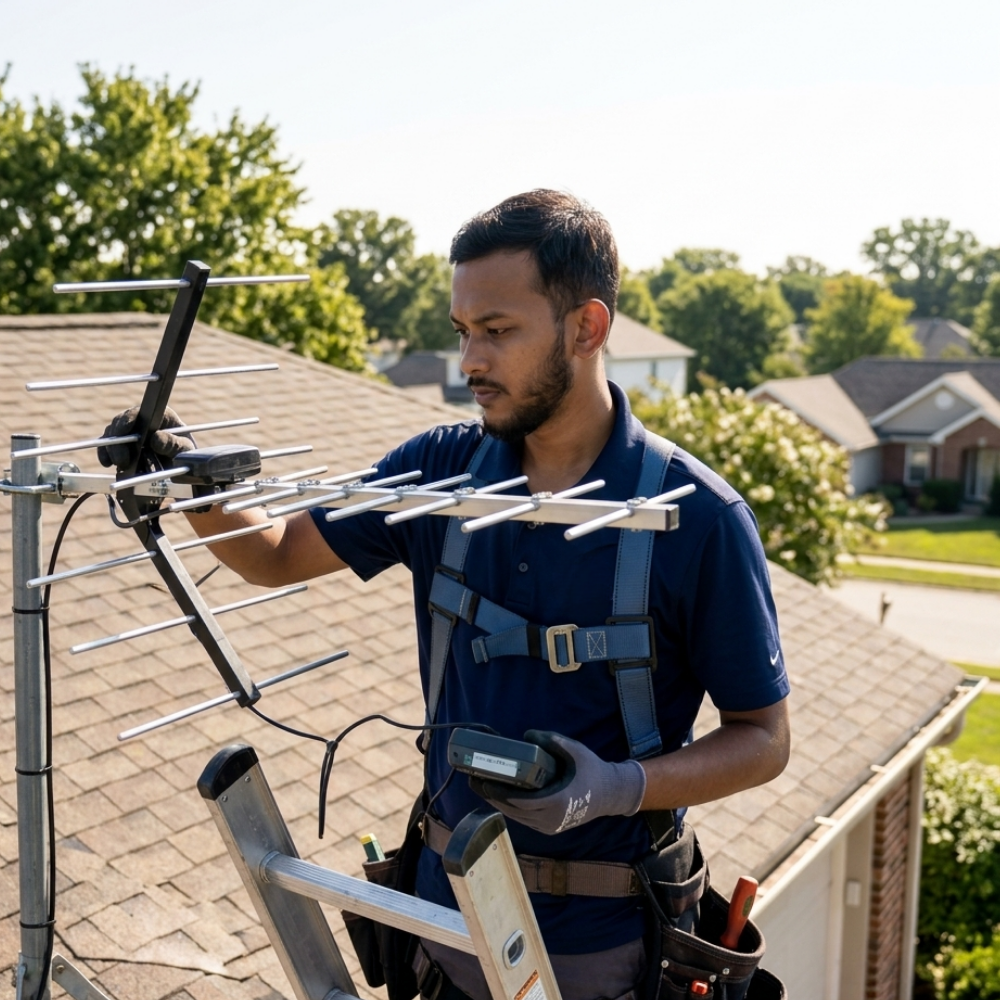
- Freestanding mast or tower. The option for properties where a tree line or outbuilding blocks everything at roof height. It is also the option with the most risk to the installer.
For a side-by-side look at the first two, see attic mount vs. roof mount for a signal booster antenna. Whichever you choose, the measured dBm at that exact spot should make the decision, not the height alone.
Safety: When This Stops Being a DIY Job
Raising an antenna puts two hazards in play: falls and power lines. Treat both as stop conditions, not as footnotes.
Power lines. The U.S. Consumer Product Safety Commission’s 2002 electrical safety alert, which we read on September 23, 2026, reported that between 1990 and 1998 more than 300 people in the U.S. were electrocuted when an antenna or pole they were holding touched a high-voltage power line. The same alert advises keeping the distance from an antenna or pole to the power line at least 1½ times the height of the antenna or pole, and grounding masts according to electrical codes.
Falls. If you do use a ladder for a low, reachable mounting spot, OSHA’s portable ladder guidance calls for three points of contact (two hands and a foot, or two feet and a hand) while climbing, a stable and level base, and never standing on the top rungs.
Stop here and hire a professional installer if:
- Any overhead line, including the service drop to your house, is closer to the mounting spot than 1½ times the height of the antenna and mast.
- The job puts you on the roof surface, on a ladder above a single-story eave, or raising a mast or tower of any height.
- The mast would need guy wires, a concrete base or a new ground connection.
If anything you are holding starts to fall toward a line, let it go and move away. If any part touches a line, do not touch it; call your utility.
FAQ
How high should I mount a signal booster antenna on a farm?
There is no single correct height. Mount it at the lowest safe spot that gives a clear path past your nearest obstructions, confirmed by a dBm reading. Check your booster’s manual for any maximum height, since some kits set one.
Is higher always better for an outdoor booster antenna?
No. Height helps until the antenna clears nearby obstructions. After that, extra height adds cable loss, wind load and lightning exposure without improving the reading. If your measurements stop improving, stop going up.
Will a taller mast fix signal blocked by a hill?
Usually not. A mast can clear trees and buildings, but a hill that rises far above your house will still block the path. In that case, aiming at a different tower is often the better fix.
Can I install a tall antenna mast myself?
Low, reachable spots such as an attic or a window-height wall mount can be a DIY job. Roof work, masts and towers carry fall and power-line hazards, and they belong with a professional installer.