Yes. A metal barn or steel-clad pole building usually blocks far more cell signal than a typical wood-frame house, because its roof and walls are continuous sheets of steel that reflect radio energy instead of letting it pass. A house loses some signal through its materials; a fully sheeted metal barn can lose most of it. The useful part of this signal booster metal barn guide is that a booster never needs signal to get through the metal. It collects signal outside, carries it in on coax, and rebroadcasts it inside. What decides success is the signal at the outside antenna, measured in dBm.
Why a Metal Barn Behaves Differently From a House
Cell signals are radio waves, and most building materials let at least some of that energy through. Wood framing, drywall, and vinyl or wood siding are relatively transparent. That is why a lot of farmhouses have usable signal in most rooms even when coverage outside is only fair.
Houses do have weak points. Low-E coated windows, foil-faced insulation, stucco over metal lath, and metal roofing all cut signal, and a house with several of these can have real dead zones. But those materials are usually mixed in with ones that signal passes through, so something gets in.
A metal barn is built the other way around. The roof is steel panel, the walls are steel panel, and the panels overlap and are screwed together into a nearly continuous shell. As weBoost puts it in its guide to boosting cell signal in a metal building (read September 23, 2026), metal is an excellent conductor, which means it can effectively block or disrupt radio waves. People often call a steel building a Faraday cage. It is not a perfect one, because doors, vents and panel seams leave gaps, but for your phone the practical result is similar: very little usable signal inside.
| Feature | Typical wood-frame house | Metal barn or pole building |
|---|---|---|
| Roof | Asphalt shingle over wood deck, sometimes metal | Steel panels, often with no gaps |
| Walls | Wood studs, sheathing, siding, drywall | Steel panels on wood posts or steel girts |
| Windows | Many, some with coated glass | Few or none |
| Insulation | Often fiberglass or cellulose | Sometimes foil-faced or reflective, which adds another metal layer |
| Openings | Small, mostly closed | Large sliding or roll-up doors, sometimes open all day |
| Typical inside result | Weaker than outside, often still usable | Often much weaker, sometimes nothing near the center |
Where Signal Leaks Into a Metal Barn
If you have ever noticed that your phone works by the big door and dies halfway down the aisle, you have already mapped your barn’s leaks. Common ones include:
- Large doors. An open sliding or overhead door is a big hole in the shield. Signal near it can be close to what you get outside.
- Translucent panels. Fiberglass or polycarbonate skylight strips in the roof or walls let light and radio signal through.
- Open eaves and gable vents. Gaps where the roof meets the walls, or vented gable ends, let some signal in.
- Mixed construction. A pole barn with a metal roof but wood or fiber cement siding is far less of a shield than a building sheeted in steel on every face.
- Open-front sheds. A three-sided equipment shed is barely a shield at all toward its open side.
These leaks matter twice. They explain why coverage inside is patchy rather than uniform, and, as the next section explains, they are where a booster system can leak back out.
The Part Most Guides Skip: The Metal Can Help Your Booster
Every booster has one physical limit that matters here: isolation. A booster listens through the outside antenna and rebroadcasts through the inside antenna. If the inside antenna’s signal reaches the outside antenna strongly enough, the booster starts amplifying its own output. That loop is called oscillation. Boosters are designed to detect it and cut their gain or shut down, and either way your coverage suffers. The full background is in our guide to antenna separation distance for a signal booster.
In a house, you usually get isolation through distance: the outside antenna goes high on the roof and the inside antenna goes low and far away. Booster makers also recommend putting a dense physical barrier, such as a metal sheet, between the two antennas. Vehicle boosters rely on the same idea, with the car’s metal roof sitting between the antennas.
A metal barn already has that barrier built in. The same steel shell that kills your signal indoors also helps keep your indoor antenna’s output from reaching the outside antenna. That is one reason a metal building is not a bad place for a booster, even though it is a bad place for a phone.
The catch is the leaks. If the indoor antenna points at a translucent roof strip, an open gable, or a door that faces the outside antenna, you are handing that isolation back. Aim the indoor antenna into the building and away from any gap that looks toward the outside antenna’s position.
Measure in dBm Before You Buy Anything
Bars are a phone’s rough summary, and different phones draw them differently. dBm is the actual received signal level. It is always a negative number, and the more negative it is, the weaker the signal. Most Android phones show it in the settings under About phone and SIM status. iPhones have a Field Test mode that shows it, though the menu layout changes between iOS versions.
Take readings at three places, for each carrier you care about:
- Inside, where you need coverage. The center of the barn, the office corner, the milking parlor, wherever phones actually get used.
- Outside, at ground level, a short walk from the building on the side facing your nearest tower.
- As high as you can safely reach from the ground, such as an upstairs window in the house or the top of a stepladder standing on firm, level ground. Do not climb onto the roof to take a reading.
Signal moves around, so stand still and watch each reading for a minute or two, then write down the range you see rather than one number. Write down which carrier, and note the time.
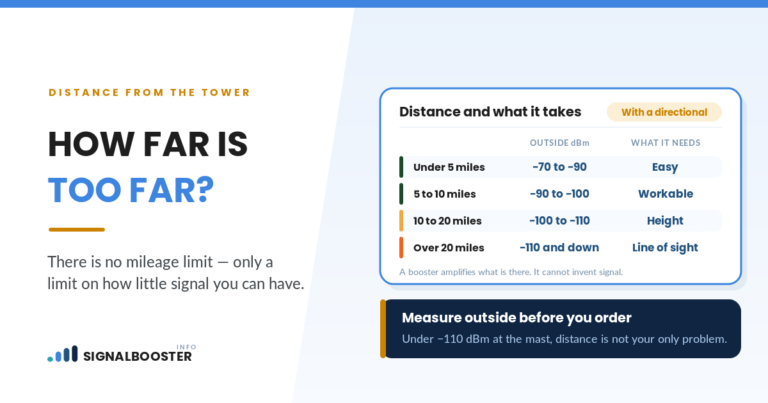
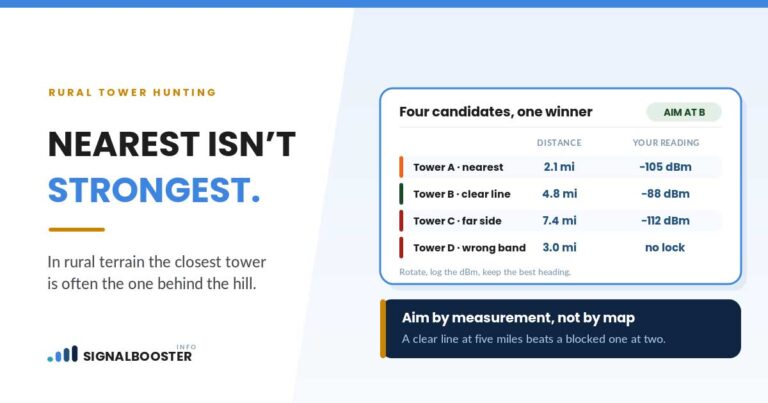
Those numbers answer two separate questions. The gap between the inside and outside readings tells you how much the building itself costs you. The outside reading at height tells you whether a booster has anything to work with. A booster amplifies what the outside antenna receives; it cannot create signal that is not there. If the outside reading is poor even at height, work out where your tower actually is before spending money. Our guide to finding your nearest cell tower in a rural area walks through the tools for that.
Signal Booster Metal Barn Setup: What Changes Compared With a House
The parts are the same as in any home booster: an outside antenna, coax cable, the booster unit, and one or more inside antennas. What changes is where each one can go.
The outside antenna has to be outside the steel
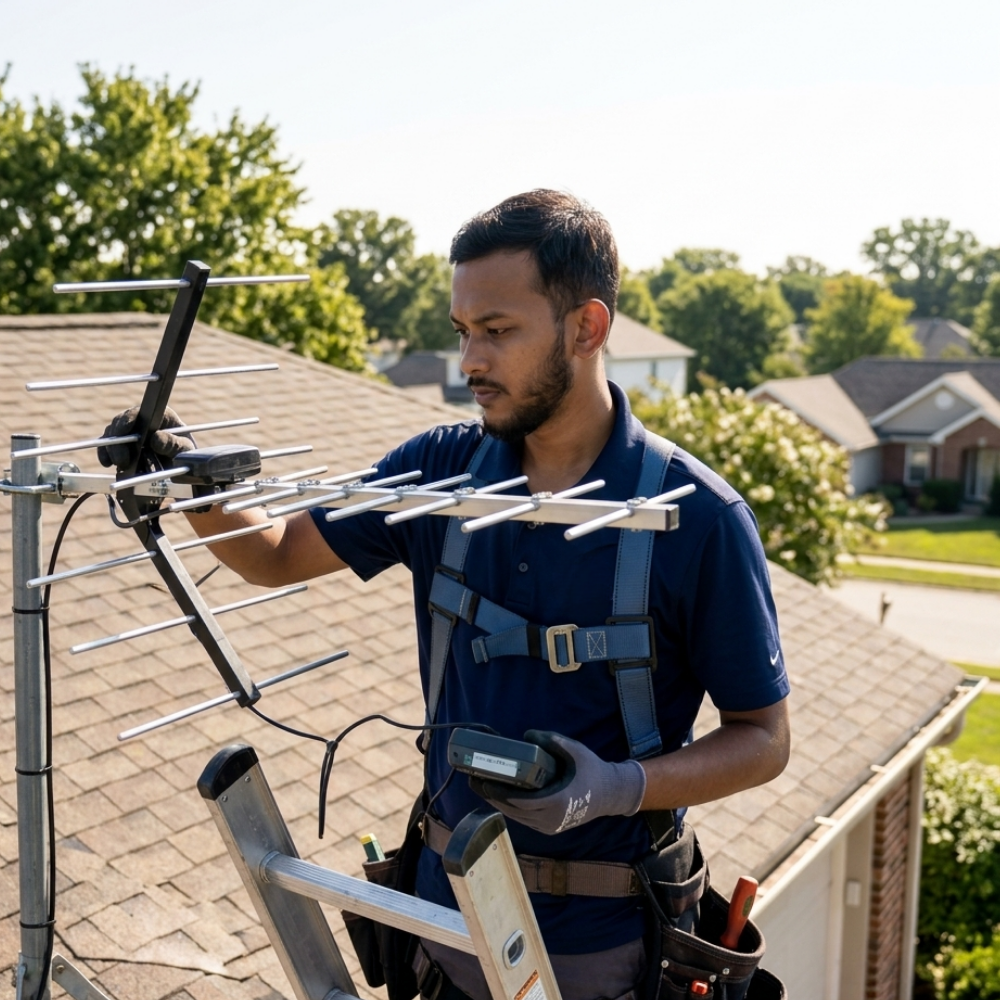
In a house with a shingle roof, some people put the outside antenna in the attic. Under a steel roof, that is not an option, because the antenna would be inside the shield. It has to sit above or beside the roofline with a clear line toward the tower. We compare the tradeoffs in attic mount vs. roof mount for a signal booster antenna, and in a metal barn the answer is settled: outside mount only.
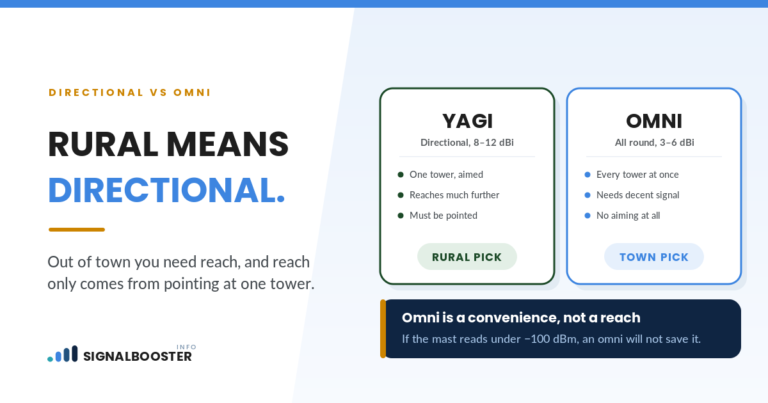
For many barns, a mast on the gable end wall is more practical than a mount through the roof panels, because every hole in a metal roof is a leak point. Rural barns far from a tower usually call for a directional antenna aimed at the specific tower you identified, rather than an omnidirectional one.
Getting the cable through the wall
The coax has to pass through the metal shell somewhere. Plan the entry point before you drill:
- Check for electrical runs, conduit, and water lines on the inside of the wall first. Barns often have wiring stapled along posts and girts, right where you would drill. Turn off the circuit if you are drilling near wiring and are not certain where it runs.
- Use a proper wall entry fitting and weatherproof sealant so rain does not follow the cable inside.
- Protect the cable inside the barn. Rodents chew coax, and livestock can rub or pull on anything within reach. Run it high and in conduit where animals are housed.
- Keep the run as short as the layout allows. Coax loses signal over its length, so a booster in the middle of a long building with a long cable run starts at a disadvantage.
The inside antenna in a tall, open space
Barns tend to be tall, open, and long. A panel antenna mounted high and aimed down the length of the aisle often suits that shape better than a ceiling dome designed for a room with an eight-foot ceiling. Aim it away from doors and translucent panels that face the outside antenna. Expect the strongest coverage near the inside antenna and a fade toward the far end, and treat the coverage area printed on a box as a best case measured in conditions that may not match your barn.
Lightning and grounding
An antenna mast on a tall building in an open field is exposed. Grounding and surge protection belong in the plan from the start, not after the first storm. See our guide to lightning protection for an outdoor booster antenna for the details.
Roof and Mast Work: Where to Stop
Metal roofs are slippery, especially with dew, frost, rain, or dust on them, and barn roofs are often high and steep. A fall from a barn roof can kill you. Many barns also have an overhead power line running to them, and a mast or antenna that touches a line while you are holding it can electrocute you.
Stop and hire a professional installer if any of these apply:
- The job needs you to stand or walk on the roof.
- The mounting point is higher than you can reach safely from a properly footed ladder.
- Any power line is near the building, near the mast location, or near the path you would carry the mast along. A mast should be placed so it could not touch a line even if it fell over in any direction.
- You would be working alone.
A professional installer also brings the right equipment for a tall mast and knows how to ground it properly, which matters more on an exposed farm building than on a sheltered house.
When a Booster Is Not the Right Fix
A booster is not the only answer, and sometimes it is the wrong one:
- The barn already has internet. If a wired line or wireless bridge reaches the barn, Wi-Fi calling on your phone may solve the problem for less money and less work. The same metal that blocks cell signal blocks Wi-Fi, so the access point needs to be inside the barn.
- The outside signal is poor even at height. A booster works with what it receives. If the outside readings are barely usable, find the tower and check whether a directional antenna aimed at it improves them before buying the rest of the system.
- You have cellular-only devices. Gate controllers, livestock cameras, and some monitoring equipment connect only over the cell network. For those, a booster, or a cellular router with its own outside antenna, is often the practical route.
If you do install a booster, it must be a consumer booster that carries the FCC label, and it must be registered with your wireless provider. The FCC’s Consumer Signal Boosters guidance (read September 23, 2026) says you should register before turning the booster on, that registration is free, and that if the FCC or any wireless provider tells you the booster is causing interference, you must shut it down until the problem is fixed.
Frequently Asked Questions
Will a signal booster work inside a metal barn?
Yes, as long as there is usable signal outside where the antenna goes. The booster carries that signal through the metal on coax, so the steel shell does not stop it. Measure the outside signal in dBm first, because a booster cannot amplify signal that is not there.
Is a pole barn with wood siding better for signal than an all-metal building?
Usually, yes. A pole barn with a metal roof but wood or fiber cement walls lets some signal in through the walls. A building sheeted in steel on every side blocks much more. Test inside both ways before deciding you need a booster.
Can I put the outside antenna in the barn loft?
Not under a steel roof. The loft sits inside the metal shell, so an antenna there hears roughly what your phone hears. The outside antenna needs to be mounted outside the steel, above or beside the roofline, with a clear line toward the tower.
Does leaving the big door open help?
It helps your phone near the door, because the opening lets signal in. With a booster running, an open door facing the outside antenna can also let the indoor antenna’s signal leak back out and reduce isolation, so aim the indoor antenna away from large openings.
Do I need to register a booster I use in a barn?
Yes. Under FCC rules, a consumer booster needs to be registered with your wireless provider before you turn it on, wherever it is installed. Registration is free.