One booster can serve more than one building, but only in a narrow set of conditions. The amplified signal has to travel through coax and usually a splitter to reach an inside antenna in the second building, and every foot of cable and every split takes decibels away. A signal booster multiple buildings setup works when the buildings are close, the outside signal is usable and the cable run is short. When the barn or shop is far from the house, or the outside signal is weak, a separate booster in each building is usually the more reliable answer.
That is the short version. The rest of this guide shows you how to work out which side of the line your property falls on, using your own measurements and published cable specs instead of guesswork.
Why a booster does not “reach” across the yard
A consumer cell booster is a closed chain: an outside (donor) antenna picks up the tower signal, coax carries it to the amplifier, and more coax carries the amplified signal to an inside antenna that rebroadcasts it into the room. The inside antenna covers the space around it, and walls, metal siding and distance shrink that space quickly.
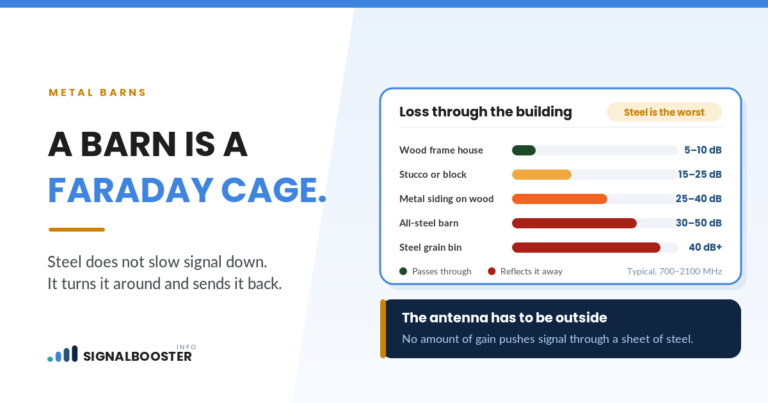
So a booster in the house does not throw signal out to the barn. The only way the barn benefits is if it has its own inside antenna, fed by a cable that runs all the way from the amplifier. That cable run is the whole question. Metal pole barns and steel shops make this more pronounced, because the metal shell blocks most signal from the outside, which means the barn needs an inside antenna under its own roof to get any benefit at all.
It also means the question is not really “how big is my booster’s coverage claim.” It is “how much signal will still be left by the time it reaches the inside antenna in the second building.”
The loss budget: cable plus splitter
Two things eat signal between the amplifier and a distant inside antenna.
The splitter. To feed an antenna in the house and another in the barn from one amplifier, you split the output. A two-way splitter divides the power roughly in half, which is about 3 dB. The weBoost Splitter -3 dB 2 Way (F-Female) spec page, which we read on September 23, 2026, lists that part at -3 dB attenuation across 700 to 2700 MHz at 75 ohms, and describes it as sending “equal amounts of signal” to multiple antennas for similarly sized areas. That last phrase matters: an equal split suits two similar rooms, not a large house and a small tack room.
The coax. Cable loss rises with length and with frequency. A cable guide published by the booster retailer SignalBooster.com, read on September 23, 2026, lists per-100-foot loss of about 4.5 dB at 700 MHz and 6.5 dB at 2100 MHz for RG11, and about 3.5 dB at 700 MHz and 6 dB at 2100 MHz for Wilson 400 cable. Your cable’s own spec sheet is the number to use for your plan, because figures vary by brand.
How to run the numbers for your layout
You do not need a signal meter to do the arithmetic, only a tape measure and the spec sheets for the parts you would actually buy.
- Measure the real cable path from where the amplifier would sit to where the barn’s inside antenna would hang. Include every drop down a wall, every trench and every run along a rafter, not the straight-line distance.
- Divide that length by 100 and multiply by the cable’s published loss at the higher frequency your carrier uses. The higher bands lose the most, so plan for them.
- Add the splitter’s rated loss, plus a small allowance for each connector and adapter.
- Compare that total with the shorter run to the house antenna. The difference is how much weaker the barn’s inside antenna will be than the house’s.
As a worked example of the method, and not a reading from any real property: a hypothetical 150-foot RG11 run at the 6.5 dB per 100 feet figure above comes to roughly 9.75 dB of cable loss, and a two-way splitter adds about 3 dB more. That antenna would be working with something like 13 dB less than one mounted at the amplifier. Because decibels are logarithmic, a loss of that size is a large fraction of the signal, and the barn antenna’s usable coverage area would shrink to match.
When one booster for two buildings can work
A shared setup is worth considering when most of these hold:
- The buildings are close together and the cable path between them is short and direct.
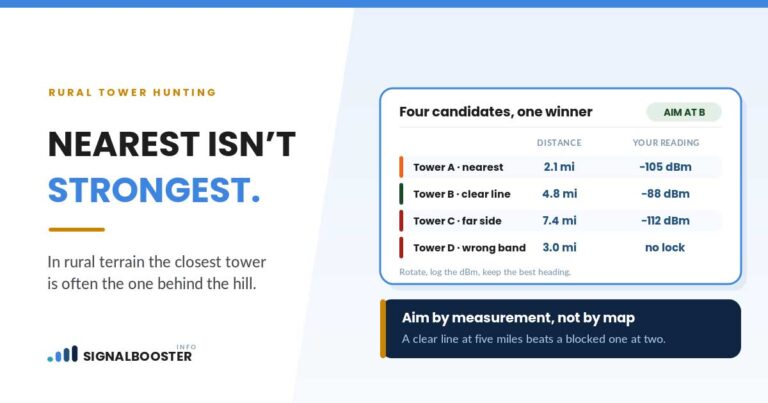
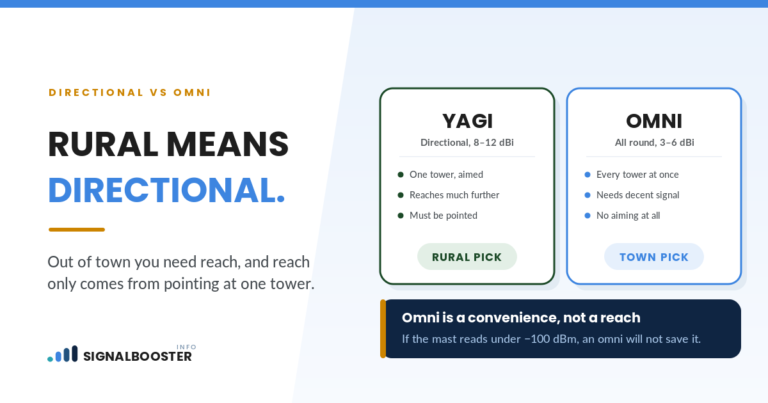
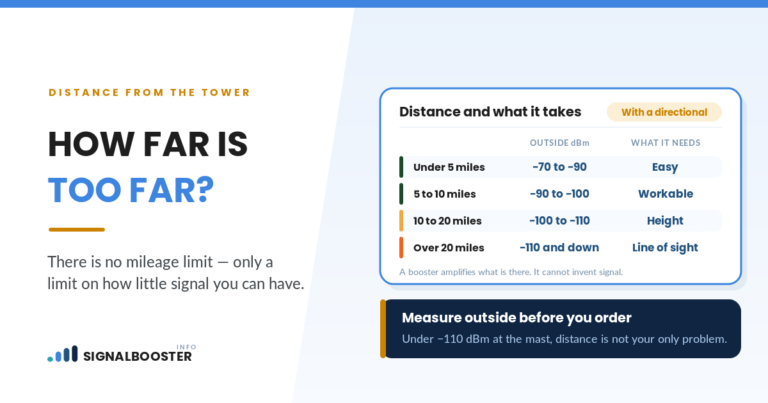
- Your outside signal is usable to begin with. A booster amplifies what the donor antenna hears. If the donor signal is weak, splitting it between two buildings leaves both of them under-served. Measure it in dBm with your phone’s field test mode at the planned donor antenna spot before you plan anything.
- The second space is small, such as a tack room, office corner of a shop or a milking parlor, rather than a whole barn floor.
- You can use low-loss cable rated for your booster’s impedance. Mixing 50-ohm and 75-ohm parts adds mismatch loss.
- The amplifier sits in the building that needs the most coverage, so the long run goes to the less important building.
The mechanics of choosing an equal splitter versus a tap, and when a second inside antenna actually pays off, are covered in our guide to a signal booster splitter for two antennas. Read that before you buy a splitter, because the wrong split can leave the house worse off than it was with one antenna.
When a second booster is the better buy
Separate kits in separate buildings avoid the long cable run entirely. Each system gets a short coax run from its own donor antenna to its own amplifier to its own inside antenna, so neither building is starved by the other.
Lean toward separate boosters when:
- The distance between buildings means a long cable run, and your loss math comes out large.
- The outside signal at your donor spot is weak, so there is little to spare for splitting.
- Both buildings need real coverage, not just a spot to stand and make a call.
- One building is metal-clad, which usually needs its own inside antenna placement and often its own donor antenna on that building.
Two systems do add planning. Each donor antenna should point at the same serving tower where possible, and our guide on how to find the nearest cell tower in a rural area walks through choosing which tower to aim at. Each system also needs its own outside-to-inside separation to avoid oscillation, the feedback loop that forces a booster to cut its gain or shut down. Our breakdown of antenna separation distance for a signal booster explains how to plan that spacing, and the same principle applies between systems: keep one kit’s inside antenna from sitting right next to the other kit’s outside antenna.
Separate boosters also mean separate registrations. The FCC’s Consumer Signal Boosters page, which we checked on September 23, 2026, says consumer boosters must be registered with your wireless provider before use, and that the registration asks for the device’s make, model, serial number and location. Two boosters at two locations are two entries, which is a two-minute job but easy to forget for the second kit.
Running cable between buildings
If your numbers say a shared setup is workable, the cable route between buildings deserves the same care as the antenna.
- Outdoor and buried runs: use cable rated for outdoor or direct-burial use, or run it in conduit. Water in a connector or a nicked jacket adds loss you did not plan for.
- Keep connectors to a minimum. Every joint and adapter costs a little, and each is a place for moisture to get in.
- Do not coil the excess. Cut to length where your connectors allow, or lay extra cable out rather than winding it tight.
- Ground and protect the run. A long cable between two buildings is exposed to lightning-induced surges. Our guide to lightning protection for an outdoor antenna covers surge protectors and grounding. Grounding and bonding between two structures is electrical work, so follow the manufacturer’s instructions and local code, and bring in a licensed electrician if you are unsure.
A safety stop for antenna mounting
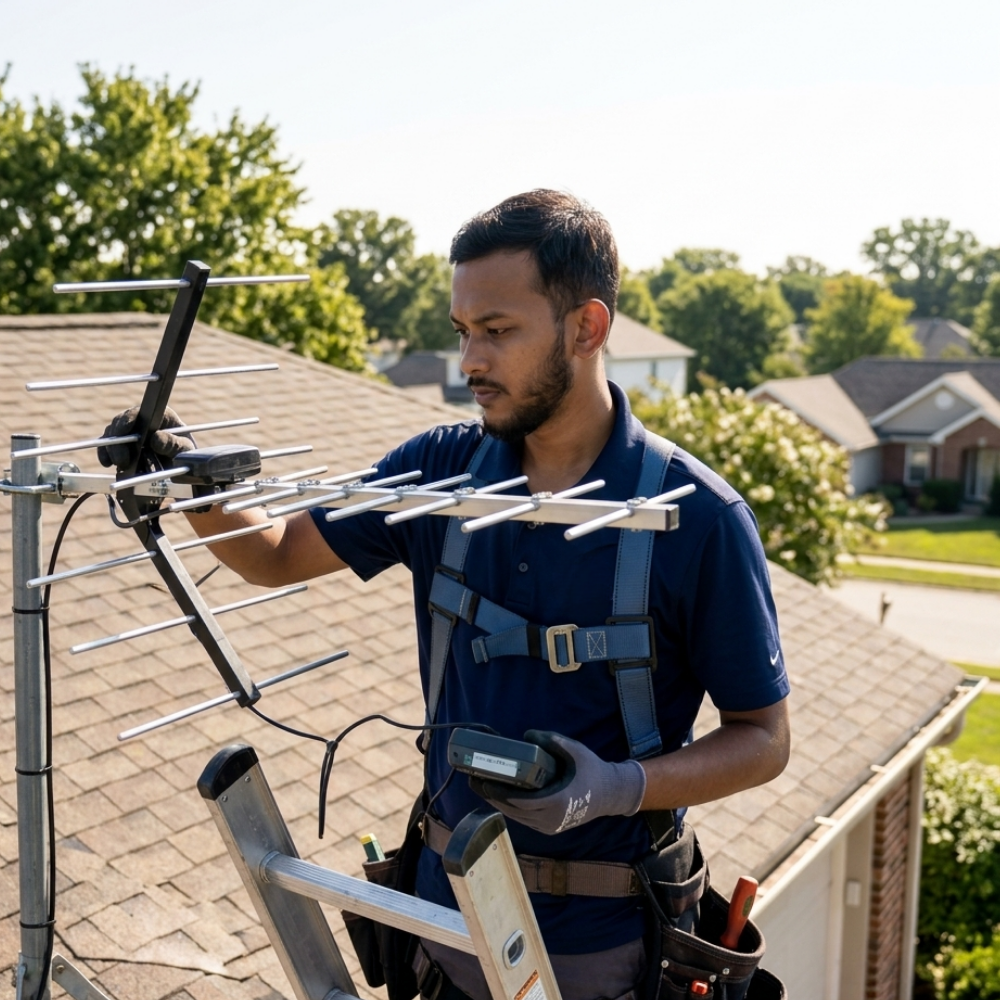
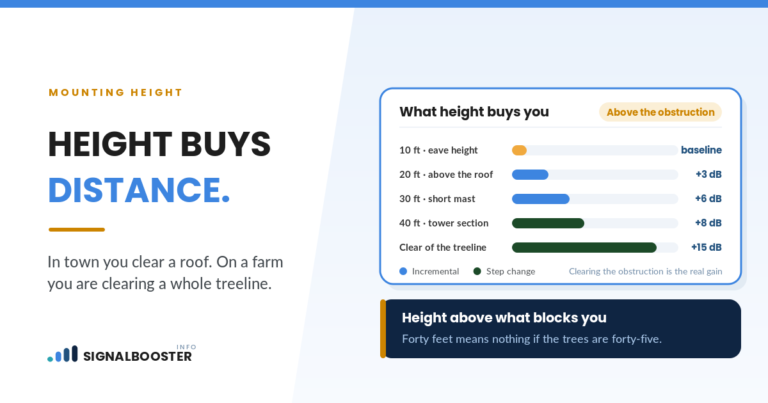
Farm buildings tempt people onto steep metal roofs and up tall poles to get the donor antenna higher. If mounting the antenna means working on a roof, a tower or a mast, or anywhere near overhead power lines, stop. Falls from height and contact with power lines can cause serious injury or death. Keep the antenna, the mast and your ladder well clear of any overhead line, never assume a line is safe, and hire a professional installer for any roof, tower or mast work.
Alternatives when the numbers do not work
Sometimes neither a shared booster nor a second kit is the practical answer:
- Wi-Fi calling in the outbuilding. If the house has internet, a point-to-point wireless bridge or a buried Ethernet run can bring a network to the barn, and phones can place calls over Wi-Fi where the carrier supports it. That is a data problem rather than a cell problem, and it does not need a booster at all.
- Moving the work, not the signal. If the barn only needs a spot to make a call, one inside antenna near the door fed from a short run may be enough, rather than trying to cover the whole building.
- A professionally designed system. Larger operations with several buildings, a shop and a house often get quoted a commercial system that uses fiber or Ethernet between buildings instead of long coax. Manufacturers route that work through site surveys and certified installers, and it is priced accordingly.
A quick decision checklist
Before you buy anything, answer these with measured numbers:
- What is the signal at the planned donor antenna spot, measured in dBm with field test mode, not bars?
- How long is the real cable path to each building’s inside antenna?
- What does the loss math come to for the longest run, including the splitter?
- How much of each building actually needs coverage?
- Is any building metal-clad?
If the longest run is short, the outside signal is solid and the second space is small, one booster with a splitter is worth a trial. If the run is long, the signal is marginal, or both buildings need full coverage, plan on separate kits. Either way, lay out and test the full system on the ground before you drill, trench or mount anything permanently.
FAQ
Can one cell signal booster cover a house and a barn?
It can, if the barn is close, the outside signal is usable and you feed a second inside antenna in the barn through a splitter and low-loss coax. Cable and splitter loss grow with distance, so long runs or weak outside signal usually make a second booster the better choice.
How much signal does a splitter lose?
A two-way splitter cuts the signal to each output by about 3 dB. The weBoost two-way F-Female splitter, for example, is rated at -3 dB across 700 to 2700 MHz. Three-way splitters lose more per output.
Do two boosters on the same property interfere with each other?
They can if one system’s antennas couple with the other’s. Keep each system’s outside and inside antennas well separated, and do not place one kit’s inside antenna next to the other kit’s donor antenna. If a booster detects feedback, it reduces gain or shuts down.
Do I need to register a second booster?
Yes. The FCC requires each consumer booster to be registered with your wireless provider before use, and the registration records the device’s location, so a booster in a second building gets its own registration.
Is it cheaper to buy one bigger booster or two smaller ones?
It depends on your cable distances and outside signal. A bigger booster does not remove cable loss to a distant building. Run the loss math for your real layout first, then compare the cost of long low-loss cable plus splitters against a second kit with short runs.