There is no fixed number of miles at which a signal booster stops working. A booster in a rural area works at any distance from the cell tower where its outdoor antenna can still receive a usable signal, and it cannot work at all where that antenna receives nothing. Terrain, the frequency band, antenna height and the booster’s legal gain limit decide the reach, not the map distance. So the question to answer before you buy is not “how many miles?” but “what does the outdoor signal measure, in dBm, at the spot where the antenna will go?”
This guide explains why mile figures mislead, what actually sets the limit, and how to check your own location first.
Why “Miles From the Tower” Is the Wrong Unit
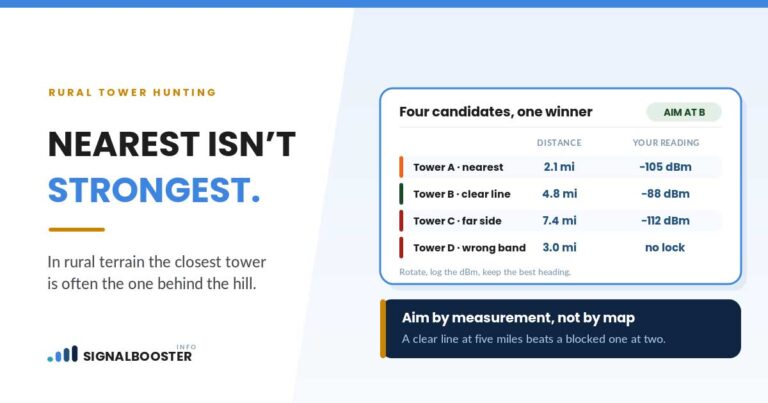
Mile figures show up everywhere in booster marketing, and they sound helpful. The trouble is that two houses the same distance from the same tower can see completely different signal. One sits on a rise with open pasture toward the tower. The other sits in a creek bottom behind a wooded ridge. The distance is identical; the signal is not.
A booster does not care how far away the tower is. It only sees the signal arriving at its outdoor antenna. If that signal is weak but readable, the booster amplifies it and rebroadcasts it indoors. If it is below what the booster’s electronics can pick out of the background noise, amplifying it just amplifies noise.
That is why the honest way to talk about reach is in measured signal, not bars and not best-case coverage claims. Bars are drawn differently by every phone maker and carrier. A dBm reading is a physical measurement you can compare from one spot to another, and from one day to the next.
Signal Booster Rural Area Miles From Cell Tower: What Actually Decides Reach
Four things sit between the tower and your outdoor antenna. Distance is only one input to the first of them.
The outdoor signal at the antenna spot
Everything a booster does starts here. Signal strength in dBm is always a negative number on a phone, and the closer the number is to zero, the stronger the signal. What matters is the reading at the exact place the donor (outdoor) antenna will sit, which is often on a gable, a pole or a roof edge, not in your kitchen. A reading taken on the ground next to the house can be noticeably different from one taken a story or two higher.
Terrain and line of sight
Hills, ridges, tree lines and metal barns absorb or block signal. Wet foliage in summer can make a marginal path worse than it is in winter. This is why the same booster can serve one farmhouse well and fail the one down the road. If you have not yet worked out which tower you are aiming at and what stands in between, start with our guide to finding the nearest cell tower in a rural area and choosing which one to aim at. The closest tower is not always the best one; a farther tower with a clear view can beat a nearer one behind a ridge.
The frequency band
Lower frequencies carry farther and bend around obstacles better than higher ones. The standard free-space path loss formula (published by the ITU in Recommendation ITU-R P.525) grows with 20 times the log of frequency. Worked through at the same distance, a 1900 MHz signal loses about 8.7 dB more than a 700 MHz signal before any terrain is involved. In practice, far from a tower, the low-band signals are often the only ones left. Which bands your carrier runs on the tower you can see is something to confirm, not assume.
Antenna height
The earth curves, and so does the radio path over it. Raising the antenna helps it see over terrain, crops and outbuildings, and it pushes the radio horizon farther out. Height is often the cheapest reach you can buy, but it is also where the safety risk lives, which is covered below.
What the FCC Gain Limit Means for Distance
This is the part most mile-based guides skip. Consumer boosters sold in the US are capped by the FCC’s Consumer Booster Network Protection Standard, the rule text in 47 CFR 20.21 as published by Cornell’s Legal Information Institute (read on 2026-09-23). For a fixed (home) wideband booster, the rule states that maximum gain “shall not exceed 6.5 dB + 20 Log10 (Frequency)”, with frequency in MHz.
Worked through, that cap comes to roughly 63 dB at 700 MHz, roughly 65 dB at 850 MHz and roughly 72 dB at 1900 MHz. Mobile boosters are capped lower: the same rule sets 50 dB when using an inside antenna, such as in a vehicle.
Why this matters for distance: a legal consumer booster cannot keep adding gain to make up for more miles. Once you are at the cap, the only remaining levers are outside the box: a better donor antenna, more height, a clearer path, or a different tower. Anyone promising that a bigger booster alone will reach a far tower is skipping this math.
The rule also cuts the other way. The same section limits uplink gain based on the signal the booster receives, so boosters throttle back when signal is strong. Far from a tower, where signal is weak, that limit is rarely the constraint; the ceiling is.
How to Check Your Location Before You Buy
A few minutes of measuring tells you more than any mile estimate. Treat this as a survey, not an install.
- Find your phone’s dBm reading. On most Android phones it sits in Settings under the About phone, SIM status or network status screen. iPhones have a Field Test mode, opened by dialing *3001#12345#* in the Phone app. Look for the signal strength value shown in dBm (on LTE it is often labeled RSRP).
- Take readings where the antenna could go, from the ground or a safe spot. Walk the yard, check each side of the house, and try an upstairs window facing the tower. Write down each reading, the location, the time and which carrier and band the phone shows.
- Repeat on a different day. Weather and foliage shift marginal readings. Our piece on whether weather affects your outdoor booster antenna explains what to expect.
- Note the direction of the best readings. That tells you which tower you are really hearing and where a directional antenna would point.
- Compare, do not guess. If the best spot still shows no readable service at all, no booster will fix it. If it shows weak but steady service, a booster has something to work with.
Keep these readings. They are the most useful thing you can bring to a conversation with an installer or a manufacturer’s support line, far more useful than an address and a mileage.
Antenna Choice When the Tower Is Far
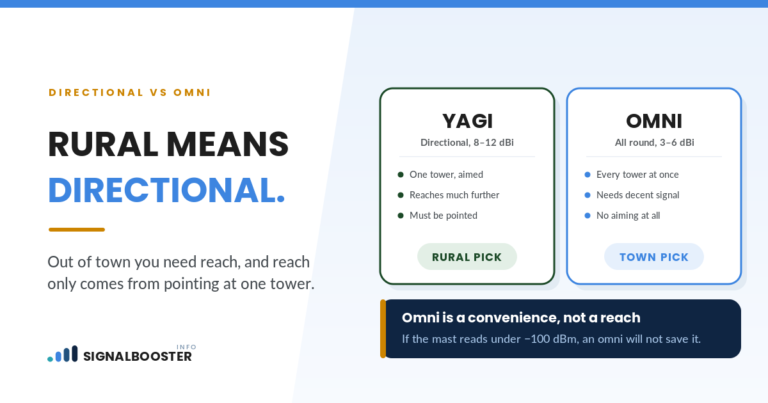
At long range, the donor antenna does more of the work than the booster. A directional antenna concentrates its sensitivity toward one tower and ignores signal from the sides and back. That usually helps in a rural setting because you are chasing one weak source. An omnidirectional antenna listens in all directions at once, which is useful when you need several carriers on towers in different directions, but it hears less from any single one.
Directional antennas have a cost: they must be aimed, and aiming is fussy at long range. A few degrees off can matter. They also need proper spacing from the indoor antenna, because a strong outdoor antenna pointed back at the house can pick up the booster’s own output and cause the booster to cut its gain. Our guide to antenna separation distance for a signal booster covers how to avoid that loop.
Where the antenna goes also matters. Mounting inside an attic avoids a trip onto the roof but puts shingles, decking and sometimes foil-backed insulation in the path. Our comparison of attic mount versus roof mount for a booster antenna walks through when an attic is good enough and when it is not.
Height, Roofs and Masts: Know When to Stop
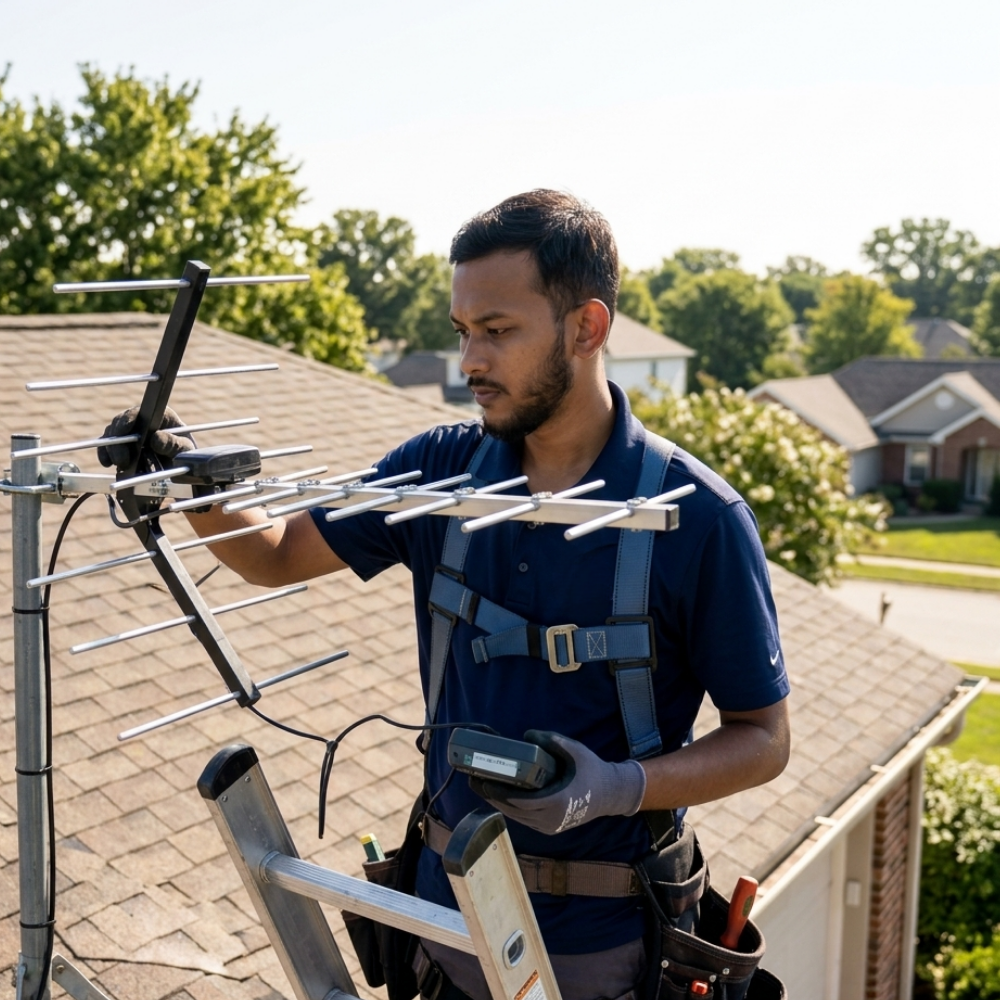
Getting an antenna higher is often the single biggest improvement at distance, and it is also the riskiest part of the job. Stop and call a professional installer if any of these apply:
- Power lines. If a mast, pole or antenna could contact or come near an overhead power line while you raise it, lower it or if it falls, do not do the work. Contact with a line can be fatal.
- Falls. Steep, wet, icy or high roofs, and any work that needs you to stand on a ladder while handling a mast, are fall risks. If you are not trained and equipped for roof work, hand it over.
- Towers and tall masts. Anything that needs guy wires, a concrete base or climbing belongs with an installer.
An outdoor antenna and its mast also need grounding and surge protection; see our guide to lightning protection for an outdoor booster antenna. A professional installer can survey signal from height safely, which is exactly the reading you want before you commit.
When a Booster Will Not Help
Sometimes the answer is no, and it is better to know that before buying hardware. A booster cannot create signal. If every spot you can reach, including a safe elevated position, shows no service, amplification has nothing to start from. The same is true if the only signal you can find comes from a carrier you do not use; a booster repeats what it hears, but your phone still needs its own network.
In those cases, look at alternatives: a different carrier whose tower you can actually see, Wi-Fi calling over whatever internet service reaches you, or fixed wireless or satellite internet paired with Wi-Fi calling. A booster is the right tool when weak signal exists outside and fails inside. It is the wrong tool when there is no signal to begin with.
Before You Switch It On
Under FCC rules, you must register a consumer booster with your wireless provider before using it, and registration is free. The FCC’s Signal Boosters FAQ (checked on 2026-09-23) also says that if the FCC or any carrier tells you your booster is causing interference, you must shut it down until the problem is fixed. Buy only boosters labeled for consumer use, not industrial use. Once you install, go back through our list of signal booster antenna mounting mistakes to avoid before you call the job finished.
Frequently Asked Questions
How many miles from a cell tower can a signal booster work?
There is no single figure. A booster works wherever its outdoor antenna can receive a usable signal, and that depends on terrain, band, antenna height and the path to the tower. Measure dBm at the planned antenna spot instead of relying on mileage.
Will a stronger booster reach a tower that is farther away?
Only up to a point. FCC rules cap consumer booster gain at roughly 63 to 72 dB for fixed home boosters, depending on frequency, and 50 dB for mobile boosters with an inside antenna. Beyond that, reach comes from the antenna, height and a clearer path.
Does a booster work with zero bars outside?
Bars are not a reliable measure. What matters is whether your phone can read any signal, in dBm, at the antenna location. If there is truly no service there, even at a safe elevated spot, a booster has nothing to amplify.
Is a directional or omnidirectional antenna better far from a tower?
For one distant tower, a directional antenna usually hears it better because it focuses on one direction. An omnidirectional antenna suits cases where you need several carriers on towers in different directions, at the cost of weaker pickup from each.
Do I need to register my booster?
Yes. The FCC requires you to register a consumer booster with your wireless provider before using it, and there is no fee to register.