Short answer: when rural cell signal comes and goes on a daily rhythm, there are two very different causes, and they need different fixes. The first is tower congestion: the signal is still there, but a busy tower shares its capacity among more users in the evening, so data slows and calls struggle. The second is the signal path itself changing, most often from air layers that form overnight and in the early morning, plus foliage and weather. A few days of dBm and speed readings logged at fixed times will tell you which one you have. A booster helps the second far more than the first.
Here is how each cause behaves, how to log it, and which fixes actually match.
Why Rural Towers Show Daily Patterns More Than Town Towers
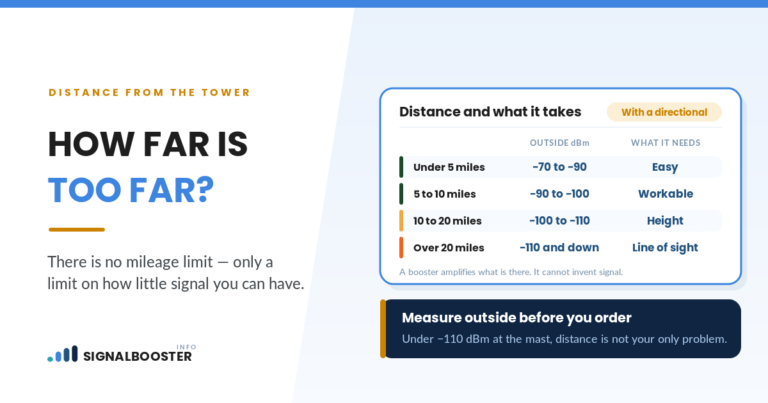
In a town, your phone usually has several towers within reach, and the network can shift load between them. On a rural property there may be one usable tower, often a long way off, covering a large area with many homes, farms and a highway.
That setup makes daily patterns easier to notice, for two reasons:
- Less spare capacity nearby. When everyone on that tower gets home and starts streaming, there is no second tower close enough to take the overflow.
- Less signal margin. A property that sits near the edge of a tower’s reach has little room to absorb small changes. A shift in the air that would go unnoticed in town can be enough to push a weak rural signal below what your phone can hold.
So the same physics happens everywhere, but rural users feel it first.
Cause 1: A Busy Tower (Congestion)
Congestion is a capacity problem, not a signal problem. Your phone can have a steady, reasonable signal and still get slow data, because the tower has only so much capacity to divide among everyone connected to it.
Carriers say this directly. Verizon’s network management page, which we read on September 25, 2026, states that “if the cell site you are connected to begins experiencing high demand during the duration of your session, your 5G and 4G LTE data speeds may be slower than the other traffic’s,” and that “once the demand on the site lessens, or if you connect to a different site not experiencing high demand, your speed will return to normal.” The same page notes that on certain plans, data may be prioritized behind other traffic.
That explains a pattern many rural users recognize: fine at midday, slow after dinner, fine again late at night. The signal did not move. The number of people sharing it did. Your plan type can also matter, because some plans are placed behind others when the tower is busy.
How congestion looks in your readings: signal strength (RSRP in dBm) stays roughly the same across the day, but speed tests drop sharply at the same hours, and pages load slowly while the phone still shows a respectable signal. This is also why full bars do not guarantee a working call or connection, which the guide on full bars but calls still dropping explains in more detail.
Cause 2: The Signal Path Changes (Air, Foliage, Weather)
The second group of causes changes the signal that actually reaches you.
Air layers and ducting
Radio signals do not always travel in straight lines through the lower atmosphere. On calm, clear nights, the ground cools and a layer of cooler, moister air can form beneath warmer air. That layering bends radio signals more than usual. Network engineers call the strongest form of this ducting, where signals are carried far beyond their normal range.
For a rural property, that can cut two ways:
- A distant tower’s signal can appear or grow stronger for a few hours, then fade when the sun heats the ground and the layers mix.
- Interference can rise. Signals from far-off towers using the same frequencies can arrive where they normally never would, which lowers signal quality even if strength looks fine.
Because these conditions tend to build overnight and clear after sunrise, the effect often shows up in the early morning and fades by midday. It depends entirely on the weather, so it can also skip days or last longer. There is nothing a homeowner can adjust in the atmosphere, but knowing the pattern keeps you from chasing the wrong fix.
Foliage and moisture
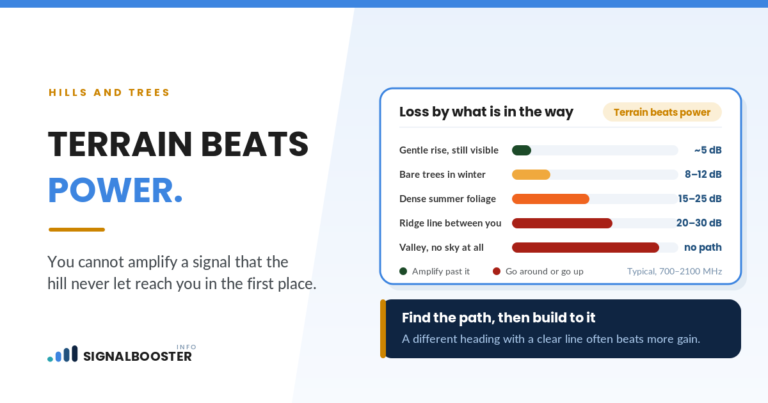
Trees absorb and scatter signal, and wet leaves absorb more. Morning dew, rain and full summer foliage can all lower the signal on a path that crosses a tree line. This is usually a seasonal or weather-driven change rather than a strict daily one, but dew can give it a morning flavor. The article on whether rain or snow affects cell signal covers the weather side.
How path changes look in your readings: signal strength itself moves. RSRP drops or rises by a noticeable amount at certain times, often along with quality (SINR or RSRQ), and the swing tracks the weather or time of morning rather than the evening rush.
Other Causes Worth Ruling Out
A few everyday causes can look like a daily pattern:
- Your phone switching bands or towers. Phones move between bands and towers automatically. A switch can change your reading without anything changing outside.
- Where you are standing. A reading at the kitchen table at breakfast and on the porch at night are different tests. Log from the same spot.
- Low battery. Some phones manage radio power differently when the battery is low, so compare readings at similar charge levels.
- Scheduled network work. Carriers often do maintenance overnight. A short outage in the small hours that clears by morning may simply be that.
Signal apps also fluctuate from second to second, which is normal. The guide to why signal strength apps give inconsistent readings explains how to average readings so you are not reacting to noise.
Rural Cell Signal Comes and Goes? Log It for a Week
This is the step most articles on the topic skip, and it is the one that settles the question. You do not need special equipment, only your phone and a notebook or spreadsheet.
What to record, at the same spot each time:
- Date and time.
- Signal strength in dBm (RSRP) from your phone’s field test screen or a signal app, with Wi-Fi turned off.
- A quality figure (SINR or RSRQ), if your phone shows one.
- A speed test result on cellular data.
- The weather in a word or two: clear, foggy, rain, windy.
When to record: at least three fixed times a day, such as early morning, midday and evening, plus any time the problem is happening. Keep it going for several days, including a weekend, since usage patterns differ.
How to read the log:
| What the log shows | Likely cause | Fix that matches |
|---|---|---|
| Strength steady all day; speed drops at the same evening hours | Tower congestion | Wi-Fi calling, off-peak use for large downloads, asking about plan priority, or a different tower or carrier |
| Strength drops at certain times, often early morning or with fog or dew; quality drops too | Path change (air layers, moisture) | Better outdoor antenna position or aim; a booster can add margin if an outdoor signal remains |
| Strength fine but quality poor at odd hours, often mornings | Interference, possibly from distant towers | Aim a directional antenna to favor your serving tower; a booster cannot remove interference |
| Strength and speed drop together in summer or after rain | Foliage and moisture | Mount position that clears the trees; retest in leaf season |
| Short outages in the small hours only | Possible network maintenance | Usually no fix needed; check carrier outage reports |
This is a diagnostic guide, not a formula. Many properties have more than one cause stacked together. But the log shows which one dominates, and that decides where your money goes.
Will a Signal Booster Stop the Signal From Coming and Going?
It depends on which cause your log shows.
For path changes, a booster can help. An outdoor antenna mounted where it sees the tower better than your phone does indoors starts with more signal. That extra margin can carry you through a morning dip that used to drop your phone off the network. A directional antenna aimed at your serving tower can also favor that tower over distant ones, which may help with some interference. Neither is guaranteed; your own before and after readings are the test.
For congestion, a booster does little. A booster strengthens the signal between your property and the tower. It does not add capacity to the tower. If the log shows steady strength and evening slowdowns, a stronger signal will not fix a busy cell site.
One more behavior is worth knowing. Consumer boosters adjust their own gain automatically when the incoming signal changes. If your outside signal swings through the day, the booster’s output will move with it. The article on signal booster automatic gain control explains why a booster sometimes turns itself down, and why that is a protective feature, not a fault.
What You Can Do Tonight Without Buying Anything
- Turn on Wi-Fi calling if you have reliable home internet. Calls and texts then bypass the cellular link, including a congested one.
- Shift heavy data use such as large updates or downloads to off-peak hours, if your log shows evening congestion.
- Check your plan’s terms. Carriers disclose prioritization in plan descriptions. Knowing where your plan sits explains some evening slowdowns.
- Confirm which tower you are on. In some rural areas a second tower is reachable from a different spot on the property, and it may be less busy.
FAQ
Why is my rural signal worse in the evening?
The most common reason is congestion. More people use the same tower after work, and the tower’s capacity is shared among them. If your signal strength in dBm stays steady while speed drops at the same hours each evening, a busy tower is the likely cause.
Why is my signal better or worse early in the morning?
Cool, calm nights can create air layers that bend radio signals more than usual. That can bring in a distant tower’s signal or cause interference from far-off towers, and it usually fades once the sun warms the ground. Morning dew on trees in the path can also lower signal.
Can a signal booster fix signal that comes and goes?
It can help when the signal reaching your property is what changes, because an outdoor antenna starts with more margin. It will not fix a congested tower, because a booster adds signal strength, not tower capacity. Log your readings first to see which you have.
How do I tell congestion from weak signal?
Compare strength and speed together. Steady dBm with falling speed at busy hours points to congestion. Falling dBm, often with poorer quality readings, points to a change in the signal path.
Does weather affect rural cell signal every day?
Not every day, but often enough to notice. Fog, dew, rain and air temperature layers can all change how signal travels, and rural properties with long paths to the tower have less margin to absorb those changes.