Short answer: for a fixed rural home or farm building served by one carrier from one distant tower, a directional antenna is usually the better outdoor antenna for a signal booster, because it concentrates its gain toward that tower and hears less of everything else. An omnidirectional antenna fits better when you need two or more carriers whose towers sit in different directions, when your usable signal arrives scattered off hills and trees instead of from one clear bearing, or when the antenna moves. The honest way to settle the directional vs omnidirectional antenna rural question is to measure signal in dBm at the mount spot before you buy anything.
That last sentence matters more than any spec sheet. Most pages that rank for this question are written by companies that sell both antenna types, and they broadly agree on the basics. Where they disagree, the disagreement is useful, and it points to the one thing only you can check: how signal actually arrives at your property.
What the Two Antenna Types Actually Do
An outdoor booster antenna does not create signal. It collects what already reaches your roof or mast and passes it to the booster. The difference between the two types is where the antenna listens.
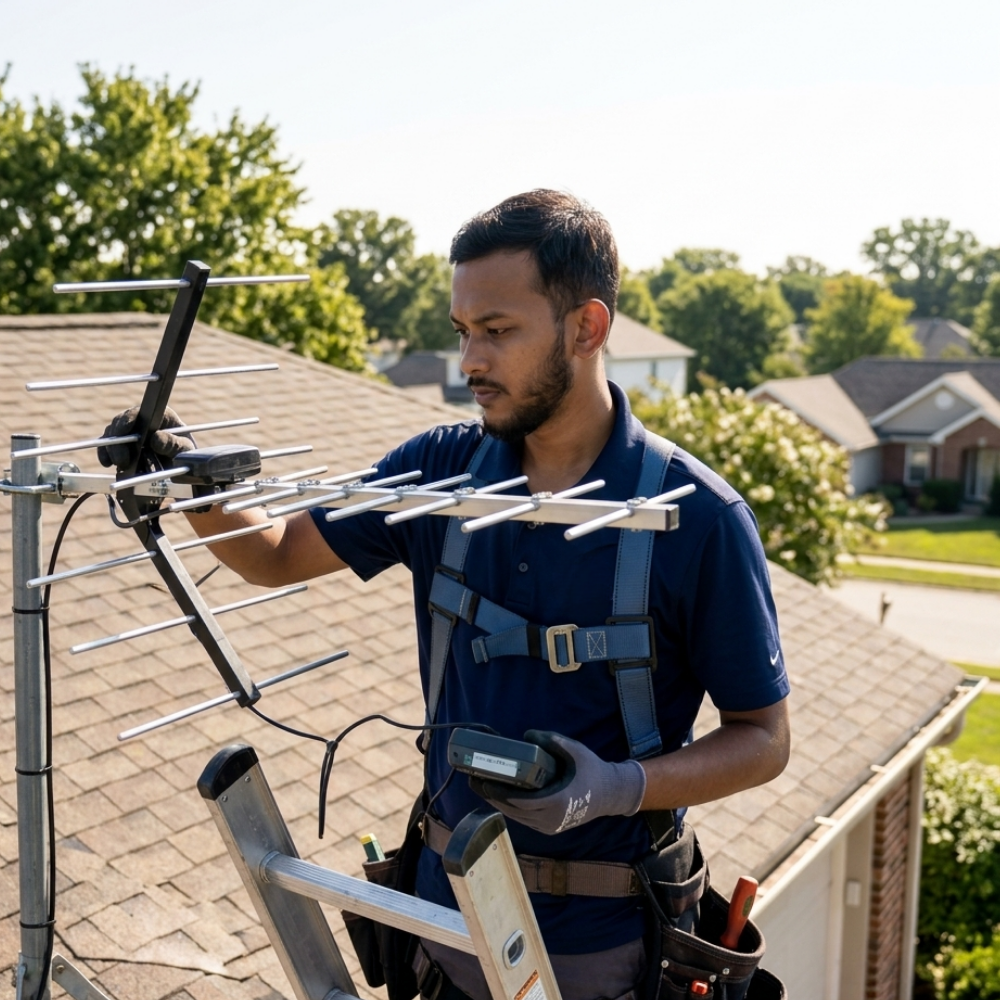
A directional antenna (common forms are the Yagi, the log-periodic or LPDA, and flat panel antennas) listens mostly in one direction. It has to be pointed at the tower you want, and it pays you back for that effort by hearing that tower better than a non-aimed antenna would.
An omnidirectional antenna listens roughly equally all the way around. You do not aim it. It hears every tower in range at once, which is convenient, but it also hears noise and competing signal from every direction at once.
Gain is the word that confuses most buyers. Antenna gain is not extra power added to the signal. It is the antenna’s ability to concentrate its sensitivity in some directions at the expense of others. Wilson Amplifiers’ guide to omnidirectional cellular antennas (published November 14, 2025, read September 23, 2026) puts it plainly: higher gain lets an antenna reach farther, “but it also compresses its radiation beam, creating some blind spots.” That trade applies to both types. A high-gain directional antenna has a narrower beam that must be aimed more carefully, and a high-gain omni has a flatter pattern that can miss signal arriving from above or below.
Directional vs Omnidirectional: Side-by-Side
| Factor | Directional (Yagi, LPDA, panel) | Omnidirectional |
|---|---|---|
| Listening pattern | Mostly one direction | All around, roughly equally |
| Aiming | Required, and worth rechecking | None |
| One distant tower, one carrier | Usually the stronger choice | Often too weak where signal is faint |
| Several carriers, towers in different directions | Covers only towers inside its beam | Hears all of them at once |
| Signal scattered by hills and trees | Can struggle if no single bearing is best | Can collect reflections from several paths |
| Nearby unwanted tower overpowering the one you need | Can be aimed away from it | Hears it at full strength |
| Antenna on a moving vehicle | Impractical | The usual choice |
| Isolation from the inside antenna | Easier: its back can face the building | Harder: it hears the building side too |
| Install effort | Higher: aiming, often a pole mount | Lower |
Read the table as a set of tendencies, not a scorecard. The right answer on your land depends on which rows describe your situation, and at least two of those rows can only be answered with measurements.
When a Directional Antenna Is the Right Call
A directional antenna is the default recommendation for rural homes across most of the booster industry, and for a stationary building the reasoning holds up. It usually fits when:
- Everyone on the property uses the same carrier, or the carriers you need share towers or sit in roughly the same direction.
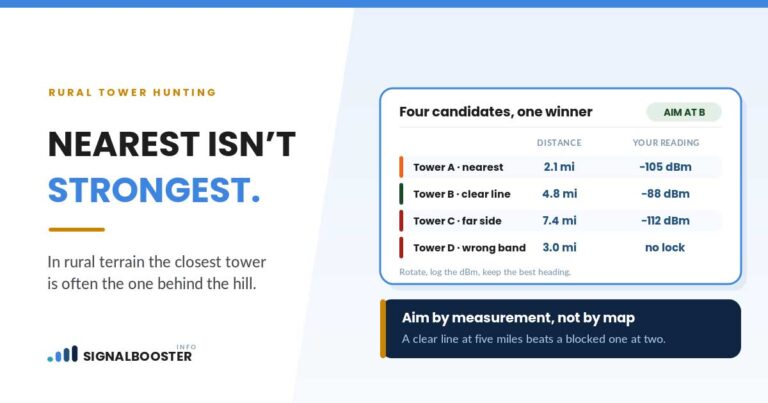
- You know which tower serves you and it is far away. If you have not worked that out yet, start by finding the nearest cell tower and deciding which one to aim at, because the nearest tower is not always the one worth aiming at.
- A closer tower from another carrier, or a strong band you do not use, is drowning the weak one you need. Powerful Signal’s knowledge base lists targeting a specific distant tower past nearby interference as a directional use case, and a directional antenna is the only type you can turn away from the problem.
- You have reasonably clear line of sight from the mount point toward that tower.
There is a second, less advertised benefit. Because a directional antenna hears little from behind, you can point its back toward the building. That helps with the isolation between the outside and inside antennas, which is what keeps a booster out of feedback and self-imposed gain reduction. Isolation still depends mostly on physical distance, so read up on antenna separation distance for a signal booster before you pick a mount location.
When an Omni Antenna Makes More Sense
An omnidirectional antenna is not the “cheap” option. It is the right tool when the problem is breadth, not reach.
- Mixed carriers on one property. A farm with a family on one network and a hired hand on another is a common case. If those towers sit in different directions, a single directional antenna will favor one carrier and short the other.
- Signal that comes from several directions at similar strength. In wooded hollows and broken terrain, the usable signal may be a set of reflections rather than one clean path.
- Antennas that move. On a truck, tractor cab or camper, you cannot keep a narrow beam aimed while driving. For stationary use, this row does not apply, and it is the main reason vehicle advice should not be copied onto a farmhouse.
- Moderate outdoor signal that just needs carrying indoors. If the signal outside is decent and the problem is metal siding or thick walls, you may not need the reach a directional antenna provides.
Some rural households try to have it both ways with two directional antennas, one per tower, joined into one booster. That adds its own losses and complications, covered in whether a signal booster splitter for two antennas is worth it.
Directional vs Omnidirectional Antenna in Rural Terrain: Why the Advice Conflicts
Here is where the ranking pages part ways. SureCall’s Canadian site (post dated December 1, 2023) says directional antennas work well in “hilly or mountainous regions where signals get blocked by the earth” and that omni antennas “may be more suitable for flat landscapes.” Powerful Signal’s knowledge base says the opposite for remote terrain: choose an omni if you are “in a remote area with mountains or dense forests, and the weak outside signal is reflecting off of natural objects.” Wilson Amplifiers, meanwhile, says high-gain omni antennas do best in flat, open rural land, and that their tight vertical pattern can miss signal in hilly country.
These are not really contradictions. They describe different ways signal reaches you:
- One strong path, even through hills. If a gap in the ridge or a hilltop gives your mount point a view toward one tower, all of the useful signal arrives from one bearing. A directional antenna aimed down that path is the better tool. This is the SureCall case.
- Many weak paths, none dominant. If the tower is hidden and what reaches you is bounced off slopes and tree lines from several angles, a narrow beam may catch only one of those reflections. An omni collects more of them. This is the Powerful Signal case.
- Open, flat land with towers at similar elevation. Either type can work here, and the choice falls back to how many carriers and towers you need.
So the question to ask about your terrain is not “is it hilly?” It is “does usable signal arrive from one direction or many?” That is a measurable question.
How to Decide With Measurements, Not Bars
Signal bars are a phone maker’s display choice, not a unit. Your phone’s field test mode or a signal-reading app shows the real figures: RSRP, reported in dBm, is received signal strength, and SINR or RSRQ tells you how clean that signal is. A slightly weaker but clean signal often serves a booster better than a stronger, noisy one.
A practical way to gather evidence before choosing:
- Identify the carrier, band and serving tower in your phone or app, and note the bearing of that tower from your property.
- Take readings at the candidate mount area, as high as you can reach safely from the ground, a window or a deck. Do not climb onto a roof to take phone readings.
- Take readings on each side of the building, holding the phone still and waiting for the numbers to settle. Write down the dBm figure, the SINR or RSRQ, and which cell the phone is connected to.
- Repeat at different times of day and in different weather. Rural readings can swing, and one snapshot can mislead you.
- Repeat for every carrier the building needs to serve. Borrow a phone on the other network if you have to.
How to read the results:
- One side consistently strongest, pointing toward the tower you identified: signal is arriving on one path. That favors a directional antenna aimed down that bearing.
- Readings similar on every side, or the “best” side changes between visits: signal is likely arriving scattered. That leans toward an omni.
- Different carriers strongest on different sides: an omni, or a two-antenna setup, rather than one directional antenna.
Be honest with yourself about the limits of this test. A phone at head height is not an antenna on a mast, and a mounted antenna will usually see more than the phone did. The test tells you about direction and consistency, which is exactly what this decision turns on. It will not predict the final indoor result.
What Neither Antenna Can Fix
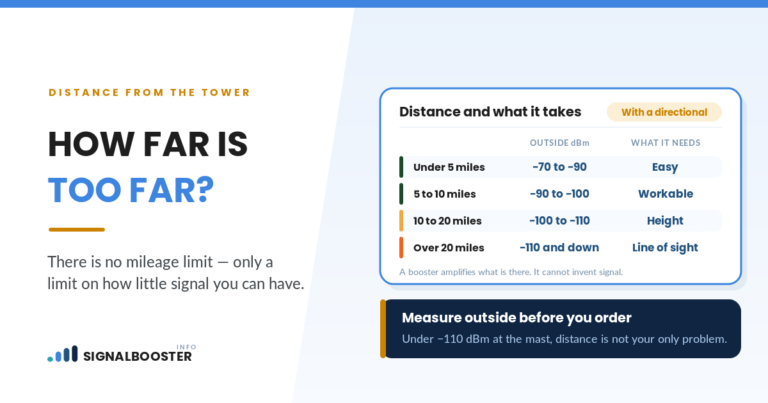
No outdoor antenna creates signal that is not there. If careful readings at the mount point show nothing usable from any direction, a different antenna will not rescue the setup, and other options such as Wi-Fi calling over another internet connection deserve a look.
An antenna also cannot fix a congested tower. If your signal reads strong and clean but data still crawls in the evening, the bottleneck is at the network end, and no booster hardware changes that.
Finally, a bigger antenna does not exempt you from the rules. The FCC’s Consumer Signal Boosters page (read September 23, 2026) says you must register a consumer booster with your wireless provider, that registration is free, and that if the FCC or any wireless provider tells you the booster is causing interference, you must shut it down until the problem is fixed. A badly aimed or poorly isolated system is exactly the kind that can cause that problem.
Mounting Safety on Roofs, Masts and Towers
Directional antennas often go higher and on a pole, because height and a clear view toward the tower both help. That makes the install more dangerous than the antenna choice itself.
Two stop conditions apply before anyone climbs:
- Power lines. If any overhead line runs near the roof, the mast location or the path a mast would take if it tipped, stop. A mast or antenna that contacts a line while you are holding it can kill you. This is professional work, and your utility can tell you about the line.
- Falls. Steep roofs, wet or frosted surfaces, tall masts and any tower climb carry a real fall risk. If you are not equipped and trained for work at height, hire a professional installer.
A mast on the highest point of a farm building is also the most exposed object on the property. Grounding and surge protection belong in the plan from the start, so read about lightning protection for an outdoor booster antenna before the mast goes up.
The Decision in Three Questions
- How many carriers, and are their towers in the same direction? One, or several in one direction, points toward a directional antenna. Several in different directions points toward an omni or a two-antenna design.
- Does usable signal arrive from one direction or many? Your own readings answer this. One points to directional; many points to omni.
- Does the antenna stay put? A house, barn or shop stays put. A vehicle does not, and moving installs almost always use an omni.
If the answers point in different directions, the carrier and signal-direction answers carry more weight than any marketing claim about range.
FAQ
Is a directional or omnidirectional antenna better for a rural home?
For a fixed rural home served by one carrier from one distant tower, a directional antenna is usually better because it focuses on that tower. An omnidirectional antenna is the better fit when several carriers or towers in different directions must be served, or when signal arrives scattered from many angles.
Is a Yagi antenna the same as a directional antenna?
A Yagi is one type of directional antenna. Log-periodic (LPDA) and flat panel antennas are also directional. They differ in shape, bandwidth and beam width, but all of them need to be aimed at a tower.
Can one directional antenna serve two carriers?
Only if both carriers’ towers fall inside the antenna’s beam, which usually means they sit in roughly the same direction from your property. If they are in different directions, one carrier will be favored and the other shorted.
Do I need to re-aim a directional antenna later?
Check it if performance drops, after strong storms, or if your carrier changes which tower serves you. Take fresh dBm readings before and after any adjustment so you know whether the change helped.
Do I have to register a signal booster in the US?
Yes. The FCC requires consumer signal boosters to be registered with your wireless provider, and the FCC says registration is free.