A solar powered signal booster is an ordinary cell signal booster running on a small off-grid power system: solar panel, charge controller, battery and, ideally, a direct low-voltage DC feed to the amplifier. It works, and the power side is rarely the hard part. The two things that decide success are whether there is usable outside signal to boost, measured in dBm at the antenna location, and whether the battery is sized to your booster’s measured draw through your worst month of sun. Get those two right and solar is a stable way to run one.
The rest of this guide gives you the method, in the order you should do it, plus the failure points that kit listings tend to leave out.
Step one: prove there is signal worth boosting
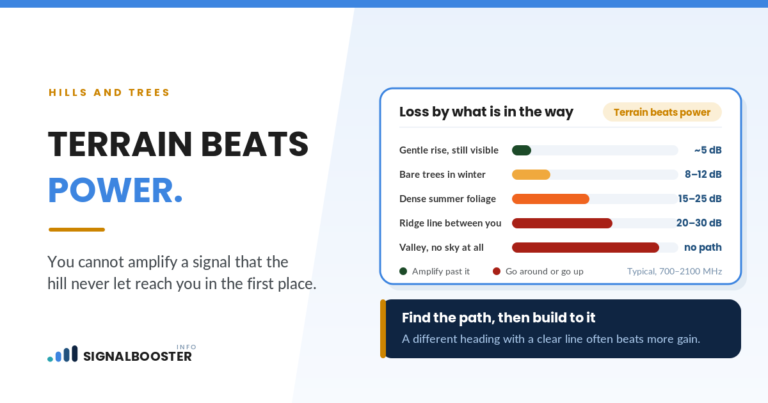
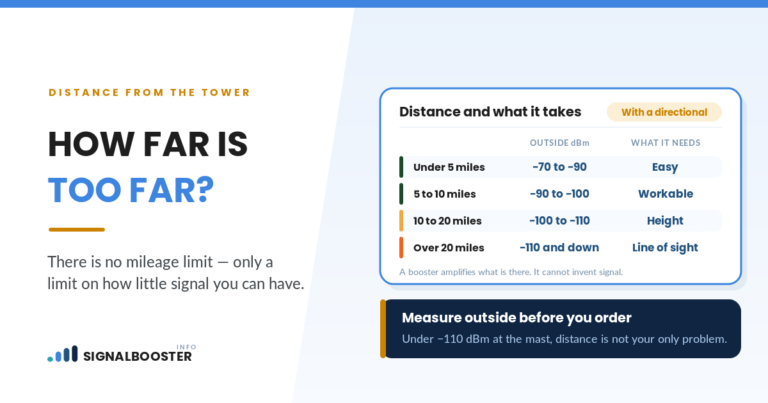
A booster amplifies what the outside antenna receives. It does not create signal. If the spot where the outside antenna will go has no usable signal from any tower, no amount of solar capacity changes that, and the money you would spend on panels and batteries is better held back until you know.
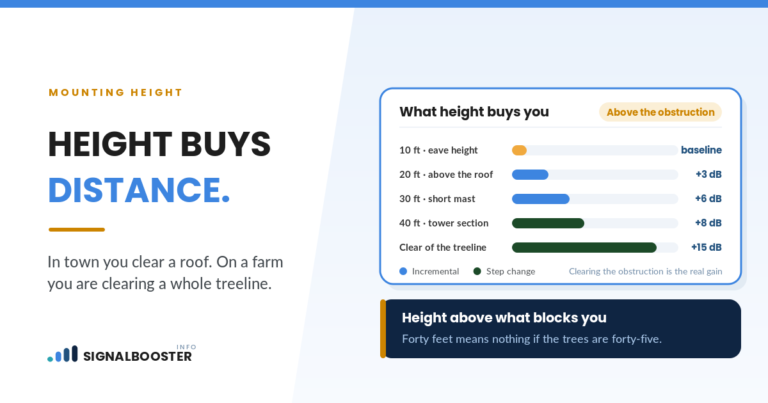
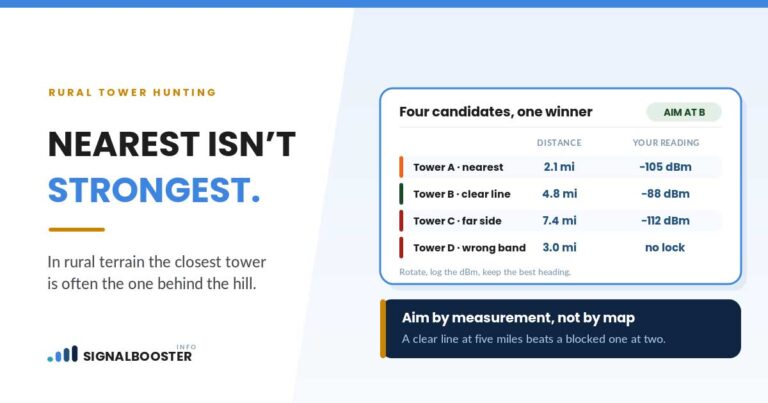
So measure before you buy power equipment. Put your phone into its field-test mode and record the actual reading in dBm, not the bars, at the place the outside antenna would mount: the roof edge, a gable end, or the top of a pole. Our guide on how to check your phone’s real signal strength in dBm explains how to pull that number up. Take readings at several times of day and note which carrier and band each one is on. If the antenna spot is somewhere you cannot stand safely, take readings from the nearest safe point and leave the high placement to an installer.
What you are looking for is a consistent, repeatable reading outdoors that is clearly better than what you get inside the structure. If the outdoor number is barely different from the indoor one, or it drops out entirely, sort out the signal question (tower direction, antenna height, terrain) before you spend anything on the power side.
What a booster actually needs from a power system
Cell signal boosters run on low-voltage DC. Home kits usually ship with a wall adapter that turns 120-volt household AC into low-voltage DC, often 12 volts, though some models use 5 or 6 volts. Vehicle kits take their power from the vehicle’s 12-volt system. The number that matters is printed on the booster itself, next to the power jack, and on its supplied adapter.
That adapter label is a ceiling, not a measurement. For example, weBoost’s own listing for its AC/DC Power Supply 12V/3A (read 2026-09-23) describes a 12-volt, 3-amp supply for the Connect 4G-X. Twelve volts times three amps is 36 watts, which is the most that adapter can deliver. The booster plugged into it will usually draw less, and how much less depends on the model and how hard it is working.
Two more points from the power side:
- Regulation matters. A booster reseller, Alternative Wireless, states on its solar power page that the supply to a Wilson amplifier must be regulated, and that Wilson recommends the voltage printed on the unit. A battery bank swings in voltage as it charges and discharges, so the booster should be fed through a regulated output that matches its label, not straight off the battery terminals unless the booster’s manual says that is acceptable.
- Match the plug and the polarity. A replacement DC cable or hardwire lead has to match the booster’s input voltage, barrel size and polarity. The booster maker’s installation guide for your exact model is the reference here.
Three ways to feed it
| Setup | How it works | Trade-off |
|---|---|---|
| Direct DC feed | Regulated DC at the booster’s rated voltage, from the off-grid system to the booster’s input | Most efficient; needs the right lead and correct fusing |
| Inverter plus the stock AC adapter | Inverter makes 120 V AC, booster’s own adapter turns it back to DC | Simple, but the inverter draws power just being switched on, all day and all night |
| Portable power station | Booster adapter plugs into a battery station, which a panel recharges | Easy to move; limited by the station’s capacity and its own idle draw |
For a booster that runs around the clock, the inverter’s standby consumption can end up a meaningful slice of the daily budget. That is why a direct DC feed is the usual recommendation when the structure has nothing else that needs AC.
How to size a solar powered signal booster system with your own numbers
Generic “boosters use X watts” figures are a starting guess at best. Your booster, at your site, has one real number, and you can measure it.
- Measure the draw. Put a plug-in inline DC watt meter between the power supply and the booster and let it run for a full 24 hours in normal use. Record the total watt-hours for the day. A booster working hard against a weak signal and heavy phone use may draw differently from one idling at night, which is why you want a full day, not a spot reading.
- Add the conversion losses. If you are going through an inverter, add its idle draw from its datasheet. If you are going DC to DC, add the converter’s efficiency loss from its datasheet.
- Decide your days of autonomy. How many cloudy days in a row should the booster survive with no solar input at all? Many off-grid planners start at two or three; a remote building nobody visits often usually justifies more.
- Size the battery for usable capacity. Multiply daily watt-hours by days of autonomy. Then check your battery’s datasheet for its recommended depth of discharge. Lead-acid batteries are generally not meant to be run close to empty, so their rated capacity needs to be well above what you plan to use. Lithium iron phosphate batteries tolerate deeper discharge, but many must not be charged below freezing unless they have a built-in low-temperature cutoff or heater.
- Size the panel for your worst month, not your average one. NREL’s free PVWatts calculator gives monthly solar production estimates for any US location. It models grid-tied arrays, so treat its numbers as a rough guide, but the monthly spread shows you how much weaker December is than June at your address. Size the panel so the worst month’s production covers the daily load and still recharges the battery.
Here is how the arithmetic looks, using a round number chosen for the math, not a typical figure: if your watt meter shows 240 watt-hours in 24 hours, and you want three days of autonomy, you need 720 watt-hours of usable battery. If your battery’s datasheet allows you to use half its capacity, you need roughly 1,440 watt-hours of rated capacity. Replace every number in that example with your own, and hand the finished load figures to the electrician who designs the system.
When the power is in one place and the signal is in another
The off-grid question often turns out to be a layout question. The structure that needs coverage has no power, but the best spot for the outside antenna, or an existing power source, is somewhere else.
You have three realistic layouts:
- Everything at the structure. Panel, battery and booster live with the building that needs coverage. This keeps coax runs short, which protects signal, but you are building and maintaining a power system at that building.
- Booster where the power is, long coax to the structure. This avoids a second power system, but every foot of cable costs signal. Read our breakdown of coax cable loss for a signal booster and do the loss math with the cable maker’s published per-foot figures before you commit. On a long run, cable loss can wipe out most of what the booster adds.
- A separate antenna site. Some people consider putting the outside antenna on higher ground with its own solar and a long cable back. That multiplies both the power and the cable problems, and it is the kind of setup to plan with a qualified installer rather than improvise.
There is no universal winner. Measure signal at each candidate antenna spot, price the coax run, and compare that against building a small power system at the structure.
The failure points nobody selling a kit mentions
Most off-grid booster problems are power problems that look like signal problems. Use this as a triage table before you blame the booster.
| What you see | Likely cause | What to check |
|---|---|---|
| Booster works in the afternoon, dead by morning | Battery too small for overnight draw | Watt meter total vs battery usable capacity |
| Fine in summer, fails through winter | Panel sized for average sun, not the worst month | Worst-month production vs daily load |
| Booster keeps restarting | Voltage sagging near the charge controller’s low-voltage cutoff | Battery voltage history on the controller’s display or monitor |
| Battery never reaches full | Inverter idle draw or a shaded panel | Switch to DC feed; look for new shade from trees or snow |
| Lithium battery stops charging on cold mornings | Low-temperature charge protection doing its job | Battery datasheet temperature limits |
| Booster lights show a warning after work on the antenna | Antennas too close, causing feedback | Separation between inside and outside antennas |
That last row has nothing to do with solar, but it catches people who move antennas while installing panels. If the booster starts cutting out, read up on signal booster oscillation and feedback loops before assuming the power system is at fault.
Two honest trade-offs are worth stating plainly. First, switching the booster off at night saves power, but it also means no boosted signal when you might need to make a call after dark. Decide that on purpose. Second, a booster at a remote building that needs an occasional power cycle is a nuisance if the only switch is on a roof or a pole. Ask whoever does the wiring to put an accessible switch or disconnect where you can reach it safely from the ground.
Where this stops being a DIY job
Choosing a booster, measuring signal and logging watt-hours are homeowner tasks. Building the power system is not something this guide walks through, and it should not be improvised.
- Stop at the wiring. Connecting panels, charge controller, battery bank, fusing and disconnects is electrical work. In the US, photovoltaic systems fall under Article 690 of the National Electrical Code, and your local building department may require a permit and inspection even for a small off-grid system. Hire a licensed electrician for this part.
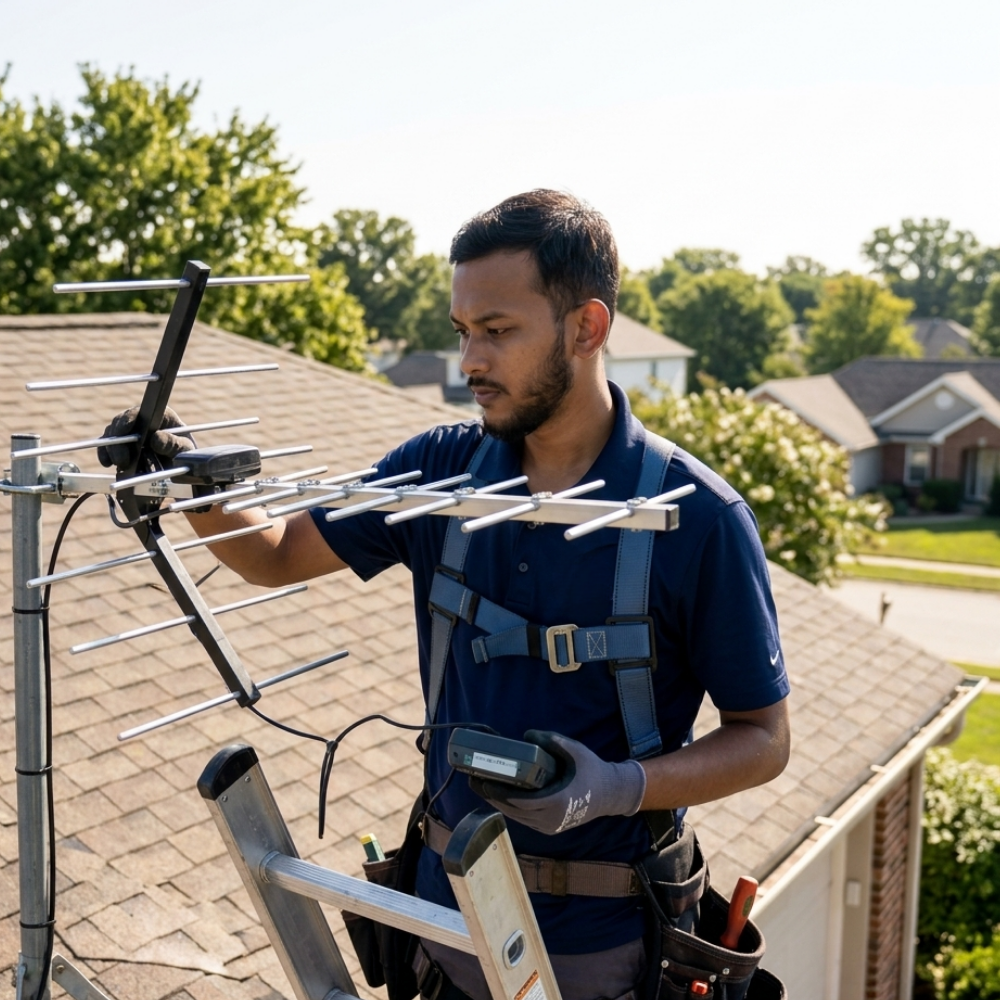
- Stop at the roof. Mounting a panel or an outside antenna on a roof or tall pole is work at height. A qualified installer should handle it. Our guide to lightning protection for an outdoor booster antenna covers why the antenna mast and coax also need proper grounding and surge protection, which is again installer or electrician work.
- Batteries carry their own hazards. Large battery banks store a lot of energy. Follow the battery maker’s installation instructions for enclosure, ventilation and fusing, and let the electrician confirm the setup.
FCC rules still apply off the grid
Running on solar does not change the regulatory side. The FCC’s Consumer Signal Boosters page (read 2026-09-23) tells consumers to use only boosters that carry the FCC consumer label and to register the booster with their wireless provider before turning it on. The FCC’s signal booster FAQ adds that registration is free. If the FCC or any wireless provider tells you your booster is causing interference, you must shut it down until the problem is fixed. A booster in a remote spot on unstable power is still bound by all of that, so register it before switching it on.
Frequently asked questions
Can any cell signal booster run on solar power?
Generally, yes. A consumer booster runs on low-voltage DC, and a solar system with a battery can supply that, either directly or through an inverter and the booster’s own adapter. The requirement is a regulated supply that matches the voltage printed on the booster, sized to its measured daily draw.
How big a battery does a solar powered signal booster need?
It depends on your booster’s measured draw and how many sunless days you want to cover. Log watt-hours for 24 hours with a DC watt meter, multiply by your chosen days of autonomy, then adjust for the battery’s recommended depth of discharge from its datasheet.
Is it better to use an inverter or run the booster on DC directly?
A direct regulated DC feed is usually more efficient for a booster that runs all day, because an inverter draws power just by being on. An inverter makes sense mainly when the structure already has one running for other loads.
My off-grid booster stopped working. Is it the booster or the power?
Check power first. Look at the battery voltage history on your charge controller’s display or monitor for the time the booster cut out, especially overnight and in winter. If the power held steady and it still fails, treat it like any other booster fault: check the cables, the antenna connections and the booster’s status lights against its manual.
Do I still have to register a solar powered booster with my carrier?
Yes. The FCC’s consumer booster rules apply whatever the power source. Register the booster with your wireless provider before turning it on.