Short answer: yes. A hill or a dense tree line between your property and the cell tower weakens the signal that reaches your outdoor antenna, and a booster can only amplify what that antenna receives. Terrain obstruction is often a bigger cell signal booster problem than raw distance, because it can drop the outside signal sharply over a short stretch of ground. The fix is rarely more amplifier. It is finding the spot, height and aim where your antenna sees the strongest, cleanest signal, measured in dBm, before you buy anything.
The rest of this guide explains how hills and trees actually block signal, how to tell a terrain problem from a distance problem using your own measurements, and where a booster simply cannot help.
Why a Booster’s “Range” Depends on What Reaches the Roof
It helps to be precise about what a booster does. The outdoor (donor) antenna collects the signal from the tower, the amplifier raises it, and the indoor antenna rebroadcasts it inside. There is no step in that chain where the booster creates signal that was not already arriving at the outdoor antenna.
So when people ask whether hills reduce a booster’s range, the honest answer is that the hill does not touch the booster at all. It reduces the input. Weaker input means a smaller usable indoor coverage area, and at some point the input is too weak or too noisy for amplification to be worth anything.
That is also why manufacturers’ coverage claims (“up to X square feet”) are best-case figures. They assume a decent outside signal. On a property with a ridge or a woodlot in the way, the starting number is the one that matters, and only a measurement at your antenna location tells you what it is.
How Hills Block Cell Signal
A hill is a solid obstruction. Radio waves at cellular frequencies do not pass through rock and soil in any useful amount. What reaches you on the far side of a ridge arrives by one of two routes:
- Diffraction over the ridge top. Radio waves bend slightly around the edge of an obstacle. The bent signal is weaker than a direct path, and the deeper you sit in the ridge’s “shadow,” the weaker it gets.
- Reflection off other terrain. Signal can bounce off a far hillside, a rock face, or even a large metal building and arrive from a direction that is not the tower’s direction at all.
Frequency matters here. Lower-frequency cellular bands bend around obstacles more readily than higher-frequency bands. In practice this means a property in a ridge shadow may still hold a usable low-band connection while the higher, faster bands drop out. If your phone shows service but data is sluggish, that pattern is worth checking in your phone’s band information before blaming the tower.
The shape of the land also creates sharp edges. Moving a short distance up a slope, or to the other end of a barn roof, can take an antenna out of a shadow and into a clearer path. That is why a single reading from the kitchen window says very little about what a well-placed outdoor antenna could see.
How Tree Lines Weaken Signal
Trees are a different kind of obstruction. They do not block completely; they absorb and scatter signal, and the loss grows with how much foliage the signal has to cross. Water content is the main factor, which is why leaves, needles and wet bark matter far more than bare wood.
The international reference for this is the ITU’s Recommendation ITU-R P.833, Attenuation in vegetation, which we consulted on September 23, 2026. It notes that at frequencies around 1 GHz, the attenuation through trees in leaf appears to be about 20% greater per meter than through leafless trees. It also warns that vegetation loss varies widely with species, density and water content, which is exactly why a general figure cannot predict your particular tree line.
Three practical consequences follow:
- A reading taken in winter can flatter the site. Deciduous trees in leaf absorb more. A measurement made in bare-branch season may be the best your property sees all year.
- Rain and wet foliage can lower it further. If your signal sags during wet weather, trees in the path are a likely contributor. The guide on how weather affects an outdoor booster antenna covers this in more detail.
- Evergreens do not take the winter off. A conifer windbreak is roughly as much of an obstruction in January as it is in July.
The Obstruction You Cannot See: The Fresnel Zone
Here is the part most rural booster guides skip. Signal does not travel along a thin pencil line from tower to antenna. It travels through an elongated, football-shaped region around that line called the Fresnel zone. The zone is widest near the middle of the path and gets wider over longer distances and at lower frequencies.
Anything that intrudes into that region costs signal, even if it does not cross the straight line of sight. So a tree line that sits just below your view of a distant hill, or a rise in a field halfway to the tower, can still take a bite out of your input.
This explains a common rural puzzle: you can see the general direction of the tower clearly from the roof, yet the numbers are poor. Seeing past an obstacle is not the same as clearing it. Raising the antenna, or moving it so the path passes over the obstruction with more room, is often what makes the difference.
Terrain, Distance or Both? A Measurement Triage
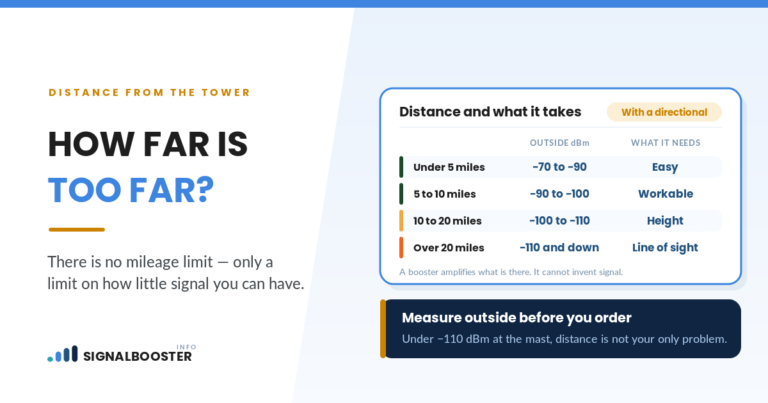
Distance and terrain both lower your signal, but they behave differently when you move around your property. Your phone’s field test screen or a signal app will show RSRP in dBm along with a quality figure such as SINR or RSRQ. Take readings at several outdoor spots, at the heights you can reach safely, and write each one down with its location.
Then look for the pattern:
| What your readings show | Most likely cause | What tends to help |
|---|---|---|
| Similar weak readings everywhere, little change with position | Distance from the tower | A directional antenna aimed carefully; confirming which tower you are on |
| Readings jump noticeably over a short move or small height change | Terrain or tree shadow edge | Relocating or raising the antenna to the better spot |
| Strength is fair but quality (SINR or RSRQ) is poor | Reflections, interference, or a crowded cell | Adjusting aim, trying a different tower, checking whether a booster is worth it at all |
| Readings drop in summer or after rain | Foliage in the path | Choosing a mount position that clears the trees; re-measuring in leaf season |
| No readable signal at any reachable spot | Deep terrain shadow | A booster will not help; see the alternatives below |
This is a diagnostic guide, not a formula. Many rural sites have distance and terrain working together. But the pattern tells you where to spend effort. If small moves change the numbers a lot, placement is your main lever. If nothing changes anywhere, the answer is more likely distance or a different tower.
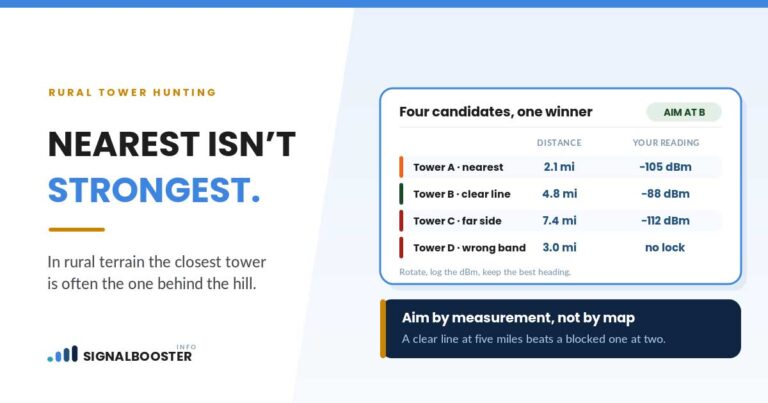
Before you aim anything, confirm which towers are actually serving you. The guide to finding the nearest cell tower from a rural property walks through that step, and it matters more in hilly country because the nearest tower on a map is not always the one with the clearest path.
Why Coverage Maps Miss Terrain Shadows
Carrier and government coverage maps are useful for knowing which networks operate near you, but they are models, not measurements. The FCC says this directly. Its National Broadband Map About page, which we checked on September 23, 2026, explains that the mobile coverage shown is based on propagation modeling, and that a user’s actual, on-the-ground experience may vary due to factors including the device used, cell site capacity and terrain. The FCC also notes that the map does not cover mobile service availability indoors.
For a rural property with a ridge or a woodlot on one side, that caveat is the whole story. The map can show coverage across your parcel while the corner your house sits in is in a shadow. Treat the map as a list of candidates, then let your own dBm readings decide.
Placement Choices That Work Around Obstructions
Once you know where the stronger signal is, the choices come down to position, height and antenna type.
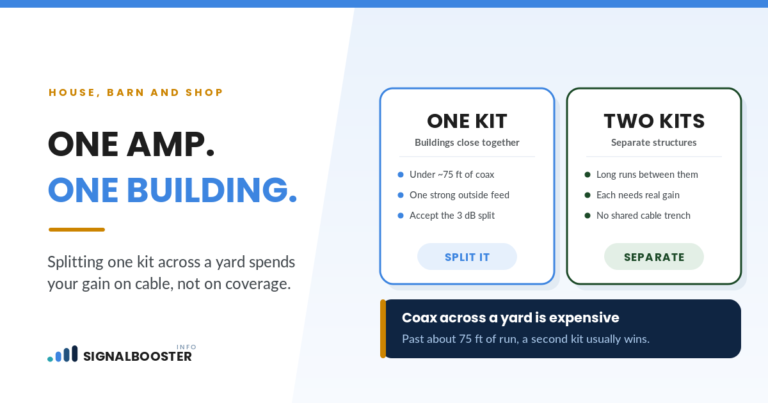
Position on the property. The best spot is not always on the house. A detached garage, a shop roof or a pole in a clearer part of the yard may see past a tree line the house cannot. Cable runs get longer, which adds its own loss, so weigh that against what your measurements show.
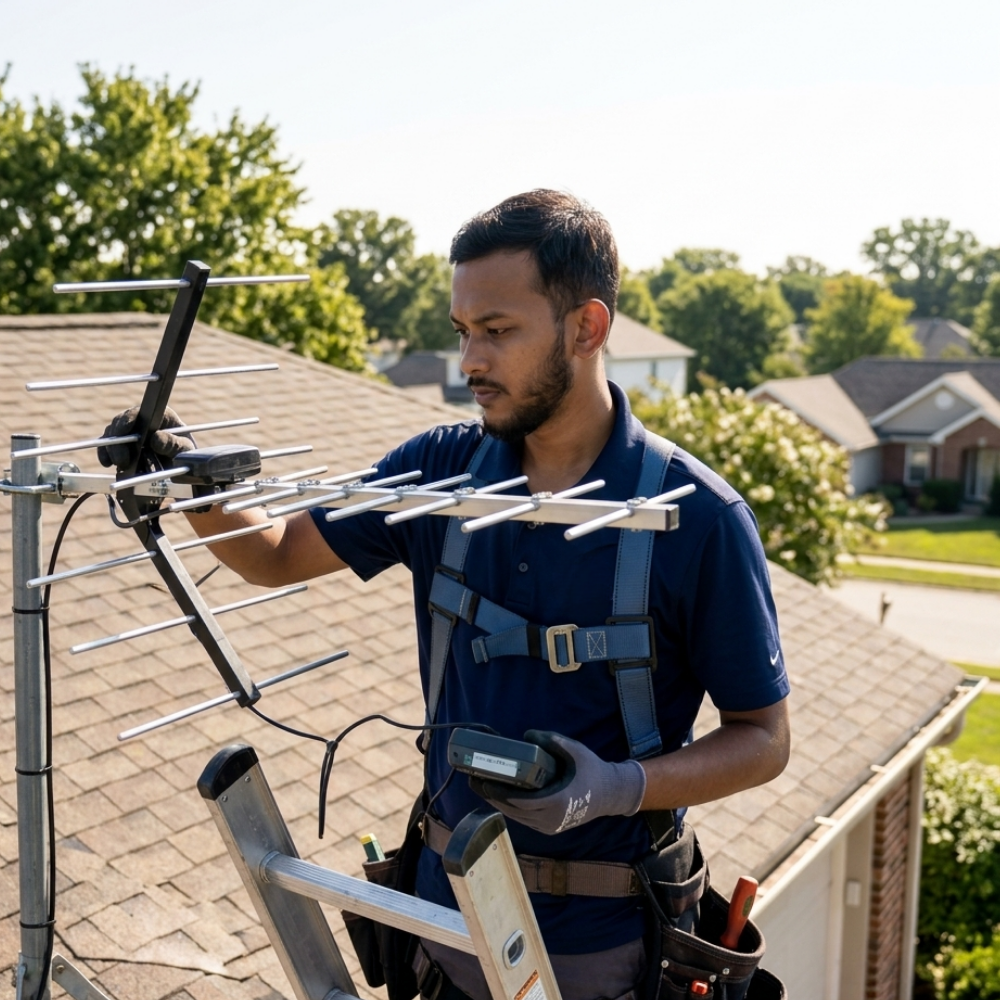
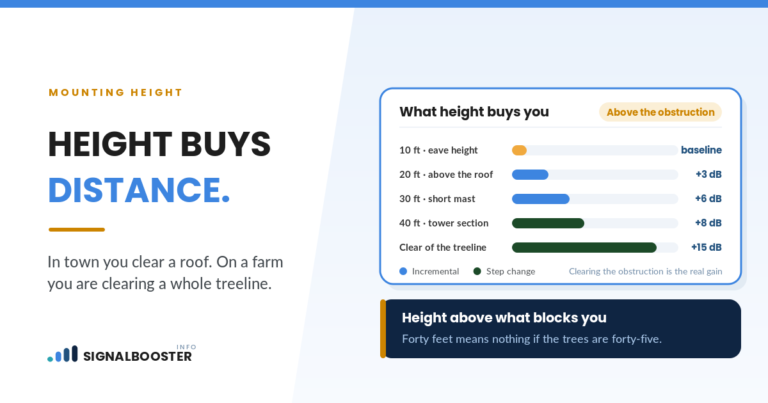
Height. Getting above nearby trees and roof-level clutter is often the single biggest gain on a wooded lot. It is also where risk rises, so read the safety section below before planning anything above the eaves. If you are deciding between a protected indoor spot and an exterior mount, the comparison of attic mount versus roof mount explains why roofing and insulation add their own loss on top of terrain.
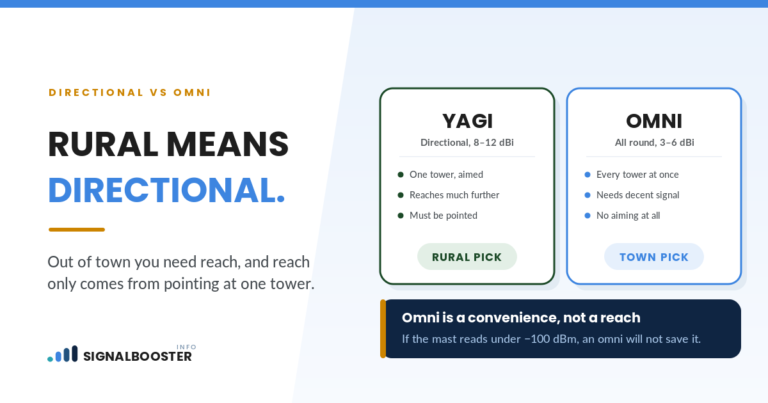
Antenna type and aim. A directional antenna rejects signal from the sides and concentrates on one direction, which helps when a single path is clear. An omnidirectional antenna collects from all directions, which some rural installers prefer where signal arrives by reflection from several directions in hilly ground. In rolling terrain, the best aim for a directional antenna is sometimes slightly off the tower’s map bearing, toward the path that reflects or diffracts best. Sweep slowly and let the readings guide you.
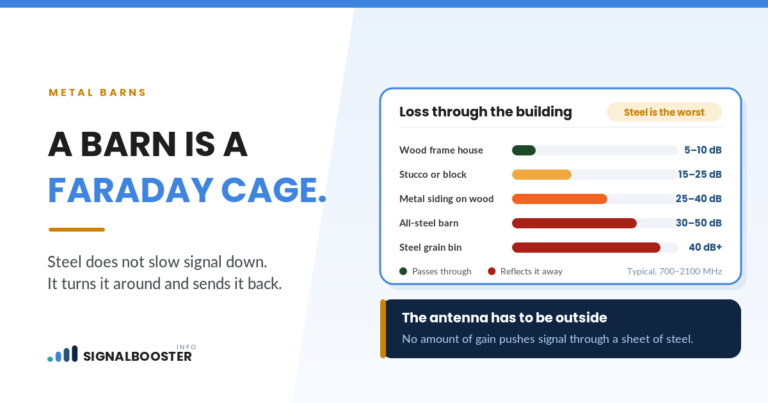
Many first installs lose signal to avoidable errors rather than terrain: aiming at the wrong tower, mounting too close to the indoor antenna, or pointing through a metal roof edge. The list of signal booster antenna mounting mistakes is worth checking before you conclude the hill is the problem.
Safety: Roofs, Masts and Power Lines
Raising an antenna above a tree line usually means a roof, a tall ladder or a mast. That is where people get hurt.
- Falls. If the mount point is above what you can reach from a properly footed ladder while keeping three points of contact, or the roof is steep, wet or icy, stop. This is work for a professional installer or a roofing contractor with the right equipment.
- Power lines. Before you raise a mast, carry a ladder, or string cable, look up. If a mast, ladder or antenna could touch an overhead line at any point, including if it tipped or fell, do not proceed. Contact your utility and a professional installer.
- Tall masts and towers. Guyed masts and freestanding towers involve structural loads, wind, and in many places permits. Have them planned and installed by a professional.
- Lightning. A taller exterior antenna is a more exposed one, and proper grounding matters. Ask your installer how the mast and cable will be grounded before you settle on a high mount.
Measuring at ground level and from safe positions first is not only cautious, it is efficient. It tells you whether height is worth pursuing at all before anyone climbs.
Terrain Obstruction Cell Signal Booster Limits: What Amplifying Cannot Fix
This is the section booster sellers rarely write. If your property sits deep in a terrain shadow and no reachable spot on the land shows a usable, readable signal, a booster will not fix it. Amplifying a signal that is barely there also amplifies the noise that comes with it, so quality stays poor even if the bars look better.
In that situation, the realistic options are different tools, not bigger boosters:
- Wi-Fi calling, if you have a fixed internet connection at the house.
- A different internet path, such as satellite or fixed wireless, if the problem is really data rather than calls.
- A different location for the donor antenna, if you control land with a clearer view, accepting the cost and complexity of a longer cable run or a separate structure.
Knowing this before you spend is the point of measuring first.
FAQ
Do trees block cell signal as much as hills?
Usually not. A hill is a solid obstruction, and signal behind it arrives only by bending over the top or reflecting off other terrain. Trees absorb and scatter signal rather than block it completely, and the loss depends heavily on foliage, species, density and moisture. A thick, wet tree line can still cost you a meaningful amount.
Will a signal booster work if there is a hill between my house and the tower?
It can, if your outdoor antenna location still receives a usable signal by diffraction or reflection. Measure RSRP and signal quality at the candidate mount spots first. If no reachable spot has a readable, reasonably clean signal, a booster will not solve the problem.
Should I measure signal in summer or winter?
Both, if you can. Trees in leaf absorb more signal than bare trees, so a winter reading on a property with deciduous trees can be the best case. If you only get one chance, measure when the trees are in full leaf, since that reflects the harder conditions.
Is an omnidirectional or directional antenna better in hilly terrain?
It depends on how the signal arrives. A directional antenna helps when one clear path exists and you want to reject signal from other directions. Where signal reaches you by reflection from several directions, some installers choose an omnidirectional antenna. Your readings while sweeping the aim will show which situation you are in.
Why does the coverage map show service where I have none?
Coverage maps are built from propagation models, and the FCC itself states that real-world experience may vary due to terrain and other factors. The FCC’s map also does not cover indoor service. A local ridge or tree line can create a shadow the model does not capture.