Short answer: Daylight basement cell signal usually fails as a gradient, not a blackout. Because the top of the walls and the windows sit above grade, signal can reach the window side of the room while the buried back wall stays dead. So the first job is measuring dBm across the room, not buying hardware. Sometimes the fix is simply moving where you use the phone. When a booster is justified, the window that makes the room bright is also the worst place for its outdoor antenna.
A fully underground basement is, in a sense, the simpler problem. Every wall sits behind soil, every path from the tower runs through earth and foundation, and the answer tends to be the same everywhere in the room. A daylight basement mixes open-air walls and buried walls in the same space, so it needs a different diagnosis and, often, a different fix.
What Counts as a Daylight Basement
A daylight basement, also called a garden-level or English basement, is a lower floor that sits partly below grade on most sides, with the upper part of the walls above ground so it can have full-size windows instead of narrow hopper windows at the ceiling line. On a sloped lot, the grade often runs higher on one side of the house than the other, so one wall may be mostly exposed while the opposite wall is almost fully buried.
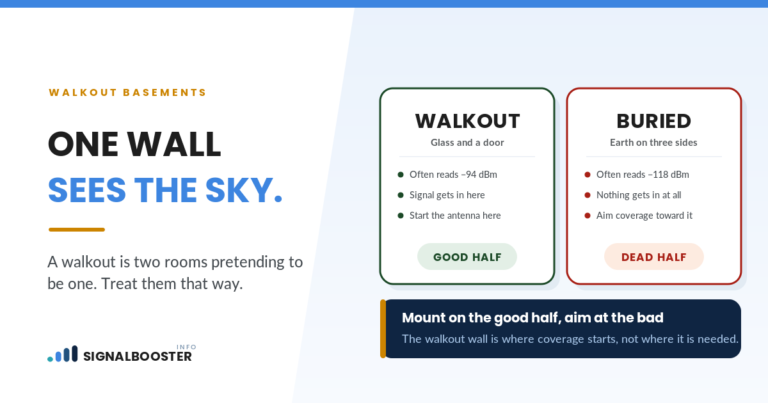
That is different from a walkout basement, where at least one full wall stands at ground level, usually with a door, and from a fully below-grade basement, where no wall is exposed at all. The labels overlap in everyday use, so go by what your walls actually do rather than what the listing called the house.
For signal, the distinction matters because each type lets radio energy in by a different route:
| Basement type | Where signal can get in | What to measure first | Most common trap |
|---|---|---|---|
| Fully below grade | Mostly from the floor above, through stairwells and framing | The outdoor reading at the highest safe point on the house | Expecting a window-side fix to help |
| Walkout | The exposed wall, its windows and the door | The outdoor reading at the walkout wall | Mounting outdoor and indoor antennas too close together at grade |
| Daylight or garden level | The above-grade band of wall and the windows | A dBm gradient from the window wall to the back wall | Treating the window as the outdoor antenna spot |
Why Daylight Basement Cell Signal Fades Across One Room
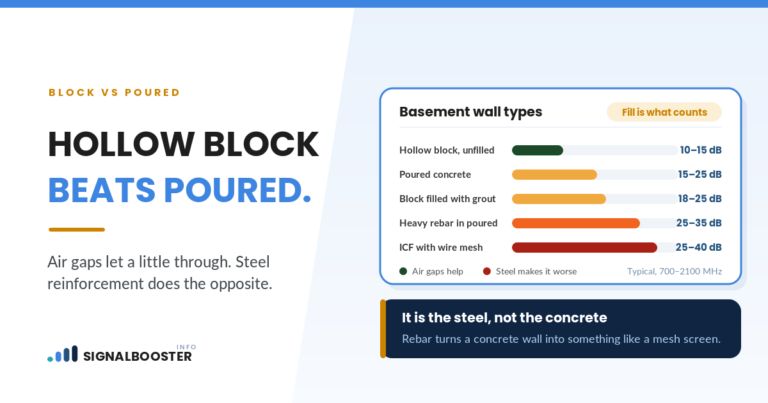
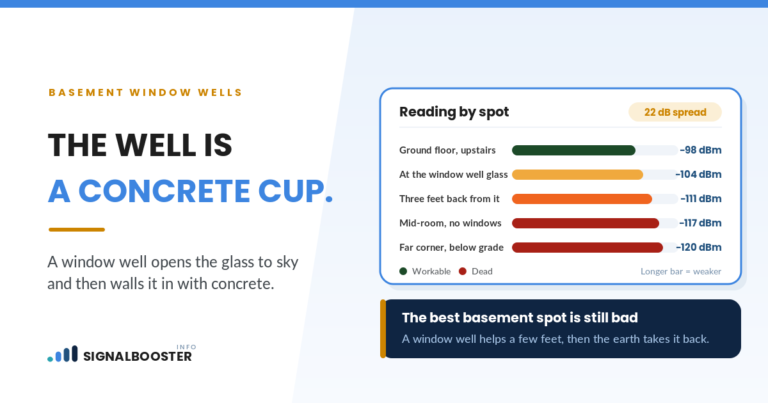
Soil and poured concrete absorb far more radio energy than wood framing and ordinary glass. In a fully buried room, every path to the tower passes through that material, so the whole room tends to be weak together. In a daylight basement, part of each wall is in open air. The window side gets a path with much less material in the way, and every step back into the room puts more earth and foundation between your phone and the tower.
The result is a pattern many owners of these houses recognize: a usable reading at the window sill, a shaky one in the middle of the room, and nothing at the back wall, all inside the same space. Three other things shape how steep that gradient is:
- Which way the windows face. Windows on the side of the house that faces your serving tower matter far more than windows facing away from it.
- How much wall is above grade. On a sloped lot, the downhill wall usually has more exposure, so that side often measures better even if its windows are smaller.
- What is outside the glass. Deep window wells, dense shrubs, a deck built over the windows or a neighboring house a few feet away all reduce how much the above-grade band helps.
Windows are not automatically open doors
Many energy-efficient windows carry low-emissivity coatings, thin metallic layers that help with heat but can also reduce how much cellular signal passes through the glass. The details are covered in our look at whether low-E windows block cell signal. A daylight basement fitted with modern coated windows can behave much more like a buried one than you would expect from how bright it is.
There is a quick way to check this in your own room: take a reading at the sill with the window closed, open the sash, let the reading settle, and take it again from the same spot. If the number improves clearly with the window open, the glass is part of your loss, and that changes which fixes are worth considering.
How to Map Your Daylight Basement Cell Signal in dBm
Bars are a rough, manufacturer-defined display, not a measurement, so this method uses the signal strength number your phone reports in dBm. If you have not pulled that number up before, start with how to check your phone’s real signal strength in dBm, then work through these positions with the same phone, in the same case, at the same height:
- Outside, at the window wall. Stand at ground level next to the basement windows and record the reading.
- Outside, on the other sides of the house. This tells you which direction the usable signal is actually coming from.
- Inside, at the sill of the window on the best-measuring side.
- The middle of the room, holding the phone at the same height as the sill reading.
- The back wall, again at the same height.
- Floor or desk height at the sill and at the back wall, because a phone sitting on a low desk or a couch arm is not where you measured it.
- The open-window check described above, at the sill.
Readings fluctuate, so give each position a minute to settle and take it more than once. Repeat the key spots at a different time of day, since network load changes. If your phone also shows a signal quality figure such as RSRQ or SINR, write it down alongside the strength number; a strong signal with poor quality points to a different problem than a weak one.
Reading the pattern
The numbers matter less than their shape. Here is how the common patterns usually read:
| What you see | What it usually means | Sensible next step |
|---|---|---|
| Good outside, decent at the sill, weak or dead at the back wall | The classic daylight gradient: signal is entering through the above-grade band | Try relocating where you use the phone before buying anything |
| Weak outside and weak at the sill | The problem is the outdoor signal, not the basement | Diagnose the tower and carrier side; a booster would have little to amplify |
| The sill improves clearly with the window open | The glass is adding loss | Treat the windows as a factor in any plan |
| Similar numbers everywhere, but calls still fail | Strength is not the limiting factor | Look at quality readings, the phone itself and network congestion |
Free Fixes That Work Better Here Than Underground
A fully buried basement rarely has a better corner. A daylight basement often does, which makes the no-cost options more useful here than almost anywhere else in a house:
- Move where you work or sit. If the gradient is steep, a desk moved to the best-measuring window can do more than any accessory.
- Leave the phone at the good spot. A phone resting on the sill of the best window, paired with a Bluetooth headset, holds the connection while you move around the room.
- Turn on Wi-Fi calling. If your home internet reaches the basement, calls and texts can travel over it instead of the cellular link. Check your carrier’s settings and support for your plan.
- Ask your carrier about a network extender. These small units use your broadband connection to create a local cell for that one carrier. They do nothing for guests on other carriers.
None of these change the physics. They work because a daylight basement already has a place where the signal is good enough, and they simply put you there.
If You Add a Booster, Don’t Mount the Outdoor Antenna at the Window
A booster uses an outdoor antenna to collect signal, a booster unit to amplify it, and an indoor antenna to rebroadcast it inside. The general case for basements is laid out in what actually fixes a basement with a signal booster. The daylight basement adds one specific trap.
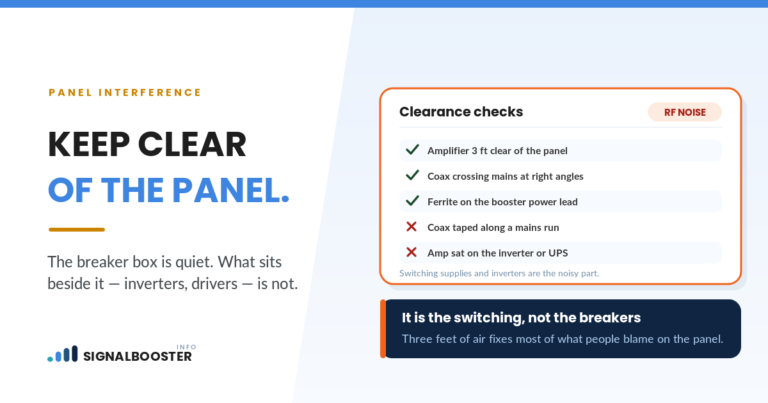
The tempting layout is obvious: the best outdoor reading was right outside the window, so the outdoor antenna goes there, and the indoor antenna goes a few feet inside. That puts both antennas at roughly the same height with only a wall and a pane of glass between them, which is exactly the arrangement that invites feedback between the two. The manufacturer weBoost, in its blog post Cell Signal Booster Oscillation and Why It Matters (read 2026-09-23), says installers should ideally keep 25 to 30 feet of vertical separation between the indoor and outdoor antennas. It also says that horizontal separation has to be greater than vertical to do the same job, that a roof or wall between the antennas can help, and that facing directional antennas in opposite directions reduces the distance needed. Your own booster’s installation guide gives the minimum for that model, and it overrides any general figure. The reasoning behind those rules is covered in our guide to antenna separation distance for a signal booster.
In a daylight basement, that usually points to a layout like this:
- Outdoor antenna high on the house, on the side that measured best outside, so the floors above the basement sit between it and the indoor antenna.
- Indoor antenna in the basement, aimed away from the outdoor antenna and toward the part of the room your gradient map showed as weak, since the window side may already work without help.
- Measure again after setup, at the same positions you used before, so you can see whether the back wall actually improved.
Safety and structure
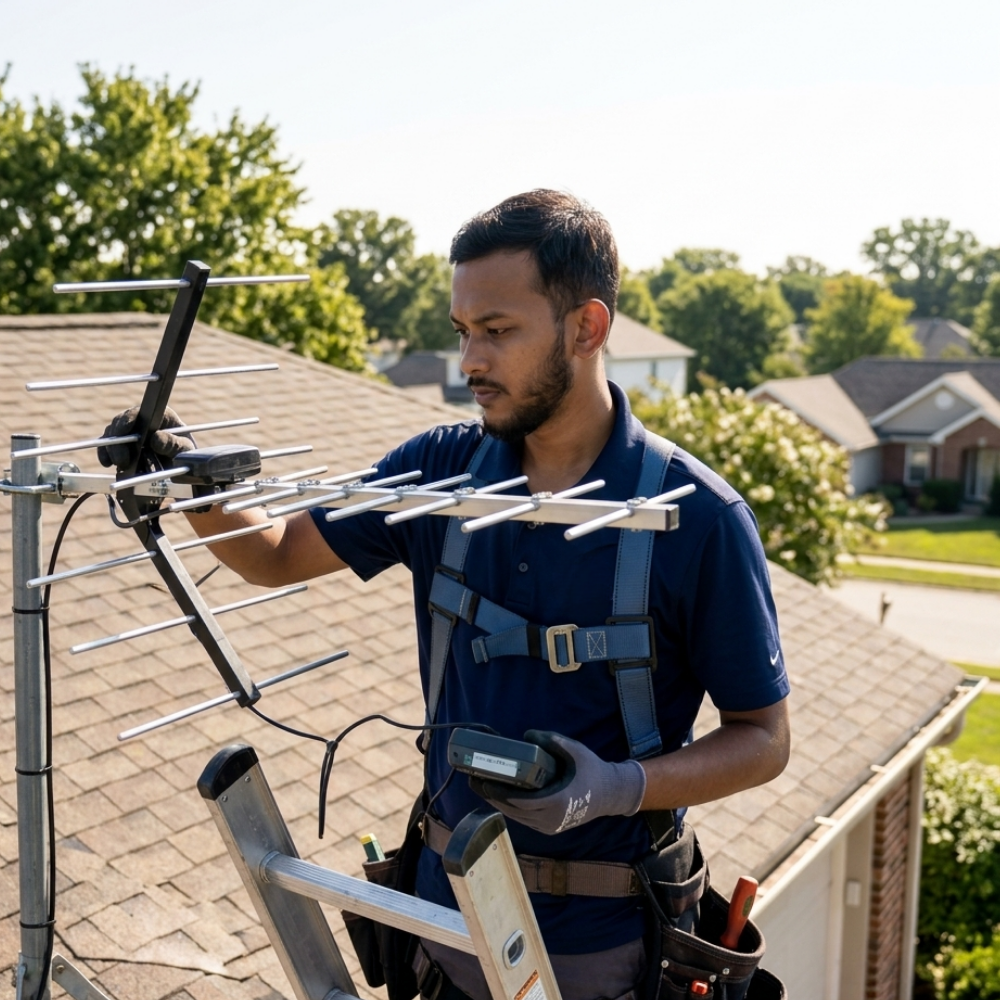
Mounting an antenna at the eave or on the roof means ladder and roof work; if you are not comfortable doing that safely, hire a qualified installer. If the booster location needs a new outlet or any change to wiring, that is a job for a licensed electrician. Think carefully about where the cable enters, too. Drilling through a foundation wall below grade can create a path for water, so have the installer choose an entry point through above-grade framing or an existing penetration and seal it properly.
Garden-Level Apartments: When You Can’t Drill
Many garden-level units are rentals in converted rowhouses or small apartment buildings, and the renter usually cannot mount an antenna outside or drill through a wall without the landlord’s permission. Check your lease and get written approval before any exterior work.
For a renter, the gradient map is even more valuable, because the free fixes are often the whole answer: find the best-measuring spot, use Wi-Fi calling, and ask the carrier about a network extender if there is broadband in the unit. A booster only makes sense if the landlord agrees to an outdoor antenna placement that respects the separation rules above, which in a single-level garden unit can be the hardest condition to meet.
The Registration Step Doesn’t Change
Basement type makes no difference to the legal side. The FCC’s Consumer Signal Boosters guidance (fcc.gov, read 2026-09-23) says you must register a consumer booster with your wireless provider before using it, that registration is free, and that you should only buy and use a booster carrying the FCC’s consumer-use label. It also says that if the FCC or any wireless provider tells you your booster is causing interference, you must shut it down until the problem is fixed.
When the Daylight Part Isn’t the Problem
The daylight basement framing only helps if there is usable signal outside to begin with. If your outdoor readings are weak on every side of the house, the basement is not the real issue; the whole property is short on signal, and a booster can only amplify what its outdoor antenna receives. In that case, carrier-side options such as Wi-Fi calling or a network extender, or a closer look at which towers and carriers serve your area, deserve attention before any amplifier.
The opposite case is worth admitting too. If your map shows a clear, usable reading at the window side and you can work there, you may not need to buy anything at all. A daylight basement gives you options a fully underground room never will, and the cheapest one is often just a different chair.
FAQ
Is cell signal better in a daylight basement than a regular basement?
Often it is, at least near the windows, because part of the wall sits above ground. The back of the room can still be as weak as a fully buried basement, so measure the whole room rather than assuming.
Why does my phone work by the basement window but not across the room?
Signal is entering through the above-grade part of the wall and the windows, and it weakens as more soil and foundation come between your phone and the tower. That gradient is the defining feature of a daylight basement.
Can I mount a booster’s outdoor antenna right outside my basement window?
It is usually a poor layout, because it leaves the outdoor and indoor antennas at the same height and close together, which invites feedback. Mounting the outdoor antenna higher on the house typically gives better separation. Follow the minimum distance in your booster’s installation guide.
Do low-E windows make a daylight basement worse for signal?
They can. Low-E coatings can reduce how much cellular signal passes through the glass. Compare a reading at the sill with the window closed and then open to see whether your windows are part of the loss.
Do I need to register a signal booster used in a basement?
Yes. The FCC requires consumer boosters to be registered with your wireless provider before use, whatever room or basement type they serve.