Short answer: antenna gain matters on a long rural path, but less than spec sheets suggest, and it is never free. Gain in dBi does not add power. It concentrates the antenna’s sensitivity into a narrower beam, so a higher-gain directional antenna hears one direction better and every other direction worse. A few extra dB help only if the antenna is aimed at the right tower and the path is reasonably clear. On many rural properties, a shorter or lower-loss cable run, a better mount position, or correct aim will deliver more usable dB than a bigger antenna. Measure first, then decide.
This guide explains how to read an antenna gain figure, what it trades away, and how to compare it against the other places your signal budget goes.
What Antenna Gain Actually Is
An antenna has no power supply. It cannot create signal. What it can do is favor some directions over others, the way a flashlight reflector concentrates light into a beam instead of lighting a whole room.
Digi International, a maker of cellular routers and modems, puts it plainly in its knowledge base article on dBi vs dBd, which we read on September 25, 2026: “Antennas do not have a power source that allows the antenna to create additional energy to boost the signal.” The same page describes an antenna as “similar to a reflective lens in principle,” focusing available energy “over a wider or narrower area.”
That is the whole trade. More gain means a tighter focus. Digi’s article states the consequence directly: “the greater the gain, the smaller the area covered as measured in degrees of beam width.”
For a booster, the outdoor antenna’s gain works on receive and transmit alike. Aimed well, a higher-gain antenna hears your tower better and sends your phone’s signal back toward it more effectively. Aimed badly, it hears less than a modest antenna would.
Reading the Numbers: dB, dBi and dBd
Three units show up on antenna and booster spec sheets, and they are not interchangeable.
- dB is a ratio. It describes how much something increases or reduces power. Booster amplifier gain and cable loss are both stated in dB.
- dBi is antenna gain compared to an imaginary “isotropic” antenna that radiates equally in all directions.
- dBd is antenna gain compared to a simple half-wave dipole, which is a real antenna.
The conversion matters when you compare spec sheets. Digi’s article gives it as “dBi = dBd + 2.15,” because a reference dipole “is defined to have 2.15 dBi of gain.” So an antenna rated in dBi will always show a bigger number than the same antenna rated in dBd. If one sheet uses dBi and another uses dBd, convert before you compare, or the dBi antenna looks better than it is.
Decibels are logarithmic, which is why small numbers matter. By definition, 3 dB is roughly a doubling of power and 10 dB is a tenfold increase. A 3 dB difference between two antennas is real. A 1 dB difference is small enough that aim, cable and placement will usually swamp it.
Where Your Signal Budget Actually Goes
It helps to think of a rural setup as a budget. The signal arrives at your outdoor antenna at some level you can measure in dBm. Then each part of the chain adds or subtracts dB:
- Antenna gain adds dB, but only in the direction the antenna points.
- Coax cable subtracts dB for every foot, and more at higher frequencies. Long runs on thin cable lose a surprising amount.
- Connectors, splitters and surge protectors each subtract a little.
- Aim can subtract a great deal. A directional antenna pointed at the wrong tower, or a few degrees off a narrow beam, loses more than its gain rating adds.
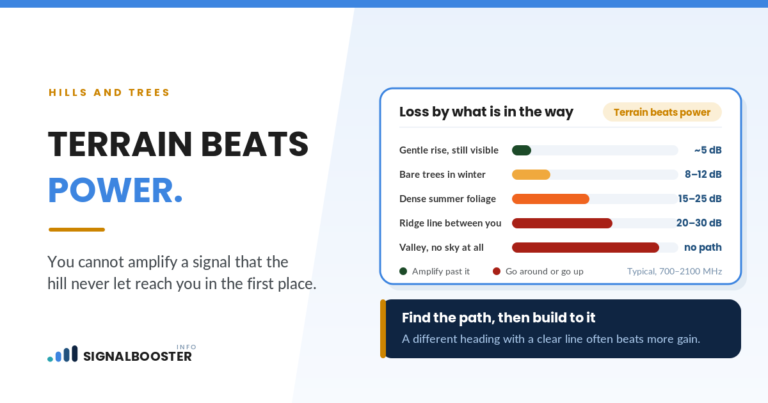
- Obstructions such as trees, a ridge or a metal roof edge subtract dB before the antenna even sees the signal.
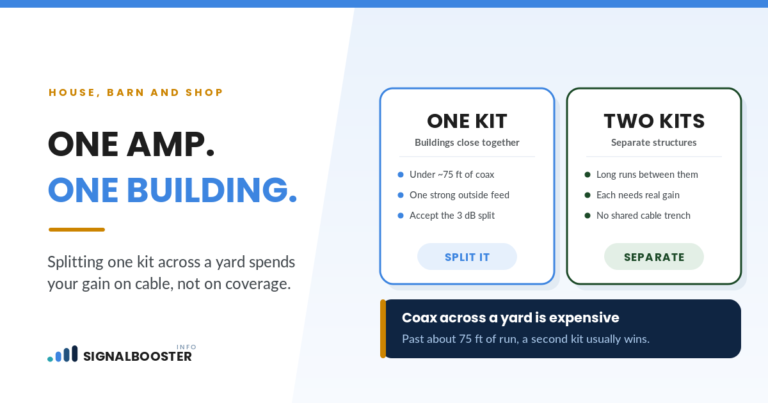
Here is the point most gain comparisons miss. Upgrading to an antenna with a few more dBi, then losing those same few dB in a longer run of thinner cable to reach a new mount point, gets you nothing. The explainer on coax cable loss for a signal booster shows how to estimate that side of the budget from the cable maker’s published loss figures.
Antenna Gain dB for a Rural Signal Booster: A Comparison Table
Use this as a way to compare options against each other, not as a promise of results. Your own before and after dBm readings are the only test that counts.
| Change you are considering | What it can add | What it can cost | When it tends to be worth it |
|---|---|---|---|
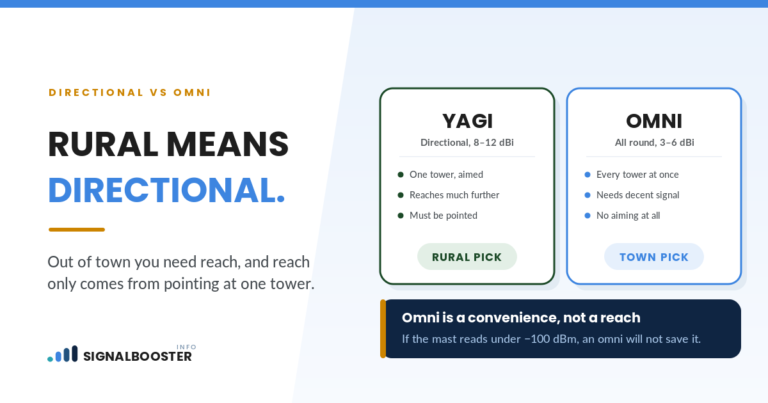
| Higher-gain directional antenna | A few dB toward the tower, better rejection of other directions | Narrower beam, harder aiming, less tolerance for reflected signal | One known serving tower, clear-ish path, careful aim |
| Omnidirectional outdoor antenna | Signal from every direction, including reflections | Lower gain toward any single tower | Signal arrives from several directions, or several towers matter |
| Shorter or lower-loss cable run | Recovers dB that the cable was losing | Cost of better cable, possibly a different mount spot | Long runs, thin cable, higher frequency bands |
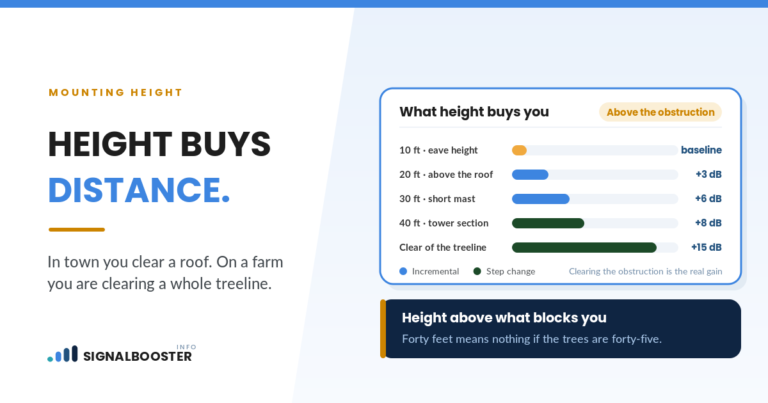
| Better mount position or height | Can clear an obstruction entirely | Ladder and roof risk, longer cable | Readings change noticeably as you move or rise |
| Correct aim at the right tower | Often the largest single gain on a directional setup | Time, patience, a methodical sweep | Anyone with a directional antenna |
When More Gain Helps
Higher gain earns its place in a specific situation:
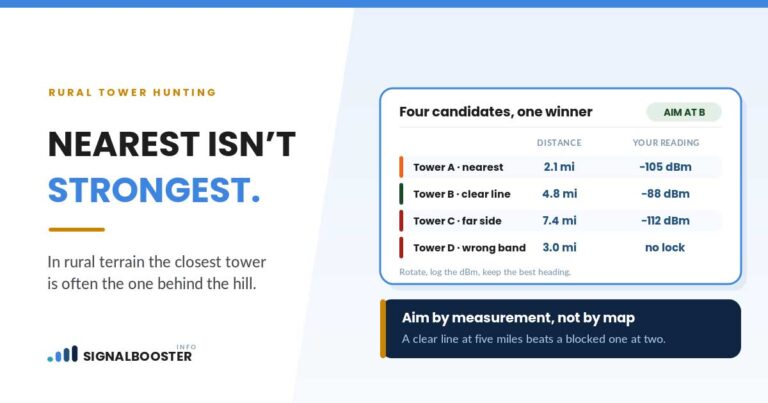
- You know which tower serves you, and your readings confirm it. The guide to finding the nearest cell tower from a rural property covers how to identify it, and why the closest tower on a map is not always the right one.
- The path to that tower is fairly clear. Gain focuses on a direct signal. It does less for signal that has scattered off terrain.
- Other towers are causing interference. A narrow beam rejects signals from the sides, which can improve quality as well as strength.
- You can aim carefully and measure while you do it. A high-gain antenna needs a slow sweep with readings at each step.
In that situation, a higher-gain directional antenna can be the difference between a marginal signal and a usable one.
When More Gain Does Not Help, or Hurts
This is the part a spec sheet will not tell you.
- The tower direction is uncertain. A narrow beam aimed at a guess can miss the tower, while a wider beam would have caught it.
- Signal arrives by reflection. In hilly or wooded ground, the strongest signal may come from a direction that is not the tower’s map bearing, or from several directions at once. A tight beam can throw away useful signal.
- You rely on more than one tower or carrier. If different carriers use towers in different directions, a single narrow beam favors one and shortchanges the others.
- Interference or congestion is the real problem. More gain adds strength. It does not add tower capacity, and it cannot separate your tower’s signal from a same-channel signal arriving from the same direction.
- The isolation between antennas is marginal. A higher-gain outdoor antenna, especially one pointed back toward the house, can make it easier for the booster to hear its own indoor antenna. The article on signal booster oscillation and feedback loops explains why that forces a booster to cut its own output, and how separation fixes it.
Gain Varies by Band
Antenna gain is not one number. Most wideband cellular antennas perform differently across the frequency bands they cover, and many spec sheets list gain as a range rather than a single figure. Low bands and high bands can differ by several dB on the same antenna.
This matters for rural setups because distant towers are often reached on lower-frequency bands, which travel farther and bend around obstacles better. If an antenna’s headline gain figure is the peak value on a high band, the gain on the band that actually reaches you may be lower. Read the spec sheet by band where it is available, and compare antennas on the band your phone reports using.
Check Compatibility Before You Swap an Antenna
Consumer boosters are sold and certified as systems, with antennas and cables the manufacturer has specified. Before you replace the outdoor antenna with a different one, check your booster’s installation manual and the manufacturer’s list of compatible antennas, including the connector type and impedance. The overview of whether a signal booster is legal covers the FCC framework for consumer boosters and where registration fits in.
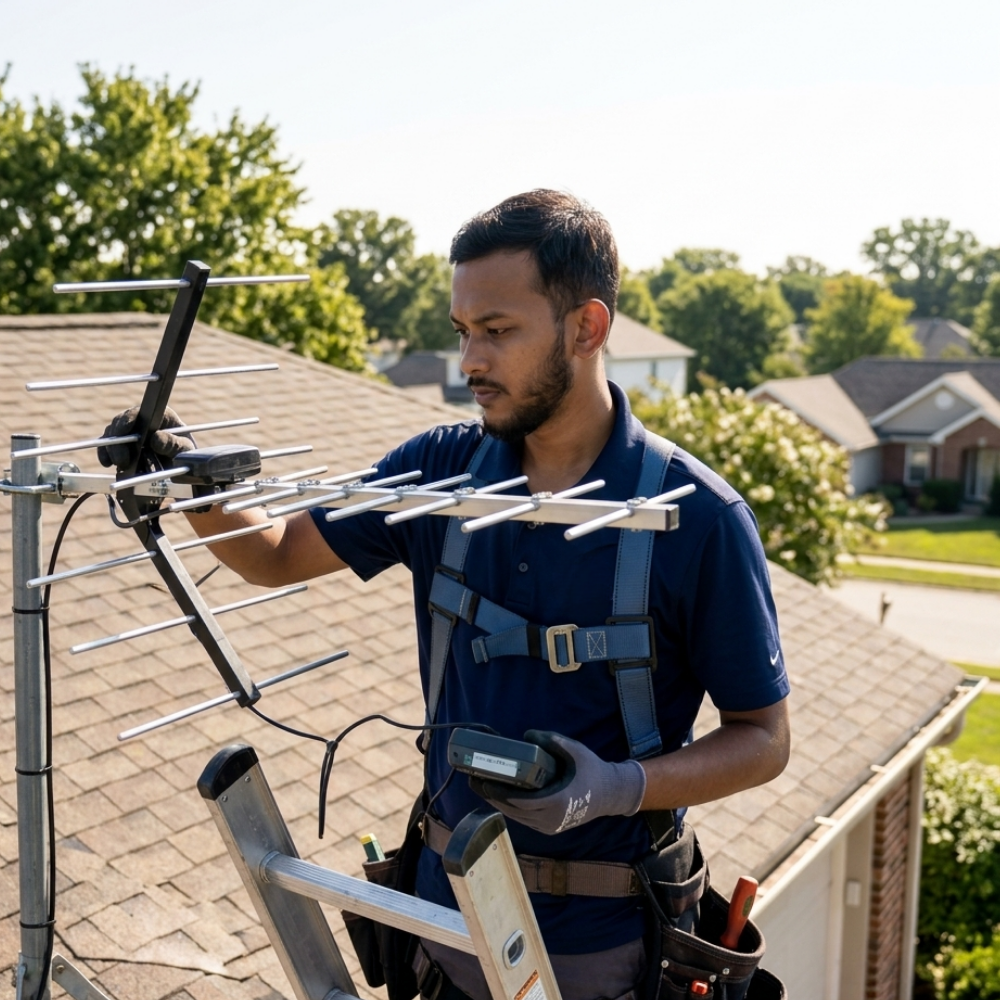
If the new antenna is going on a roof, a tall pole or anywhere near overhead power lines, that part of the job belongs to a qualified installer. A higher antenna is also a more exposed one, so ask how it will be grounded.
A Measure-First Method for Deciding
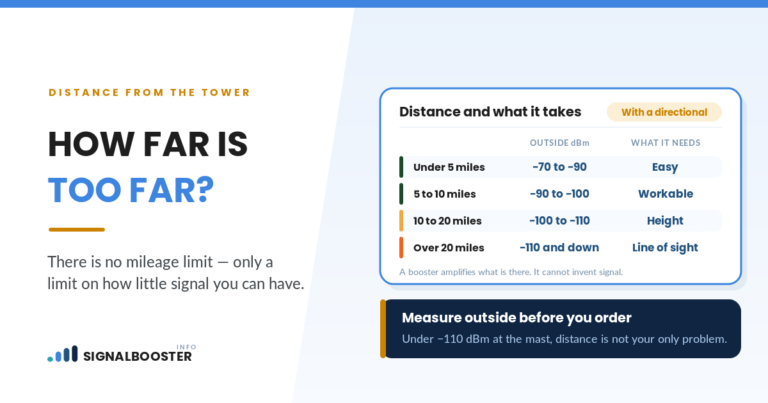
- Measure the outside signal in dBm and a quality figure (SINR or RSRQ) at the candidate mount spot, with Wi-Fi off on your phone.
- Identify the serving tower and its direction, and note which band your phone reports.
- Estimate your cable loss for the run you actually need, from the cable maker’s published figures.
- Compare your options on paper: a few dB from a higher-gain antenna, a few dB saved on cable, or a better position that clears an obstruction.
- Change one thing at a time and remeasure. If you cannot see the difference in your readings, the change did not matter at your property.
FAQ
Is a higher dBi antenna always better for a rural booster?
No. Higher dBi means a narrower beam. It helps when you know which tower to aim at and the path is fairly clear. It can hurt when the tower direction is uncertain, when signal arrives by reflection, or when you need to reach towers in different directions.
What is the difference between dBi and dBd?
Both measure antenna gain but against different references. dBi compares to an imaginary antenna that radiates equally in all directions; dBd compares to a real dipole. A reference dipole is defined as 2.15 dBi, so dBi equals dBd plus 2.15.
How many dB is a meaningful improvement?
Because decibels are logarithmic, 3 dB is roughly a doubling of power. Differences of a dB or so between antennas are usually smaller than the losses from aim, cable length and placement, so fix those first.
Does antenna gain add power to my booster?
No. An antenna has no power source. Gain describes how the antenna focuses its sensitivity toward some directions at the expense of others. The amplifier inside the booster is what adds power.
Should I buy a higher-gain antenna or better cable?
Estimate both. If your planned cable run is long, especially on thin cable, the loss you save with better cable or a shorter run can match or exceed what a higher-gain antenna would add. Your measured readings after each change are the real answer.