Short answer: no, not always. A taller antenna mast gives better signal only while the extra height is clearing something: a tree line, a barn roof, a rise in a field, or the clutter near the ground that sits in the signal’s path. Once the antenna already has a clear path to the tower, more height adds little, and it brings real costs: a longer cable run that loses signal, more wind and lightning exposure, and more risk near power lines. The way to know is to measure signal in dBm at the heights you can reach safely before anyone builds or raises a mast.
This guide explains why height helps, where it stops helping, and how to decide for your own property.
Why Height Helps at All
Cell signals travel best along a clear path between the tower and your antenna. On a farm, that path usually runs low across the land, so anything tall between you and the tower gets in the way: tree lines, grain bins, barns, equipment sheds, even the house itself when the antenna sits on the wrong side of it.
Raising the antenna helps in three ways:
- It clears near obstacles. A tree line fifty yards away blocks much less of the sky once the antenna is above its top.
- It clears the path’s “bulge.” Signal does not travel along a thin line. It occupies an elongated, football-shaped region around the direct path, called the Fresnel zone, which is widest near the middle of the path. Objects that poke into that region cost signal even when you can see the tower direction clearly. Height lifts the path so more of that region is clear.
- It gets above ground clutter. Near the ground, signal bounces off buildings, vehicles and terrain. A higher antenna sees more of the direct signal and less of the scattered mess.
That is why height is often the single biggest improvement on a wooded or cluttered rural property.
Why a Taller Mast Does Not Always Mean Better Signal
Height helps only when something is in the way. The benefit follows a pattern of diminishing returns, and on some properties it is close to zero from the start.
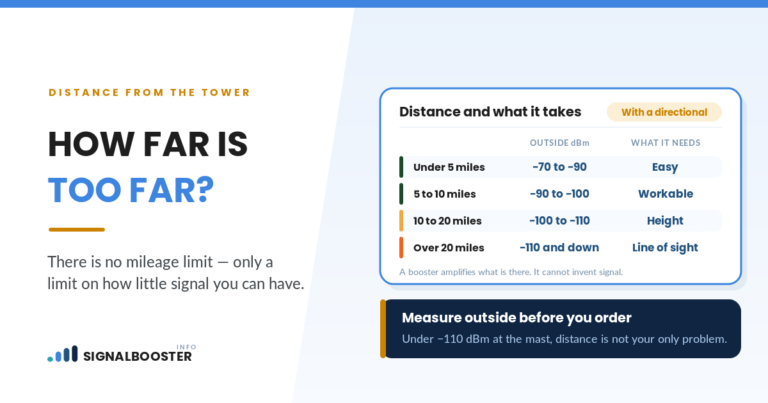
Once the path is clear, extra height adds little. If your antenna already sits above the nearby trees and roofs with an open view toward the tower, raising it further mostly adds distance to the sky, not signal. The change in total path length to a tower miles away is trivial.
Distant terrain does not care about your mast. If a ridge a few miles out sits between you and the tower, a mast on your property is unlikely to rise high enough to clear it. The signal you get is whatever bends over or reflects around that ridge, and a few more feet at your end may not change it much.
Longer cable eats the gain. Every extra foot of mast usually means an extra foot or more of coax. Cable loses signal per foot, and more at higher frequencies. A taller mast that needs a much longer run can lose part or all of what the height gained. The guide to coax cable loss for a signal booster shows how to estimate that loss from the cable maker’s published figures.
A higher antenna can hear more than you want. From a high vantage point, an antenna may pick up more distant towers and signals from the same frequencies. On some properties that raises interference and lowers quality even as strength improves. This is uncommon, but it is one reason to check both strength and quality readings, not strength alone.
Taller Antenna Mast, Better Signal? A Quick Decision Table
| What you observe | Will a taller mast likely help? | Why |
|---|---|---|
| Trees or buildings close by, between you and the tower | Often yes | Height clears near obstacles and more of the Fresnel zone |
| Readings improve noticeably from ground level to an upper-floor window | Likely yes | The signal gets stronger with height at your site |
| Readings barely change between ground level and upper floor | Probably not much | Something else, often distance or far terrain, is limiting you |
| A ridge or hill miles away blocks the tower | Rarely enough | A practical mast will not clear distant terrain |
| Antenna already sits above everything nearby | Little extra | The path is clear; cable and aim matter more now |
| Strength rises with height but quality falls | Maybe not | Height may be adding interference from distant towers |
This is a way to reason about your own measurements, not a prediction. Your before and after readings decide.
How to Test Whether Height Will Pay Off, Safely
You do not need to climb anything to learn most of what you need. The idea is to take readings at different heights using places you can already reach safely, and see whether the numbers move.
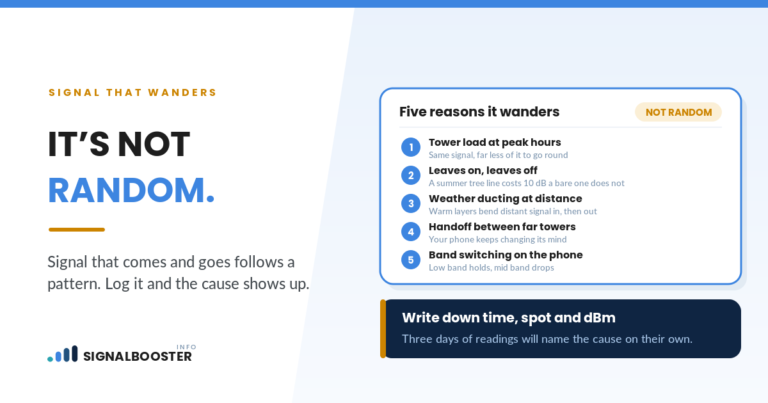
- Turn off Wi-Fi on your phone and open the field test screen or a signal app so you can read signal strength in dBm (RSRP) and a quality figure such as SINR or RSRQ.
- Take several readings at ground level outdoors, at the spot nearest where a mast would go. Wait for the readings to settle and note the typical value.
- Repeat at higher points you can already stand at safely: an upper-floor window facing the tower, a hayloft or mezzanine with proper flooring and railings, or a naturally higher spot on the land.
- Compare. If the reading improves steadily as you go up, height is working at your site and a mast may pay off. If the readings stay flat, a taller mast is unlikely to change much.
- Check quality as well as strength. A strength gain with poorer quality may not help calls or data.
Do not climb onto a roof, a grain bin, or a ladder above a comfortable reach to take a reading. The point of this method is to decide whether height is worth pursuing before anyone goes up.
The Hidden Costs of Going Taller
Height has a price beyond the pole itself.
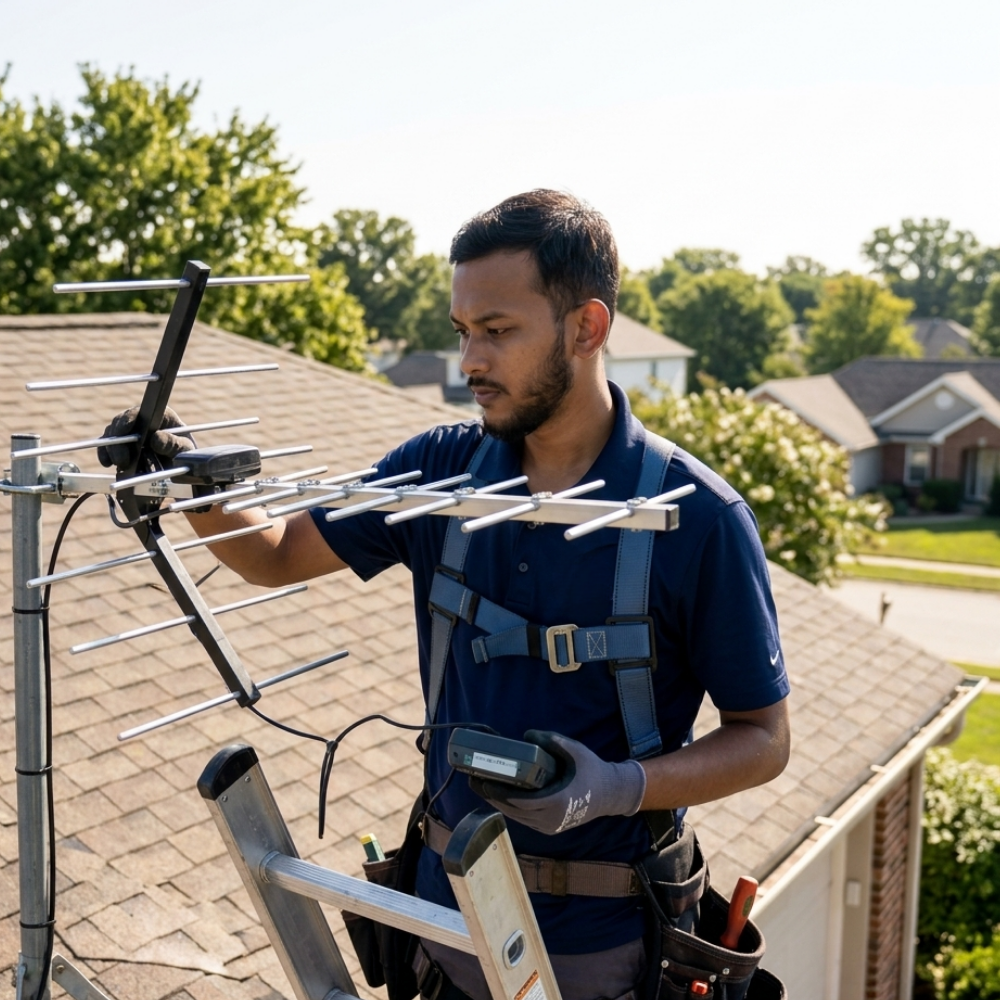
Wind and structure. A taller mast catches more wind and puts more load on its mounts and the building it attaches to. Tall masts and freestanding towers usually need guying or engineered foundations, and in many places a permit. That is a job for a professional installer, not a weekend project.
Lightning. A taller antenna is a more exposed one. Surge protection and proper grounding of the mast and cable matter more as the mast rises. The article on lightning protection for an outdoor booster antenna covers what that involves, and bonding to your home’s electrical grounding system is work for a licensed electrician.
Separation from the indoor antenna. A higher outdoor antenna often makes it easier to get good vertical distance from the indoor antenna, which helps prevent feedback. But a mast that puts the antenna closer horizontally, or pointed back toward the house, can work against you. The guide on antenna separation distance for a signal booster explains how to check this.
Maintenance access. Whatever goes up has to be re-aimed, inspected and eventually taken down. A mast that needs a lift or a climber each time has an ongoing cost.
Power Lines: The Rule That Overrides Everything Else
Antennas and masts near overhead power lines are a documented cause of fatal accidents. The U.S. Consumer Product Safety Commission’s overhead power line safety alert, released in May 2002 and read by us on September 25, 2026, reports that between 1990 and 1998, more than 300 people were electrocuted when an antenna or pole they were handling touched a high-voltage power line, and nearly 150 more died when ladders contacted electrical lines.
The same CPSC alert advises keeping masts, poles, ladders and tools far away from power lines at all times, setting the distance from any power line at no less than one and a half times the height of the antenna or pole, and never assuming an overhead line is insulated.
On a farm, that means:
- Look up before choosing a mast location. Service drops to the house, barn and outbuildings, and lines along the road, all count.
- Apply the distance rule to the full height, including the antenna on top, and to the path the mast would take if it tipped or fell during raising.
- If the only good location is near a line, stop. Contact your utility and a professional installer before anything goes up.
When to Hire, and Who
A taller mast is often where a do-it-yourself booster install should hand off:
- Any work on a roof, or above what you can reach from a properly footed ladder on level ground: a qualified antenna installer or roofing contractor.
- Masts that need guy wires, a foundation, or a freestanding tower: a professional installer, and check local permit and zoning rules.
- Grounding and bonding the mast and cable: a licensed electrician.
- Anything near overhead power lines: your utility first, then a professional installer.
If you are weighing whether a roof position is necessary at all, the comparison of attic mount versus roof mount explains when an interior location is good enough and when it gives up too much signal.
FAQ
How high should a farm signal booster antenna be?
There is no single right height. The antenna should be high enough to clear nearby trees, buildings and ground clutter in the direction of the tower. Beyond that, extra height adds little. Test at different heights you can reach safely and let your dBm readings show where the improvement stops.
Will a taller mast fix signal blocked by a hill?
Usually not if the hill is far away. A mast on your property rarely rises high enough to clear distant terrain. It can help if the obstruction is close, such as a nearby rise or tree line.
Does a longer cable cancel out a taller mast?
It can. Coax loses signal per foot, and a taller mast often needs a longer run. If the height adds only a little signal and the cable takes back more, the net result is worse. Estimate cable loss before building.
How far should an antenna mast be from power lines?
The CPSC advises keeping the distance from any power line at no less than one and a half times the height of the antenna or pole, and further if possible. If you cannot meet that, contact your utility and a professional installer.
Can I raise a mast myself?
Ground-level work and a short mast on a secure mount may be within reach for some owners. Anything on a roof, anything that needs guy wires or a foundation, grounding work, and anything near power lines should go to a qualified installer, a licensed electrician or the utility.