Most phone cases do not meaningfully affect your reception. Some do. Which group yours falls into depends on what it is made of and what is sitting behind it, and the useful thing about this particular question is that you do not have to take anyone’s word for it. This is the one variable in your entire signal problem that you can test in five minutes, for free, by taking the case off.
That matters because it is the cheapest item on the diagnostic list. Before you consider any hardware, rule out the thing already in your hand.
What Actually Interferes, and Why
Your phone’s antennas are not buried in the middle of the device. On modern handsets they run around the edges of the frame and across the back, which is exactly where a case sits. That proximity is why the material question is not silly.
Two mechanisms matter, and they are different.
Conductive material reflects and absorbs radio energy. Metal is the obvious example. Placed directly against an antenna it interacts with the field the antenna is trying to radiate and receive, which is why metal-backed cases and cases with metal plates behave differently from plastic ones.
Detuning. This is the less obvious one. An antenna is designed to operate efficiently at particular frequencies, and putting conductive or dense material immediately next to it can shift its effective tuning. The antenna still works, just less efficiently on the bands it was designed for. This is also why the same case can affect one phone model more than another, the antenna layout differs.
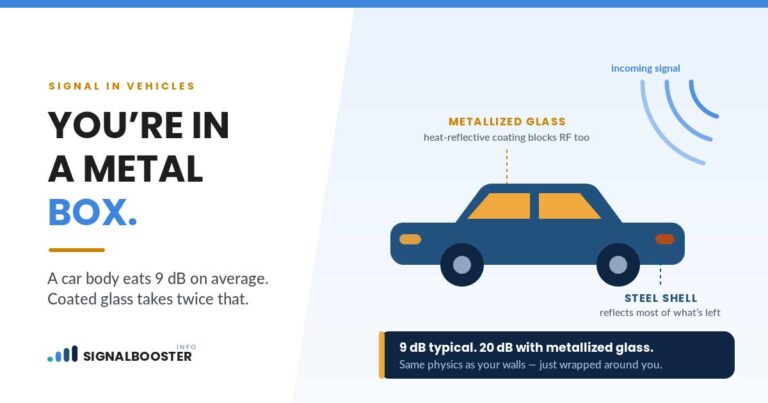
Ordinary non-conductive materials do neither of these things to a meaningful degree. Silicone, TPU, polycarbonate and leather are transparent to radio energy in the way that matters here. Radio waves pass through your walls and windows; a two-millimeter layer of soft plastic is not what stops them.
Materials, Ranked by How Much They Matter
In rough order of how much attention each deserves:
Worth investigating: metal plates for magnetic car mounts. This is the most common real culprit and the one people forget about, because the plate is often a thin adhesive disc stuck inside the case rather than part of the case itself. It is a piece of sheet metal held flat against the back of the phone. If you have one and you also have a signal complaint, test it.
Worth investigating: metal or metal-framed cases. Aluminum and stainless cases exist, and so do cases with decorative metal backing, metal bumpers or metal logo plates.
Worth a quick look: very thick or heavily armoured cases. Rugged cases with substantial material around the edges sit over the antenna bands. The material itself is usually harmless plastic, so this is a lower-probability cause than a metal plate, but the geometry is worth checking.
Worth a quick look: wallet cases with cards in them. Contactless payment cards contain an antenna coil. That is not the same as a solid metal sheet, but a stack of cards pressed flat against the back of the phone is not nothing, and some wallet cases also include deliberate RFID-blocking metal layers.
Unlikely to matter: plain silicone, TPU, clear plastic, leather. These are the majority of cases sold and the majority of cases in use, and they are not a plausible explanation for a serious signal problem on their own.
You will find pages online quoting specific percentages or decibel losses for each material. Those figures are not reproduced here, because none of the ones we found traces back to a published measurement from a manufacturer or a regulator. What follows is more useful than a borrowed number anyway: your own reading, from your own phone, with your own case.
The Five-Minute Case Test
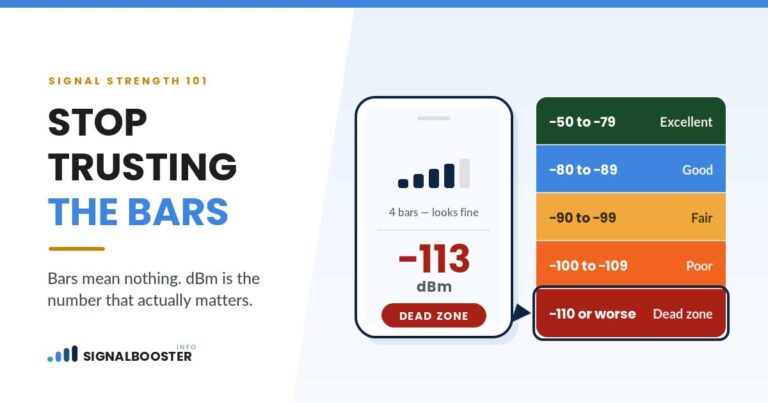
This works because dBm is a real measurement rather than a rendering of bars. If you have not done it before, how to check your real signal strength in dBm covers the steps for iPhone and Android.
- Pick one fixed spot. Somewhere with a middling signal, not your best room and not your worst. A spot with excellent signal will hide a small effect; a dead zone will bury it in fluctuation.
- Put the phone down and leave it. Holding a phone changes its reception. Rest it on a table in the same orientation for every reading.
- Take three readings with the case on, roughly a minute apart. Write each one down.
- Take the case off, including any magnetic mount plate or cards, and wait a minute before starting.
- Take three readings with the case off, same spot, same orientation, same position on the table.
- Compare the averages, not the individual numbers.
Interpreting the result honestly is the part that matters. Signal fluctuates on its own by a few dBm from minute to minute even when nothing changes, so a difference of two or three points between your two averages tells you nothing. A consistent difference of ten dBm or more is a real effect worth acting on, because on a logarithmic scale that is a substantial change in received power rather than a rounding artefact. Anything in between is ambiguous, and the sensible response to ambiguous is to repeat the test at a different time of day before concluding anything.
If you want context on whether your readings are healthy in the first place, what counts as a good dBm number explains the scale.
What to Do If Your Case Really Is the Problem
If the test shows a genuine difference, the fix is proportionate to the finding and does not involve buying anything expensive.
Remove the magnetic mount plate first if you have one, and re-test. That single component is responsible for a disproportionate share of real cases. If the plate is the culprit and you need a car mount, mount types that grip the phone rather than requiring a metal disc avoid the problem entirely.
If the case itself is the cause, switching to a plain silicone, TPU or polycarbonate case will resolve it. There is no need for a case marketed as signal-friendly or reception-enhancing. A case does not enhance reception; the ordinary ones simply do not get in the way, and that is the whole of it. No product is recommended here because this site does not test cases and will not pretend otherwise.
When the Case Is Not the Problem
Here is the honest expectation to set before you run the test: for most people, it will come back negative. The case is worth ruling out because it costs nothing to check, not because it is likely.
If your readings are essentially the same with and without the case, you have learned something genuinely useful. You can stop wondering about it and move on to causes that scale with the size of your problem. A case cannot explain a whole-house dead zone or a basement that has never worked. Those come from the building, the distance to the tower, or the network, and our walkthrough of why your signal is weak at home is the next step for narrowing that down.
It also cannot explain a signal that is bad everywhere including outdoors and away from home. If the problem follows you, the case is not it.
FAQ
Does a phone case block signal?
Most do not. Cases made from silicone, TPU, polycarbonate or leather are effectively transparent to the radio frequencies phones use. Cases with metal components, and thin metal plates added for magnetic car mounts, are the ones worth testing.
Do clear cases affect signal?
Clear cases are typically polycarbonate or TPU, both non-conductive, so they are among the least likely to cause a problem. Check whether anything metal has been added inside.
Does a magnetic car mount plate reduce signal?
It is the most common case-related cause worth checking, because it places a flat piece of metal directly against the back of the phone near the antennas. Remove it and re-test to find out on your specific device.
Do MagSafe cases affect reception?
Magnet arrays designed to work with a phone’s own magnetic alignment system are engineered around that phone’s antenna layout, which is a different situation from an aftermarket metal disc stuck on afterwards. Test yours the same way regardless.
How can I tell if my case is affecting my signal?
Take three dBm readings with the case on and three with it off, in the same spot with the phone resting untouched, and compare the averages. A difference of a couple of points is normal fluctuation. A consistent ten-point difference is real. More detail on the readings themselves is on our boosters FAQ page.