Short answer: the “covers up to 5,000 sq. ft.” number on the box is a best-case figure, measured with strong outdoor signal, an open single-floor layout, and no interference. Your real coverage depends on three things the box doesn’t tell you: how strong your outdoor signal actually is where the outside antenna will go, what your walls and roof are made of, and how many floors you’re trying to cover. A booster rated for 5,000 sq. ft. can realistically deliver as little as 1,000 to 2,500 sq. ft. once you factor in real conditions. Here’s how to translate the advertised number into a figure that actually applies to your house.
What “Covers Up to X,000 Sq. Ft.” Actually Means (and Doesn’t)
Every manufacturer’s coverage rating is measured under the conditions that produce the biggest possible number: a strong outdoor signal (typically 4 to 5 bars), a single open floor with no interior walls to speak of, and an omni-directional antenna placed in the center of the space. That’s a lab-adjacent scenario, not a house.
Look at the fine print on any product page and you’ll find some version of the same disclaimer. HiBoost lists its 4K Plus Pro at up to 6,000 sq. ft. and its 10K Plus at up to 10,000 sq. ft. weBoost lists its Home MultiRoom (model 470144) at up to 5,000 sq. ft. Those numbers are real, they’re not made up, but they describe the ceiling, not the average outcome. Nobody buys a booster and gets to choose ideal conditions. You get the conditions your house already has.
The sq. ft. number is really a stand-in for a different spec: gain, measured in dB, which is how much the booster amplifies the signal it receives. HiBoost’s 10K Plus is rated at roughly 65 dB of gain, and its larger 15K model steps up from there. Higher gain is what lets a booster push amplified signal across a larger rated area, but gain works on whatever signal it’s given. A high-gain booster fed a very weak outdoor signal still ends up with a modest usable result indoors, which is exactly why the sq. ft. rating on the box and the sq. ft. you actually get can be two different numbers.
The Realistic-vs-Advertised Coverage Gap
Here’s what that gap actually looks like, using the weBoost Home MultiRoom’s own published rating as the example, since it’s one of the few products where a retailer states the lower-signal number outright instead of just the headline figure.
| Outdoor signal at the antenna location | Advertised rating | Realistic indoor coverage |
|---|---|---|
| Strong: 4-5 bars outdoors | “Up to 5,000 sq. ft.” | Close to the advertised number is realistic here |
| Moderate: 2-3 bars outdoors | Same “up to 5,000 sq. ft.” rating | No manufacturer publishes this middle figure. Budget for meaningfully less than 5,000 sq. ft. until you can test it on site |
| Weak: 1 bar or less outdoors | Same “up to 5,000 sq. ft.” rating | 1,000 to 2,500 sq. ft., stated directly on the retailer’s own spec page for this exact model |
That middle row is the honest gap. Manufacturers publish the best case and, occasionally, the worst case. Almost nobody publishes what happens in between, which is where most houses actually land.
The Three Things That Shrink Real-World Coverage
A booster amplifies the outdoor signal that reaches it. It doesn’t generate signal, and it doesn’t overcome a weak starting point on its own. Three variables decide how much of the advertised number you actually get.
Outdoor signal strength. This is the single biggest lever. A booster can only work with what’s already there. Strong outdoor signal gives the amplifier more to work with, so more of it survives the trip through your walls. Weak outdoor signal means there’s less to amplify in the first place, and coverage shrinks accordingly, regardless of how large the box says the booster is rated.
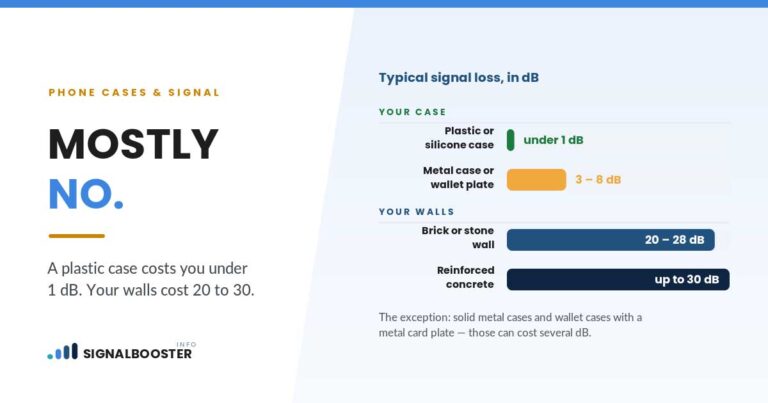
Building materials. Brick, poured concrete, metal roofing and siding, and energy-efficient low-E window coatings all block or reflect cellular radio waves more aggressively than drywall or wood framing. Two houses with identical outdoor signal and the same booster can end up with noticeably different indoor coverage purely because of what the walls are made of.
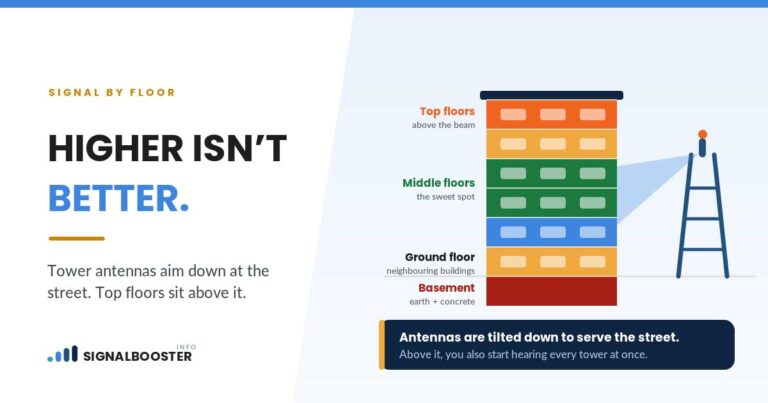
Number of floors and layout. A booster’s rating usually assumes one open floor. A two-story house with the same total square footage as a ranch doesn’t automatically get the same coverage, because the antenna type and placement that work for a single floor don’t distribute signal the same way vertically. More on that below.
Outdoor Signal Strength Is Your Real Starting Point
Before you compare a single sq. ft. number between products, find out what you’re actually starting with. Standing at the spot where the outside antenna would mount (usually the roof or an exterior wall) and checking your bars gives you a rough read, but bars are a rounded, four- or five-level approximation. The actual number, in dBm, tells you far more precisely where you land, and it’s the number that determines which row of the coverage table above applies to you. If you haven’t checked it yet, see how to check your dBm signal strength before you shop by sq. ft. rating alone.
The Honest Section Most Booster Sites Skip
To be fair, some manufacturer content acknowledges this gap exists. Wilson Amplifiers’ own blog post on “expectations vs. reality” states plainly that advertised square footage assumes ideal conditions, and that real coverage depends on outdoor signal, building materials, and antenna placement. That’s a genuinely honest caveat, more honest than most product pages in this space offer.
But even that piece stops at the disclaimer. It tells you the number will be lower, then directs you to call a sales line for a personalized estimate. None of the ranking guides we reviewed while researching this piece, including that one, give the reader an actual method to translate “up to X,000 sq. ft.” into a realistic number for their own house before they’ve spent the money. That’s the piece that’s missing, and it’s the reason this article exists.
A Simple Way to Estimate Your Actual Coverage
This isn’t a validated formula. It’s the same rough field judgment a technician applies before quoting a job, adjusted so you can do a version of it yourself with a phone and a tape measure.
- Start with the box number. Note the manufacturer’s advertised max sq. ft. for the model you’re considering.
- Check your actual outdoor signal at the antenna mounting location. Strong (4-5 bars, good dBm reading) means you can expect to land closer to the advertised number. Weak (1 bar or worse) means you should plan on roughly a quarter to half of it, in line with the retailer-published range above.
- Subtract for construction. If your home has brick, concrete block, stucco over metal lath, a metal roof, or low-E windows, discount your estimate further. None of these are a fixed percentage; treat it as another reason to expect less than the headline number, not more.
- Divide by floors, not just total square footage. A single indoor antenna covers one level well. If you’re covering two or three floors, the effective footprint per floor drops even if the total house square footage matches the box rating.
The point isn’t to arrive at an exact number. It’s to stop comparing your house to the best-case scenario on the label.
Multi-Floor and Multi-Room Homes: What Changes
A single omni-directional (dome) indoor antenna broadcasts in a circle around one central point and is designed for one floor. It’s a poor match for a multi-story house, even if the total square footage is well under the booster’s rating, because the signal doesn’t travel down a stairwell the way it travels across an open room.
For multi-floor coverage, the usual fix is a panel antenna, which directs signal down a long space like a hallway or stairwell rather than broadcasting it in a circle, or multiple indoor antennas run off a single booster through a splitter, one per floor or per problem area. Basements are their own case: they typically need dedicated attention (a nearby antenna, sometimes a repeater aimed specifically at that level) rather than an assumption that the whole-house rating will simply reach downstairs.
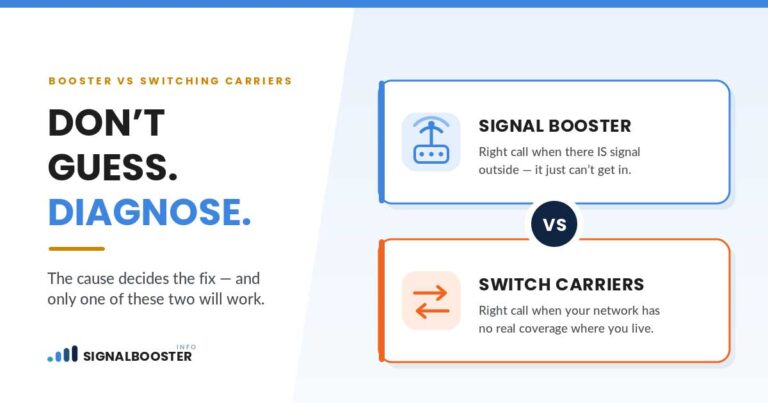
If you’re still not sure whether your issue is even a coverage-and-distance problem in the first place, rather than a network or device issue, it’s worth ruling that out with a quick diagnostic before you size a booster at all. And if it turns out your outdoor signal is weak everywhere, not just indoors, a booster may not be the right tool; see when switching carriers actually solves the problem instead.
For a broader explanation of how boosters work before you get into coverage math, our guide to what a signal booster actually does covers the underlying mechanics.
FAQ
Does a higher sq. ft. rating always mean a stronger booster?
Generally yes, a higher rating reflects a higher-gain amplifier and typically a higher price tier, but the rating only tells you the ceiling. A “10,000 sq. ft.” booster in a weak-signal house can still underperform a “5,000 sq. ft.” booster in a strong-signal house.
Should I just buy the largest booster to be safe?
Not necessarily. Oversizing wastes money on a mid-range or premium tier unit you don’t need, and a system’s actual output is still capped by your outdoor signal, not by how much you spent. Size to your real conditions, not to the biggest number on the shelf.
What if my outdoor signal is weak everywhere, not just inside?
A booster amplifies existing signal; it can’t create signal that isn’t there. If you get no usable bars standing outside either, the fix may not be a booster at all. Compare that scenario against switching carriers instead.
Do building materials matter more than distance from the cell tower?
Both matter, and they compound. A home close to a tower but built with metal roofing and low-E glass can have worse indoor signal than a home farther out with standard wood-frame construction. Check your outdoor dBm first; it already reflects the distance factor.
How much coverage do I lose in a two-story house compared to a single story of the same size?
There’s no single published number, because it depends on antenna type and placement, not just square footage. The practical takeaway is that a single indoor antenna rated for the whole house’s square footage should not be assumed to cover both floors equally; plan for a panel antenna or an additional antenna per floor instead.