Your phone reports two entirely different things about your connection, and almost every guide online only discusses one of them. Strength is how much power is arriving. Quality is how much of that power is actually usable once interference and noise are accounted for. You can have plenty of the first and very little of the second, and when that happens your bars look great while your calls fall apart.
This distinction is not academic. It is the difference between a problem an amplifier can fix and a problem an amplifier will make worse.
Two Numbers, Two Different Problems
Think of it as volume versus clarity. Strength is how loudly the tower is speaking to you. Quality is how much competing noise is in the room while it speaks.
A quiet voice in a silent room is easy to follow. A loud voice in a crowded bar is not. Turning up the volume in the bar does not help, because the noise gets louder with the voice. That is the entire concept, and it is also why a booster helps in some houses and does nothing in others.
Strength: RSRP, Measured in dBm
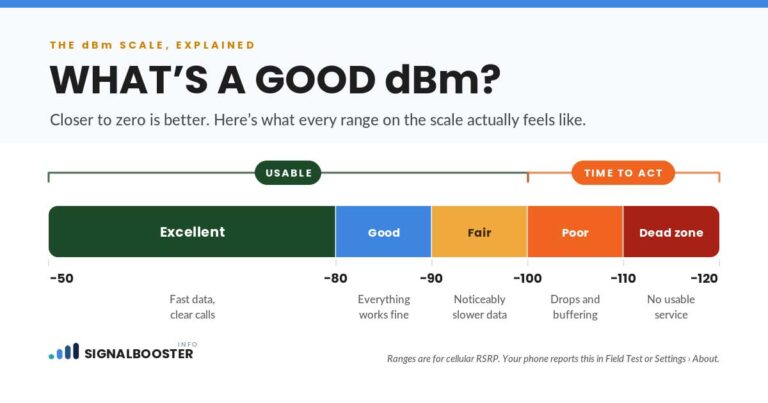
RSRP stands for Reference Signal Received Power. It measures the power of the reference signal your phone receives from the tower, expressed in dBm, a negative number where closer to zero is stronger.
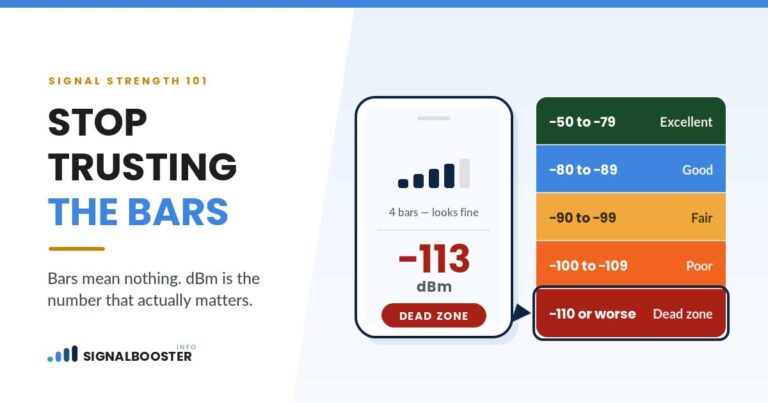
This is the number people mean when they say "signal strength," and it is the one that maps to your bars. It is driven by physical things: how far the tower is, what is between you and it, and how much of the signal your walls, windows and roof absorb or reflect before it reaches you. If you want yours, our guide to checking your real signal strength in dBm walks through it on both iPhone and Android, and what counts as a good dBm number covers how to read the result.
RSRP is the number a booster acts on. An outdoor antenna and amplifier take a weak-but-present outdoor signal and raise its power inside the building. That is a strength intervention, and it works when strength is genuinely what you lack.
Quality: RSRQ and SINR, Measured in dB
Two metrics describe quality, and they sit right next to RSRP on the same screen once you know they are there.
RSRQ (Reference Signal Received Quality) compares the useful reference signal against the total power on the channel, including everything else arriving at the same time. It is reported in dB, and like RSRP it is negative, with closer to zero being better.
SINR (Signal to Interference plus Noise Ratio) is the cleanest expression of the idea: how strong the signal you want is compared with everything you do not want. Unlike the other two, SINR is usually a positive number when things are going well, and a higher figure is better. A negative SINR means the noise is louder than the signal, which is roughly as bad as it sounds.
The published reference bands, from Powerful Signal's knowledge base entry on strength and quality:
| Metric | Excellent | Good | Fair | Poor |
|---|---|---|---|---|
| RSRP (strength) | -89 dBm or stronger | -90 to -104 dBm | -105 to -114 dBm | -115 to -124 dBm |
| RSRQ (quality) | -9 dB or better | -10 to -14 dB | -15 to -19 dB | -20 dB or worse |
| SINR (quality) | 11 or higher | 6 to 10 | 0 to 5 | Below 0 |
As with any published scale, these are conventions drawn on a continuous range rather than official regulatory boundaries. They are useful for telling a comfortable reading from a marginal one, not for splitting hairs over a point or two.
The Four Combinations, and What Each One Means
Once you have both a strength number and a quality number, there are only four situations you can be in, and each one has a different answer.
| Strength | Quality | What is happening | Sensible next step |
|---|---|---|---|
| Strong | Good | Normal, healthy connection | Nothing is wrong with your signal. If service is still bad, look at the phone, the plan or the app. |
| Strong | Poor | Signal is arriving with plenty of power but carrying interference, or the tower is congested | Amplification will not help. Interference or capacity is the issue, and neither responds to more power. |
| Weak | Good | A clean but faint signal, usually distance or building attenuation | This is the classic case where bringing the outdoor signal inside is the category of fix that applies. |
| Weak | Poor | Faint signal with noise on top, often several distant towers competing | The hardest case. Directional aiming at a single tower helps more than raw amplification, and sometimes nothing sensible helps. |
The row worth staring at is the second one. Strong strength with poor quality is extremely common, it is what most "full bars but nothing works" complaints actually are, and it is the exact case where a purchase is most likely to disappoint. If that describes you, full bars but calls still dropping goes through the specific mechanisms in more detail.
Why This Changes Whether a Booster Helps
Here is the part that gets left out of most articles on this subject, including a great many written by companies that sell amplifiers.
An amplifier raises everything it receives. It does not distinguish between the signal you want and the interference arriving alongside it. If your problem is a faint but clean signal, raising it is exactly right. You end up with a stronger signal that is still clean. If your problem is a strong signal buried in noise, raising it produces a stronger signal still buried in the same proportion of noise. The ratio, which is the thing that was hurting you, does not improve.
That is why two neighbors can install identical equipment and get opposite results, and why the honest first question is never "which one should I buy" but "which of my two numbers is actually low." Our overview of what a signal booster is and how it works covers the mechanism in plain language.
There is a second implication. If your quality is poor because the tower is congested rather than because of interference, no hardware you install at home addresses it at all, the constraint is on the network side. In that situation the realistic options are a different carrier with different tower loading, or a Wi-Fi-based calling path. Our comparison of a booster versus switching carriers works through that decision without a product to sell at the end of it.
Where to Find Both Numbers on Your Phone
The good news is that quality metrics live in the same places as strength metrics, so if you can find one you can find the other.
On iPhone, Field Test Mode shows RSRP, RSRQ and SINR together in the LTE or 5G section. Which values appear depends on your model, iOS version and carrier, and some combinations show fewer metrics than others.
On Android, Settings, then About Phone, then Status, then SIM Status shows signal strength on most devices, though the quality figures are more often hidden. Samsung's service mode and third-party network-information apps expose the full set on phones where the built-in menus do not.
Full step-by-step instructions for both platforms are in our dBm measurement guide, and everything there applies to the quality numbers too. They are on the same screen.
One caution: take these readings the same way you would take strength readings. Several spots, several times, written down. Quality fluctuates more than strength does, because it depends on what everyone else nearby is doing, so a single SINR reading during a busy hour is a particularly unreliable thing to make a purchase decision on.
FAQ
What is the difference between signal strength and signal quality?
Strength (RSRP, in dBm) is how much power your phone receives from the tower. Quality (RSRQ and SINR, in dB) is how much of that power is usable once interference and background noise are accounted for. Strength is volume; quality is clarity.
Can I have strong signal and bad quality?
Yes, and it is one of the most common complaints in this niche. It usually means interference from competing signals or a congested tower. Neither responds to amplification.
Which matters more, RSRP or SINR?
Neither by itself. RSRP tells you whether there is enough signal to work with; SINR tells you whether it is clean enough to use. A decision made on one without the other is a guess.
Does a signal booster improve signal quality?
It amplifies what it receives, including any interference riding along with it. It raises strength. It does not improve the ratio between signal and noise, which is what quality measures.
What is a good SINR value?
Using the published bands above, 11 or higher is excellent, 6 to 10 is good, 0 to 5 is fair, and below 0 means noise exceeds signal. Treat those as conventions rather than exact cutoffs.