Short answer: yes, a cell phone signal booster is legal in the United States, but only if it meets two conditions. First, the unit itself has to be FCC-certified, built to the FCC’s 2014 consumer booster rules. Second, you have to register that specific booster with your cell carrier, free, before you turn it on. Skip either step and you’re operating the booster illegally, even if the hardware is a legitimate model sold by a real retailer. This is federal law under 47 CFR 20.21, and it exists for a real reason: an uncertified or unregistered booster can interfere with the same cellular network everyone around you, including emergency callers, depends on.
I’ve been through the registration step myself, on my own install. It takes about five minutes and it’s the part almost nobody enjoys explaining, so here’s the plain version.
The Short Answer: Yes, If It’s FCC-Certified and Registered
The rule that governs this is 47 CFR 20.21, the FCC’s signal booster regulation. It applies specifically to what the FCC calls “wideband consumer signal boosters,” the category that covers the home, office, and vehicle units sold to regular consumers (as opposed to specialized public safety or industrial repeaters, which fall under different rules).
Under that rule, using a booster legally requires two things:
- The device is FCC-certified. It was tested and authorized to meet the FCC’s technical standards for consumer boosters.
- You’ve registered it with your wireless carrier. Every major carrier that permits booster use has to provide a free registration system, and you’re required to use it.
The FCC’s own consumer signal boosters page states this directly: there are two things a consumer needs to do to use a booster, get their wireless provider’s approval, and register the specific unit with that provider. For units carrying the standard manufacturer warning label (all units sold after March 1, 2014 should have one), the four major carriers have already granted blanket approval, which covers step one automatically. Registration is the step that still has to happen on your end, unit by unit.
What “FCC-Certified” Actually Means (and How to Check Yours Has It)
FCC certification for a consumer booster means the specific model was tested against, and passed, FCC Part 20 Subpart O, the technical standard written for wideband consumer signal boosters. A certified device is issued an FCC ID, a code you’ll find printed on the unit itself or on the box.
Before you buy, or right after you unbox, do this:
- Find the FCC ID on the device label or the packaging.
- Confirm it’s real by searching that ID in the FCC’s public equipment authorization database, not just trusting a sticker.
- Check for the manufacturer consumer warning label required on units sold after March 1, 2014. Its presence is the shorthand carriers use to recognize a pre-approved unit.
If a booster has no FCC ID printed anywhere, or the seller can’t point you to one, that’s the single clearest signal you’re looking at a non-compliant unit, regardless of how convincing the listing looks.
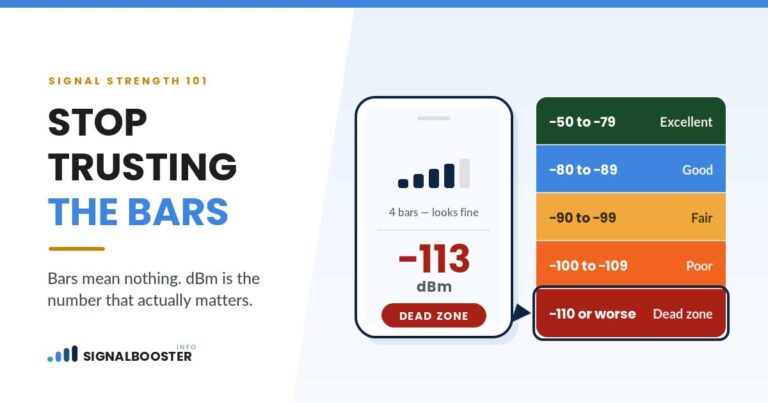
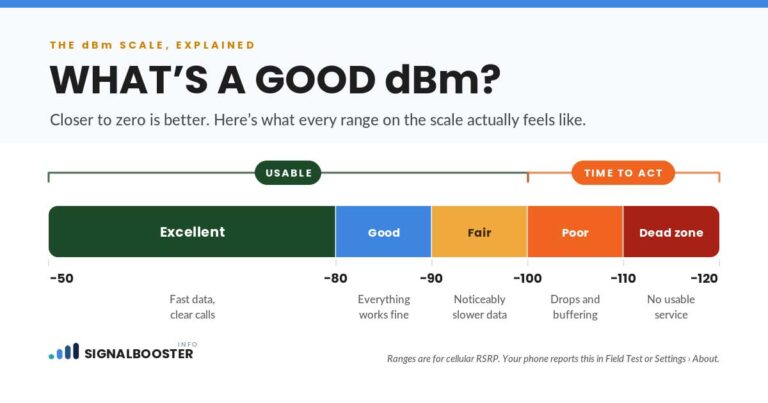
If you’re not sure your indoor coverage problem is even a booster-shaped problem yet, it’s worth checking your real signal strength in dBm before you buy anything, certified or not.
Why Registration Is Required, and What Actually Happens If You Skip It
Registration exists so your carrier has a record of every booster active on its network: who owns it, what it is, and where it’s operating. Under the rule, the carrier’s registration system has to collect the owner or operator’s name, the booster’s make, model, and serial number, the installation location, and the date it went into service.
Here’s the honest part most product pages skip: for an individual homeowner running a certified, correctly installed booster, the practical risk of skipping registration isn’t a knock on the door or a fine in the mail. FCC enforcement action has historically targeted the manufacturers and importers of uncertified, illegal boosters, not individual users of legitimate ones. The real-world consequence of an unregistered unit is narrower but still real: if your booster is ever flagged as a source of interference, whether from a bad install, a failing unit, or genuine non-compliance, your carrier has the authority to require it be shut off, and without a registration record, there’s no fast way for them to identify and resolve the problem before it escalates. Registering at install is what keeps that scenario from ever becoming your problem.
How to Register With Your Carrier
Every major US carrier that permits consumer boosters, including Verizon, AT&T, and T-Mobile, is required to run a free registration system, and the core information they ask for is consistent across all of them:
- Your name (the booster’s owner or operator)
- The booster’s make, model, and serial number (all printed on the unit itself)
- The physical address where it’s installed
- The date it went into service
Because carriers occasionally move or redesign their registration pages, the fastest reliable path is to search “[your carrier] signal booster registration” and use the current form on the carrier’s own site rather than a bookmarked link from an old article, this one included. Submit the form, and save the confirmation. That confirmation is the only proof you’ll need if the topic ever comes up again.
What Actually Causes Interference (and Why the FCC Cares)
The FCC’s rules require every certified consumer booster to include what’s called a network protection standard: built-in circuitry that automatically detects and corrects oscillation, the feedback loop that happens when a booster’s outdoor and indoor antennas are too close together or aimed wrong. Certified units are required to detect and either reduce gain or shut down within 0.3 seconds in the uplink band and within 1 second in the downlink band, and that feature can’t be disabled by the operator.
This is the actual mechanism a badly installed or non-compliant booster can hurt for everyone nearby, not just the person who bought it. Oscillation and excess gain from a runaway booster don’t just weaken a signal, they can degrade capacity on the carrier’s tower for everyone connected to it in that area, in a worst case including a 911 call trying to go through. That’s the entire reason this is federal regulation and not a courtesy suggestion.
If you want the mechanics of why your home has a dead zone in the first place, before you get anywhere near a booster purchase, that’s covered separately in why your signal is weak at home.
The Part Nobody Selling You a Booster Wants to Slow Down and Explain
Every company selling boosters online has an incentive to get you to checkout fast, and the FCC-certified, correctly registered path is genuinely not the fastest one. That gap is exactly where uncertified boosters come from.
Since the FCC’s crackdown on non-compliant devices, most illegal boosters aren’t sold by US retailers anymore, they’re marketed by overseas sellers on general marketplaces, often at a price that looks too good against a certified unit’s tier. These units typically skip the network protection standard entirely: no automatic oscillation shutdown, gain set higher than the rule allows, no FCC ID because they were never tested against Part 20 Subpart O in the first place. Because they don’t self-correct, a bad one left running can quietly degrade a carrier’s local coverage in a way a certified unit is engineered not to.
Worth saying plainly since the terms get confused: a signal booster and a cell phone jammer are not the same category of device, and jammers are illegal outright, full stop, no certification path exists for them at all. A booster amplifies a real signal that’s already there. A jammer blocks signal on purpose. If anything marketed to you claims to “block” or “cut” cell signal, it’s not a booster and it’s not legal to own, sell, or operate under federal law, regardless of who’s selling it.
The honest test before you buy anything: if a listing can’t show you an FCC ID, or the price seems disconnected from every certified competitor’s, treat that as a real warning sign, not a bargain.
Signal Booster Legal Compliance Checklist
| Requirement | What it means | How to confirm it |
|---|---|---|
| FCC certification | The unit passed testing under Part 20 Subpart O, the FCC’s rule for consumer boosters | Look for an FCC ID on the label or box, then verify it in the FCC’s public equipment database |
| Manufacturer warning label | Confirms a unit sold after March 1, 2014 was built to the current rules and is pre-approved by major carriers | Check the box or device casing for the required label |
| Carrier registration | A free record with your carrier: your name, the booster’s make/model/serial number, install address, activation date | Submit through your carrier’s current signal booster registration page and keep the confirmation |
| Network protection standard | Automatic oscillation detection and gain reduction or shutdown, built in, can’t be turned off | Present by default in any certified unit; a device that lets you disable it isn’t compliant |
| Not a jammer | Boosters amplify signal; jammers block it entirely and have no legal path at all | If a device claims to block or cut cell signal rather than boost it, it’s not a legal booster |
Once a booster is registered and running, the honest next question is usually how much of your space it will actually reach, which is its own topic covered in how much coverage a signal booster really gives you, separate from the marketing square-footage numbers on the box.
FAQ
Do I need a government permit to install a signal booster in my home?
No. You don’t need a permit from any city or federal agency. What you do need is to register the specific unit with your wireless carrier, which is free and takes the place of anything resembling a permit.
Can I actually get in trouble for using an unregistered signal booster?
The realistic consequence is that your carrier can require you to turn it off if it’s ever identified as a source of interference. Registering at the time of install is what avoids that conversation entirely.
Are cell phone signal boosters the same thing as cell phone jammers?
No, and this is worth being clear on. Boosters amplify an existing carrier signal and are legal when FCC-certified and registered. Jammers block signal on purpose and are illegal to sell, buy, or operate under federal law, with no certification path available at all.
Does the registration requirement apply to boosters in an RV or vehicle, not just a house?
Yes. The FCC’s registration requirement applies to any consumer signal booster regardless of where it’s installed, home, office, or vehicle.
How do I check that a booster I’m considering is actually FCC-certified before I buy it?
Look for the FCC ID printed on the unit or its box, then confirm that ID is real in the FCC’s public equipment authorization database before purchase, not after. For more on how boosters work and where they fit, see what a signal booster actually is and the full list of common booster questions we’ve collected. Our full disclaimer on regulated equipment covers this same requirement in short form.