Everyone assumes higher is better. Get above the obstructions, get closer to the sky, get a better signal. It is a reasonable intuition and it is frequently wrong, which is why so many people end up confused by a top-floor flat that performs worse than the one they moved out of.
Three separate mechanisms decide how signal behaves floor by floor, and two of them work against height. Understanding which one applies to your building tells you whether there is anything worth doing about it.
Higher Is Not Automatically Better
The mental model most people carry is a tower broadcasting outward in all directions like a light bulb, so being higher and less obstructed means catching more of it.
Real cell sites are not built that way. They use sector antennas with deliberately shaped beams, aimed to cover a specific area on the ground. The engineering objective is to serve the streets and buildings within that area and, just as importantly, to avoid spraying signal into neighboring cells where it becomes interference for someone else.
That design intent has consequences for anyone living vertically, and they are not intuitive.
Downward Tilt: Why the Top Floor Can Be the Worst One
Sector antennas are typically downtilted, angled toward the ground rather than out at the horizon. The main beam, where signal is strongest, is directed at the coverage area below and around the site.
The result is a coverage pattern shaped roughly like a cone pointing downward and outward. Below and within the cone, service is as designed. Above it, you are outside the beam that was aimed at you.
Once a building rises past the height that the surrounding sites were designed to serve, upper floors can find themselves above the main beam of every nearby site. The phone is not blocked by anything (it has a clear view for miles), but the signal it can see is coming from the edges of beams pointing somewhere else. This is the mechanism behind the recurring complaint that a high floor gets a worse signal than the lobby did.
There is no universal floor number at which this begins. It depends entirely on how tall the surrounding sites are, how they are tilted, how far away they are, and how tall your building is relative to its neighbors. Any article giving you a specific storey as the threshold is generalising well past what the physics supports.
Too Many Towers at Once: Strong Signal, Bad Service
The second height problem is subtler and catches people who have plenty of signal.
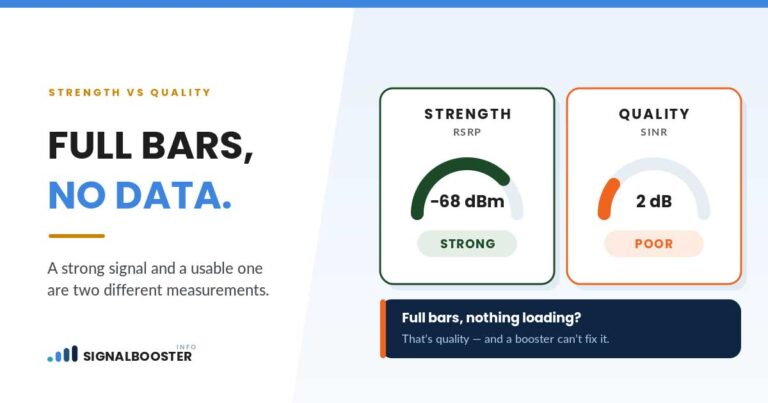
From a high floor with clear sightlines, your phone can often see many cell sites at once, including distant ones it would never reach from ground level. Each of those is transmitting. Your phone connects to one and receives all the others as interference.
The measurable result is a strong power reading with poor quality, high RSRP, poor RSRQ and SINR. Service is unreliable in a way that makes no sense to anyone looking at bars, because the bars look excellent. This is exactly the pattern covered in signal strength versus signal quality, and it is one of the clearest real-world illustrations of why those two numbers need to be read together.
It also has an important consequence for what helps. Amplification raises the interfering signals along with the wanted one, so it does not improve the ratio. What helps in this situation is selectivity (favoring one direction over all the others), which is a different property from raw gain.
Lower Floors: More Building in the Way
The opposite problem applies at the bottom.
Ground floors and below-grade levels sit inside more building. Signal reaching them has passed through more structure, and in larger buildings it also has to travel through the mass of the building itself rather than arriving through an exterior wall. Concrete with steel reinforcement is a substantial obstacle, and a ground-floor unit in the middle of a large footprint may be a long way from any exterior wall in every direction.
Basements are the extreme version of this and they behave differently enough to deserve their own treatment, which they will get elsewhere on this site. For now the relevant point is simply that “low” and “high” fail for opposite reasons, and confirming which one you have determines what to do next.
Why the Middle Often Wins
Put the three mechanisms together and the shape of the answer appears.
Low floors lose to building mass. High floors lose to downtilt, and to interference from seeing too many sites at once. Mid-level floors are frequently the sweet spot: high enough to be above the densest structure and to clear immediate obstructions, low enough to still sit inside the main beam of the sites designed to serve the area, and not so exposed that they receive every distant transmitter in the region.
This is genuinely actionable and costs nothing. If you have access to more than one floor (a house, a maisonette, an office where you can choose a desk) the middle is where to try first.
Mapping Your Own Building, Floor by Floor
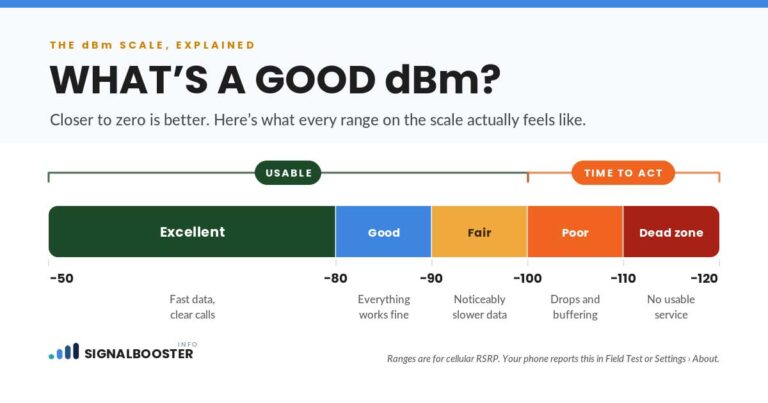
Generalisations only get you so far. Your building has a specific answer and it takes about twenty minutes to find it. Use dBm readings rather than bars; our guide to checking real signal strength covers the steps, and what counts as a good number explains the scale.
- Start outside at ground level. Walk around the building and take a reading on each side. Note which side is strongest. That is very likely the direction of the nearest usable site, and it matters for everything that follows.
- On each floor you can access, take two readings: one beside a window on the strong side identified in step 1, and one in an interior space away from exterior walls.
- Record the quality figures too, not just strength. On upper floors especially, this is where the story often is.
- Write down floor, position, strength, quality, and time.
Then read the pattern:
Strength falls steadily as you go up, quality stays reasonable. Downtilt. You are climbing out of the beam.
Strength holds up or improves with height but quality gets worse. Too many sites visible at once. This is the high-floor interference case, and the fix is directional rather than amplifying.
Strength is poor at the bottom and improves as you climb. Building mass at ground level. The conventional pattern, and the one most people expect.
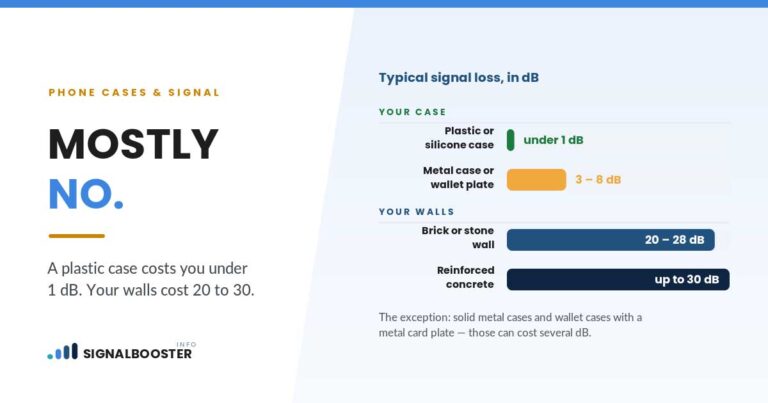
Window readings are far better than interior readings on every floor. The problem is the building envelope more than the floor level. The materials in your walls and windows are the thing to look at, which our article on whether metal siding or stucco blocks cell signal goes into.
What Actually Helps, Depending on the Pattern
Because the causes are different, the responses are different, and a fix aimed at the wrong one is wasted.
If it is downtilt or building mass (a weak but reasonably clean signal) this is the classic case for capturing signal outside and distributing it inside. Where the outdoor antenna goes is the whole question, and higher is not automatically the right answer here either: the right position is wherever your survey found the strongest clean reading, which may well not be the roof. Our explanation of what a signal booster is and how it works covers the category, and what coverage claims in square feet actually mean is worth reading before you judge any equipment by its stated coverage, because a multi-floor building is exactly where those numbers are least meaningful.
If it is high-floor interference (strong but noisy) amplification is the wrong tool, because it raises the noise proportionally. Directionality is what helps: favoring one site and rejecting the others.
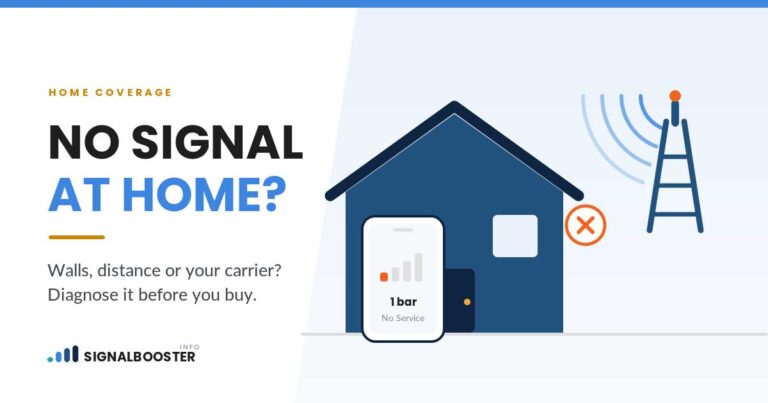
If the pattern varies wildly between rooms on the same floor. That is not really a floor-level problem at all. It is an internal layout and materials problem, and why your signal is weak at home is the better starting point.
One practical constraint worth naming, because most articles on this subject quietly assume a homeowner. If you rent a flat in a multi-occupancy building, mounting anything on the exterior or the roof is usually not yours to decide, and in many buildings it is explicitly not permitted. Do the survey anyway, knowing which room and which side of the building works best is free, and it is often the only change actually available to you.
FAQ
Why is cell signal worse on higher floors?
Cell site antennas are usually angled downward to cover the ground below them. Above a certain height a building can sit above that main beam, so upper floors receive only the weaker edges of beams aimed elsewhere.
Which floor has the best cell signal?
Frequently a middle floor. Low floors are hindered by building mass and high floors by downtilt and by interference from seeing many sites at once. The only reliable answer is a survey of your own building.
Why do I have full bars on the top floor but bad service?
Because from height your phone can see many cell sites at once. Power is high while quality is poor, since all the sites you are not connected to arrive as interference.
Does a signal booster work in a multi-story building?
It depends which problem you have. A weak but clean signal responds to amplification. A strong but noisy one does not, and needs directionality instead. Multi-floor coverage also makes stated square-foot figures particularly unreliable.
Can I improve signal on my floor without installing anything?
Often, yes. Identify the strongest side of the building from outside, then work near a window on that side. In a multi-floor home, trying a middle floor is free and frequently helps.