There is nothing contradictory about four bars and a call that dies mid-sentence, even though it feels like your phone is lying to you. It is not lying exactly. It is reporting one narrow thing and letting you assume it means something broader.
Once you know what the bars actually measure, the whole situation stops being mysterious and turns into a short list of four specific failure modes. Each one has a different cause, and (this is the part worth staying for) only one of them is the kind of problem hardware fixes.
What the Bars Are Actually Showing You
Your signal indicator is a rendering of downlink received power. That is it. It reflects, roughly, how much power is arriving at your phone from the tower on the path that runs tower to phone.
Three consequences follow, and every one of them is a way for bars to be high while your call fails.
The bars do not show quality (how much interference and noise is mixed in with that power. They do not show capacity) whether the tower has room for your call. And they do not show the uplink, the return path from your phone back to the tower, which is a separate radio link with separate constraints.
There is a fourth problem with bars that has nothing to do with any of that: the scale is not standardised. Every manufacturer picks its own formula for how many bars to display at a given power level, so two phones side by side on the same carrier can disagree. This is why our editorial policy commits to discussing signal in measured dBm rather than in bars, and why the first practical step in any of the four cases below is to stop looking at the icon and start reading your actual dBm number.
Reason One: Strength Is Fine, Quality Is Not
The most common explanation by a wide margin.
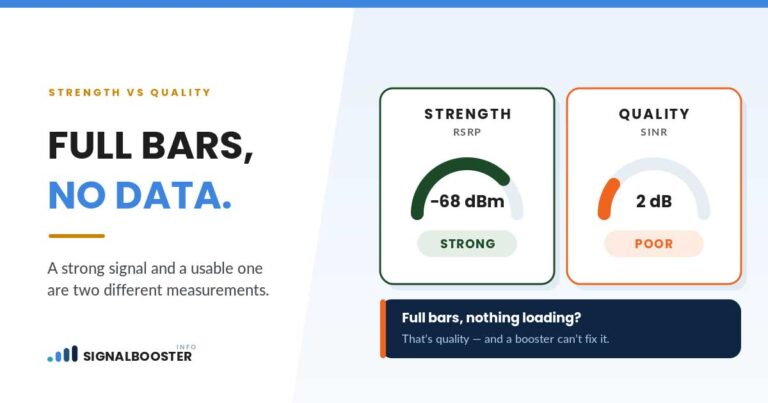
Your phone reports strength as RSRP and quality as RSRQ and SINR. Strength is how much power arrives. Quality is how much of that power is actually usable once competing signals and background noise are subtracted. They are independent, and one can be excellent while the other is dreadful.
Interference is the usual source. If your phone sits where signals from several towers overlap at similar power, or where electrical noise is being generated nearby, it receives plenty of energy and has to extract your conversation from the middle of it. When the ratio gets bad enough, the link cannot be maintained and the call drops, with the bars still showing strong, because the power was never the problem.
Our full explanation of signal strength versus signal quality covers the metrics and what each range means. The key implication for this article: amplification raises signal and interference together, so it does not improve the ratio that was failing.
Reason Two: The Tower Is Busy, Not Far
Signal power and network capacity are completely unrelated quantities, and this catches almost everyone out.
A cell site can be delivering a textbook-strong signal to your window while having no capacity left to carry another conversation. Capacity is finite and shared. When demand at a site exceeds what it can carry, new calls fail to set up and existing ones can be dropped.
The tells for congestion are behavioral rather than numerical. It happens at predictable times, evenings, commutes, the moment a nearby event lets out. It affects everyone in the area at once rather than just you. It comes and goes on a schedule, and if you take dBm readings during a bad episode you will find your strength number looks perfectly normal, because it is.
Nothing you install in your house changes the capacity of a tower. This is the single most important thing an independent site can tell you about this scenario, and it is the reason we do not carry affiliate links: there is no product that solves it.
Reason Three: The Handoff Failed
When you move between the coverage areas of two cell sites, your call has to be transferred from one to the other while it is in progress. That transfer is a coordinated negotiation, and it can fail.
Handoff failures are the reason calls drop at the same spot on the same drive every time. They are also why a call can fail when you walk from the garden into the house, or across a large building. Bars are irrelevant to it. You can be moving between two areas that both show strong signal and still lose the call in the gap where the transfer was supposed to happen.
The distinguishing feature is that the drop is tied to movement or location transition, not to time of day and not to a particular room. If your calls survive fine while you sit still and die whenever you walk somewhere or drive a particular stretch of road, this is your mechanism. It is not something you have done wrong, and it is not something a device in your house addresses.
Reason Four: Downlink Is Strong, Uplink Is Not
The asymmetry that almost nobody explains.
A cellular connection is two separate radio links. The tower transmits to your phone on the downlink, and your phone transmits back on the uplink. Your bars report the downlink only.
Those two links do not have the same budget. A tower transmits with far more power available to it than a phone running on a battery in your pocket. So there is a real and fairly common situation where the tower’s signal reaches you comfortably (strong bars, high RSRP), while your phone’s much weaker transmission does not make it back reliably. The link is broken in the direction you cannot see.
The symptom is distinctive and worth recognising. You can hear the other person perfectly and they cannot hear you, or the call drops specifically when you start speaking after a quiet stretch. If that pattern sounds familiar, the uplink is the leg that is failing, and no amount of looking at your bars will ever reveal it.
How to Tell Which One You Have
Four causes, four different signatures. Work through them in this order.
- Log dBm and quality readings over several days. Note the time of day with each one. Instructions are in our dBm measurement guide, and what counts as a good number explains how to read the results.
- Is strength good and quality poor? Interference. Reason one.
- Do the failures cluster at particular hours, and does strength look normal during them? Congestion. Reason two.
- Do the failures happen while moving, or at the same physical transition point? Handoff. Reason three.
- Can you hear them but they cannot hear you? Uplink. Reason four.
- Is strength genuinely weak too? Then bars were misleading you about the strength as well, and this article is the wrong one. You have an ordinary weak-signal problem.
What Each Cause Means for Whether Hardware Helps
Setting expectations honestly, because this is where most articles on this subject quietly stop being useful.
Interference: amplification raises the noise along with the signal, so it does not fix the ratio. A directional outdoor antenna aimed at one tower can help by rejecting signals arriving from other directions, but that is a targeting benefit rather than an amplification one, and it depends on your specific geometry.
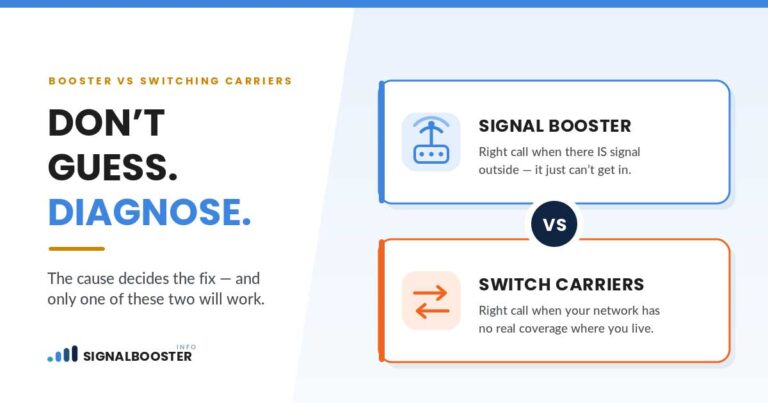
Congestion: nothing installed at your property changes it. The constraint is on the network side. A different carrier with different tower loading in your area is the realistic option, which our comparison of a booster versus switching carriers walks through.
Handoff failure: not addressed by equipment in your home. It is a network behavior between cell sites.
Uplink limitation: this one is genuinely a strength problem, just on the leg you cannot see. It is the case in this article where an amplified path between your phone and the tower is the category of fix that applies.
Three of four point away from a purchase. That is not a discouraging conclusion, it is an accurate one, and knowing which of the four you have is worth considerably more than a product recommendation would be.
FAQ
Why do my calls drop when I have full bars?
Because bars show downlink received power only. Interference, tower congestion, a failed handoff between cell sites, or a weak uplink from your phone can each break a call while the bars still read strong.
Do full bars mean good signal?
They mean the power arriving from the tower is high. They say nothing about interference, network capacity, or the return path from your phone, all of which can fail independently.
Why can they hear me but I cannot hear them, or the other way round?
That asymmetry points to one leg of the link failing. Being heard poorly while hearing well usually indicates an uplink limitation, since your phone transmits with far less power than the tower does.
Will a signal booster stop my calls dropping?
Only if the underlying cause is insufficient signal strength. If the cause is congestion or a failed handoff, it will not, and if the cause is interference, amplification raises the interference too.
Why do my calls only drop at certain times of day?
That pattern points to network congestion rather than signal strength. Take a dBm reading during a bad period, if the number looks normal, capacity rather than coverage is your constraint.