A basement window well usually helps cell signal a little, because the window is often the only part of a below-grade wall that is not concrete backed by soil. The well can also take most of that advantage back. A metal grate cover, low-E glass, or a deep well on the wrong side of the house can each close the opening that made the window useful. The only reliable way to know what your basement window well cell signal is doing is to measure it in dBm, with the cover on and off.
Below, the well is broken into its parts, each part is matched to what it does to a radio wave, and a short test shows you which part is costing you signal.
Why the Window Is the Basement’s Weak Spot, in a Good Way
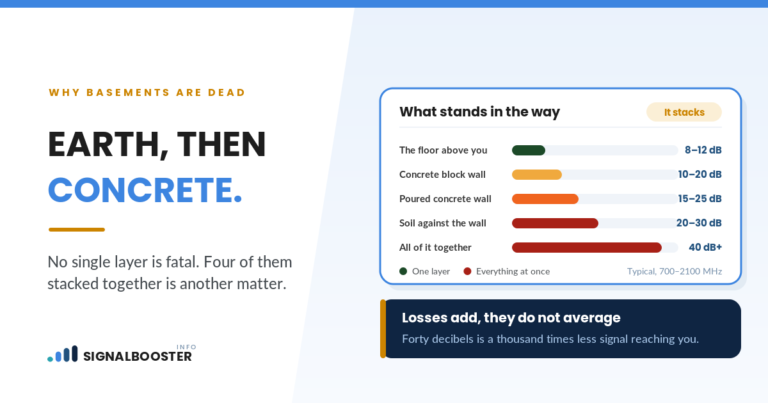
A basement is surrounded by the materials that are hardest on cell signal: poured concrete or concrete block, often with steel rebar, and a wall of backfilled soil on the outside. Overhead there is a full house of floors, framing and whatever else sits between you and the sky.
Glass is a much thinner barrier than any of that. That is why booster makers themselves suggest walking your basement with your phone and checking near windows for a “sweet spot” before assuming the whole space is dead. The window is a gap in the armor.
The catch is that a gap only helps if signal can actually reach it. For an ordinary ground-floor window, the outside world is right there. For a basement window, the outside world is at the top of a pit. If you want the bigger picture of why basements lose signal and what fixes it at the whole-room level, our guide to a signal booster for a basement covers that ground. Here the focus is the well itself.
What a Window Well Changes About Basement Window Well Cell Signal
A window well exists because the window sits partly or fully below the ground line. That one fact changes the geometry of how signal arrives.
Unless you live very close to a tower, cell signal reaches your house at a low angle, close to horizontal. A normal window faces that signal directly. A basement window at the bottom of a well faces the inside wall of the well, with soil behind it. There is no straight line from the tower to the glass.
So whatever reaches a basement window arrives the long way: over the lip of the well and down, by bending around the edge (diffraction) and bouncing off nearby surfaces (reflection). Both of those paths lose energy compared with a direct view. The practical rules that follow are simple:
- The open top of the well is the real antenna aperture. Anything that covers it matters more than anything else in the well.
- A deeper well sees less sky. The window at the bottom of a deep, narrow well gets a thinner slice of the incoming signal than one in a shallow well.
- Which side of the house the well is on matters. A well on the side facing the serving tower has the house behind it. A well on the far side has the entire house in the way before the signal even reaches the lip.
Depth and position are fixed once the well is built, so they set the ceiling on how much the window can ever help. A shallow well on the tower side has real potential. A deep well on the far side of the house may have little to offer no matter what cover or glass you use.
The Three Parts You Can Check, Ranked by How Much They Matter
1. The cover: usually the biggest factor
The cover sits directly over the one open side of the well, so it is the first thing to suspect. Covers generally come in two families: metal grates (steel or aluminum bars or diamond mesh) and solid clear covers, often polycarbonate.
Metal mesh behaves differently depending on how big its openings are compared with the wavelength of the signal. When the openings are much smaller than the wavelength, the mesh acts much more like a solid metal sheet and reflects a large share of the signal. When the openings get closer to the wavelength, more passes through. Cell signal wavelengths are long, measured in inches, which is why a grate that looks wide open to your eye can look close to solid to a low-band signal.
Wavelength is the speed of light divided by frequency. For a few frequencies used for US cell service, that works out to roughly:
| Frequency | Approximate wavelength |
|---|---|
| 600 MHz | 50 cm (about 19.7 in) |
| 700 MHz | 43 cm (about 16.9 in) |
| 850 MHz | 35 cm (about 13.9 in) |
| 1900 MHz | 16 cm (about 6.2 in) |
| 2500 MHz | 12 cm (about 4.7 in) |
| 3700 MHz | 8 cm (about 3.2 in) |
Measure one opening in your own grate with a tape and compare it with the table. The smaller the opening relative to the wavelength, the more that grate is likely to cost you, and the effect is typically worst on the low bands that are otherwise best at getting indoors.
A clear plastic cover is a much smaller obstacle at cell frequencies than metal. The exception is whatever piles up on it: a layer of wet leaves, standing water or packed snow adds its own loss, so a reading taken in winter may not match one taken in summer.
2. The glass
Plain glass costs relatively little. Low-emissivity (low-E) glass is different, because its heat-reflecting coating is a thin metallic layer. Basement windows are often replaced when a basement is finished or an egress opening is added, and a new, energy-efficient unit may well be low-E. If yours is, the coating can cost more than the well does. Our look at whether low-E windows block cell signal explains how to identify the coating and what the evidence shows.
3. The liner: matters less than you would guess
Window well liners are commonly made of corrugated galvanized steel, polyethylene or vinyl, or fiberglass and composite. It is tempting to blame a steel liner, but the liner walls have soil behind them either way, and signal was never coming sideways through the ground. A metal liner mainly acts as a reflector. It can bounce some signal down toward the window, or it can set up reflections that partly cancel each other at certain spots. A plastic liner does little of either. The honest summary is that the liner’s effect is small and unpredictable, and it is the last part worth worrying about.
Quick Read: What Your Window Well Is Probably Doing
| What you have | Likely effect | What to check first |
|---|---|---|
| Shallow well, tower side, clear cover, plain glass | Probably the best spot in the basement | Confirm with readings at the glass vs. mid-room |
| Any well with a metal grate over the top | Grate likely costing signal, most on low bands | Reading with cover on vs. cover off |
| Newer energy-efficient window | Low-E coating may cost more than the well | Reading with window closed vs. open |
| Deep well on the side away from the tower | Little to gain from the window at all | Outdoor reading at ground level beside the well |
| Snow, ice or debris on a clear cover | Temporary extra loss | Recheck after it is cleared |
| Steel liner, no cover | Open top admits signal; liner effect small | Readings at several spots near the glass |
How to Test Your Window Well in dBm
Bars are a poor tool for this job, because they are a rough summary that each phone maker defines its own way, and they can hide differences that matter. Use your phone’s actual signal readings instead. If you have not done that before, here is how to check your phone’s real signal strength in dBm, including the field-test screens on iPhone and Android.
Run the test as a sequence, changing one thing at a time:
- Baseline, middle of the basement. Hold the phone the same way throughout, and take several readings over a minute or two. Write down the average, and the band if your phone shows it.
- At the glass, window closed, cover in place. This is what the window does for you today.
- Window open, cover in place. The difference from step 2 is roughly what the glass is costing.
- Window open, cover lifted. The difference from step 3 is roughly what the cover is costing. Only lift a cover that is designed to be opened and that you can move without climbing into the well. If it is bolted down or heavy, skip this step.
- Outside, at ground level beside the well. The difference between this and step 4 is what the well’s depth and walls are costing.
- Outside, standing, phone at chest height. This is the best signal your property has near that wall.
A few reading rules keep the comparison honest. Signal readings move around on their own even when nothing changes, so compare averages rather than single numbers, and repeat any step where the difference looks small. Watch the band: if the phone switches bands between steps, the comparison is not like for like. And remember the decibel scale is logarithmic. A 3 dB drop is roughly half the power, and a 10 dB drop is one tenth, so a difference that looks modest on screen can be large in practice.
Check signal quality too, not only strength. A window can raise the strength number while quality stays poor, which is why calls can still break up there.
Reading the result. If step 6 is already weak, no window well change will rescue the basement, because there is little signal outside to let in. If step 6 is healthy but the numbers collapse between steps 6 and 2, the steps in between tell you whether to blame the cover, the glass or the depth.
Should You Put a Booster’s Outside Antenna in a Window Well?
Generally, no. A window well is the lowest point on the outside of the house, so it is close to the worst place to collect signal. weBoost’s own guide to finding the best location for your cell signal booster antennas (read September 23, 2026) names the roof as the preferred spot because it minimizes obstacles between you and the tower, with an outside wall facing the tower as the fallback. A below-grade pit is the opposite of that advice.
There is a second problem. An outside antenna in a window well and an inside antenna in the basement would be separated by little more than a wall. Boosters need enough distance between the two antennas to avoid feedback, and our explainer on antenna separation distance for a signal booster covers why a cramped layout makes a booster throttle itself or shut down.
Third, many window wells serve egress windows, the basement’s emergency escape route. Nothing should be mounted or routed in a way that blocks the window from opening or makes the well harder to climb out of.
Where the window can help a booster install is as a temporary cable path. For a trial run, a coax cable can come in through a slightly open window while you test antenna positions. A permanent cable entry is a different job: drilling through a rim joist or foundation wall means first confirming there is no wiring, gas line or plumbing in the path, and if you are not certain, a qualified installer should do it. Any new outlet or electrical work for the booster belongs to a licensed electrician.
Whatever you install, the FCC’s Consumer Signal Boosters page (read September 23, 2026) says a consumer booster must be registered with your wireless provider before you turn it on, and that providers who allow boosters must offer free registration.
What a Window Well Cannot Do
It helps a spot, not a room. Even when the window is working well, the improvement usually fades within a few feet as you move back behind concrete.
It cannot create signal that is not outside. The well only decides how much of the outdoor signal gets in, and if the outdoor reading at that wall is poor, the basement will be too.
It is not worth trading safety for. A metal grate is often there to stop people and animals from falling into the well. If you replace it for signal reasons, choose a cover that still does that job and still lets the window be used as an exit.
And standing at the window is a workaround, not a fix. If the only usable signal in the basement is at the glass, that is useful diagnostic information: it tells you signal is reaching the house, and that a proper fix means getting it past the concrete.
FAQ
Does a window well cover block cell signal?
A metal grate cover can, because metal mesh with openings much smaller than a cell signal’s wavelength reflects a large share of it. The effect is usually strongest on low-band frequencies. A clear plastic cover blocks far less, unless it is loaded with snow, water or debris. Test your own cover by comparing readings with it on and off.
Is a basement window a good spot for a signal booster’s outside antenna?
Usually not. It is the lowest point on the house, so it sees the least signal, and it puts the outside antenna close to the inside antenna, which risks feedback. Manufacturer placement guidance points to the roof first and a tower-facing outside wall second.
Why do I get signal by the basement window but not in the middle of the room?
The window is the one spot where signal does not have to pass through concrete and soil. A few feet away, you are back behind the foundation wall, so the reading drops quickly. That pattern tells you signal is reaching the house, which is useful to know before choosing a fix.
Does a deeper window well mean worse signal?
Generally, yes. Signal reaches a basement window by coming over the lip of the well and down, so a deeper, narrower well gives the window a smaller view of the sky. Depth is fixed once the well is built, which is why it sets the limit on how much the window can ever help.