Short answer: weak cell signal at a campground usually has one of four causes, and the coverage map cannot tell you which. The coverage your carrier reports to the FCC is a modeled outdoor claim: for 4G LTE, at least 5 Mbps down and 1 Mbps up at the edge of the mapped area, with at least a 90% probability, on a network assumed to be at least 50% loaded. A test inside your RV, a test at 11 p.m., or one bad result does not contradict that claim. Tests taken outside at your site, at two times at least four hours apart, can.
That last sentence is not our rule of thumb. It is how the FCC itself decides when a consumer’s tests are strong enough to dispute a carrier’s map. This guide reads those rules, then turns them into a test plan you can run from a campsite in about a day, with nothing more than your phone.
What “coverage” on the map actually promises
Since the FCC’s Broadband Data Collection began, mobile carriers file their coverage maps under fixed modeling rules, and those filings feed the FCC’s National Broadband Map. The rules are in 47 CFR 1.7004. Four of them matter at a campground.
1. A speed floor, not a signal level. For 4G LTE, a covered area is one where users should expect at least 5 Mbps download and 1 Mbps upload at the cell edge. For 5G-NR, carriers map two tiers: 7 Mbps down and 1 Mbps up, and 35 Mbps down and 3 Mbps up. The map says nothing about bars, and nothing about speeds above the floor.
2. A probability, not a guarantee. The maps must reflect areas where users should get those speeds “with cell edge coverage probability of not less than 90% and a cell loading of not less than 50%.” Read that literally: at the edge of a mapped area, the model itself allows roughly one attempt in ten to fall short. Deeper inside the area, the odds should be better.
3. Outdoors only. The rule says the maps “must depict outdoor coverage, to include both on-street or pedestrian stationary usage, and in-vehicle mobile usage.” Standing outside, or riding in a vehicle. Indoor use is not on that list.
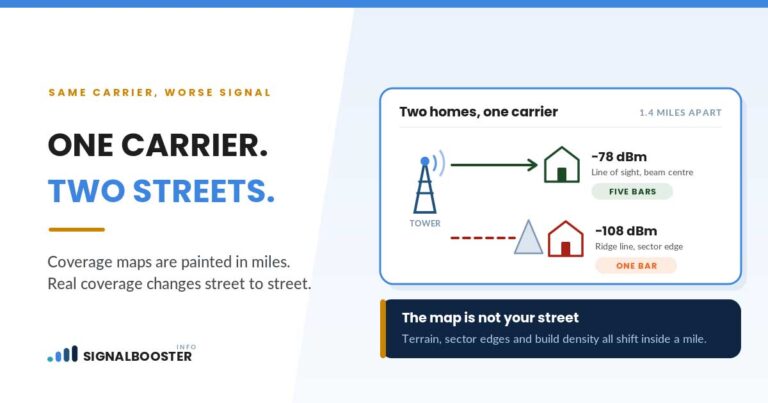
4. A 100-meter grid. Maps “must account for terrain and clutter and use terrain and clutter data with a resolution of 100 meters or better.” That is a ceiling on detail, so a map built at that resolution may not separate a campsite under a dense tree canopy from an open site one loop over. Our reading, not a rule: differences inside a single campground can be finer than the map was required to see.
Three conditions the map never claimed to cover
Put those four rules next to a typical campground evening and the gaps are obvious.
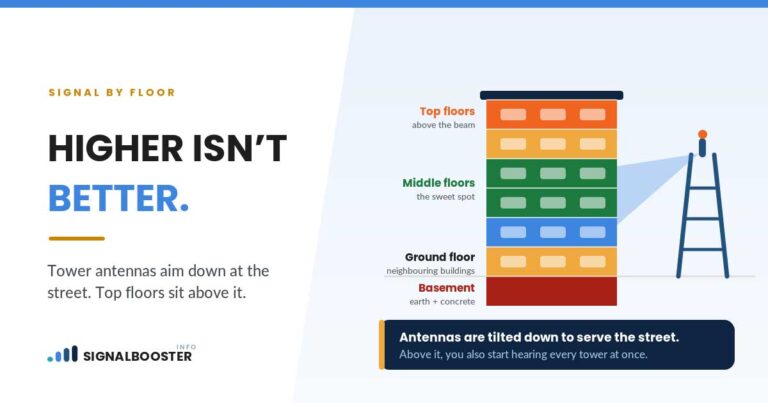
You are inside the RV. The “in-vehicle mobile” condition does cover a phone inside a vehicle (when carriers verify their maps, the rule requires the test antenna to be inside the vehicle), but the rule does not say what vehicle, or how much body loss the model allows. That figure lives in each carrier’s link budget, which the same rule requires carriers to disclose to the FCC. We did not obtain any carrier’s link budget, so how much RV shell the model allows for is unknown. What is known is that sitting at the dinette in a parked trailer is not “on-street or pedestrian stationary usage,” and the map makes no indoor promise. If you want to see how much a metal shell costs you, the method in our guide to why signal gets worse inside your car works the same way in a parked RV.
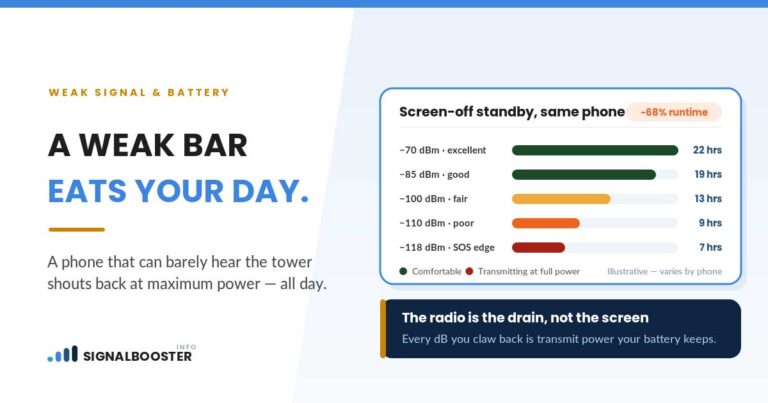
The campground is full. The model assumes a cell loading of at least 50%. A holiday weekend could load the serving cell more heavily than whatever figure the carrier modeled. We have no loading data for any campground, so this is a possibility to test for, not a finding. Our article on rural signal that comes and goes covers the time-of-day pattern that load tends to produce.
You ran one test. A single failure at the edge of a mapped area is inside the model’s own 10% allowance. It is evidence of a bad moment, not of a wrong map.
The FCC’s own bar for “the map is wrong”
The FCC lets consumers challenge a carrier’s mobile map, and the rules for that challenge, in 47 CFR 1.7006(e), are the most precise statement anywhere of what counts as evidence against a coverage claim. The key conditions:
- Tests must use a speed test app the FCC has designated. The FCC’s own Mobile Speed Test app, launched in July 2024, replaced the original FCC Speed Test app.
- The challenger certifies “that the speed test measurements were taken outdoors.”
- Tests must be “Conducted outdoors between the hours of 6:00 a.m. and 10:00 p.m. local time,” and each test runs between 5 and 30 seconds.
- Download and upload are judged separately. A “negative” is a result below the floor the carrier reports at that spot, for example under 5 Mbps down on 4G LTE.
- Timing: an area needs two failing results of the same type at one time of day and another two “with a time-of-day difference of at least four hours” from the first pair, “regardless of the date of the tests.”
- Volume: with 20 or fewer results of one type in an area, at least five must fail. With more, the required failing share steps down from 24% (21 to 29 results) to 16% (100 or more).
- Spread: the rule judges an area (an H3 resolution-8 hexagon), not one spot. Where that hexagon has accessible sub-areas along mapped roads, tests must come from up to four of them, each holding two results of the same type, one of them failing.
Every one of those failure shares sits above the 10% miss rate that the 90% probability allows at the edge. Our reading, not an FCC statement: the challenge bar sits above the failure rate a correct map could produce at its edge. When carriers have to prove their own maps, the same section requires showing, with 95% statistical confidence, “that the cell coverage is 90% or higher.”
You do not have to file a challenge to use this. The point is that the rules already define what a fair test looks like, and a fair test is exactly what separates the campground from the carrier.
A campground test plan built from those rules
Run every test on cellular data with Wi-Fi turned off, so a campground hotspot cannot hide the answer. Use the same app each time. Note whether your phone shows 4G LTE or 5G, because the floor you compare against depends on it. If your app shows dBm, record it too; our guide to signal apps that disagree explains why one reading on its own proves little.
- Check the map first. Look up your carrier at the campground on the FCC’s National Broadband Map. If the site is not shown as covered for your technology, stop here: there is no claim to test, and the honest answer is the carrier, not the campground.
- Test outside, at your site, in the morning or early afternoon. Stand clear of the RV. Two or three tests.
- Test again outside at least four hours later, before 10 p.m. Two or three tests.
- Test inside the RV right after each outdoor set, in the spot where you actually use the phone.
- Repeat one outdoor set at an open spot nearby, such as a clearing or the campground road, to compare with your site.
Then read the pattern:
| What you see | What it points to | Why |
|---|---|---|
| Outside fails at both times, at your site and at an open spot nearby, map shows coverage | The carrier’s map, in this area | This is the pattern the challenge rules are built to catch: failures outdoors, hours apart |
| Outside passes earlier, fails only later | Network load | Consistent with demand above what the model assumed; failures clustered in one evening window do not meet the four-hour rule |
| Outside passes, inside the RV fails | Your RV, not the campground or the map | The map makes no indoor claim; the loss is between the sky and your seat |
| Your site fails, an open site nearby passes | Your campsite’s position | Trees, slope or terrain finer than the map’s 100-meter grid |
These rows can stack. Load and RV loss often arrive together in the evening, which is why the outdoor tests matter: they remove the RV from the question before you judge the network.
Use the reader below to enter your own results and see which row they point to.
Campsite speed-test reader: do your results fall short of the FCC coverage map’s speed floor?
Enter one speed test per spot, run on cellular data with Wi-Fi off. Leave a spot blank if you did not test there. Outdoor tests count only between 6 a.m. and 10 p.m. local time.
Your reading will appear here.
Optional: how many failing results would an FCC challenge need?
The count will appear here.
Sources and limits
Speed floors, 90% edge probability and outdoor scope: 47 CFR 1.7004(c)(3) and (c)(5). Outdoor hours, separate download and upload judging, four-hour rule, failing-result counts and the one-spot cap: 47 CFR 1.7006(c)(1) and (e)(1) to (e)(2). Both read on eCFR, retrieved November 9, 2026. Everything runs in your browser; nothing is sent or stored.
If the reader above does not load, compare each result with the floor for the technology the map lists at your site, then use the table earlier in this section:
| Technology on the map | A result falls short if download is under | or if upload is under |
|---|---|---|
| 4G LTE | 5 Mbps | 1 Mbps |
| 5G-NR, 7/1 tier | 7 Mbps | 1 Mbps |
| 5G-NR, 35/3 tier | 35 Mbps | 3 Mbps |
For a formal challenge, this is how many failing results of one type (download or upload) an area needs. The four-hour rule and the spread across road-side spots apply on top.
| Results of one type in the area | Failing results needed |
|---|---|
| 20 or fewer | at least 5 |
| 21 to 29 | at least 24% |
| 30 to 45 | at least 22% |
| 46 to 60 | at least 20% |
| 61 to 70 | at least 18% |
| 71 to 99 | at least 17% |
| 100 or more | at least 16% |
Sources: 47 CFR 1.7004(c)(3) and 47 CFR 1.7006(e)(2)(vi)(C), retrieved November 9, 2026.
Illustrative example (made up for this guide, not a real test log)
A camper on 4G LTE runs the plan. At 9 a.m., outside, both tests clear 5 Mbps down; inside, both fall short. At 7 p.m., outside, one of two falls short; inside, both fail. Reading the table: the morning results already show RV loss, because the network passed outside at the same moment. The single evening outdoor miss is within the map’s own allowance and does not establish a load problem. The fix worth thinking about here is getting signal through the RV shell, not changing carrier.
Where a booster fits, and where it does not
The table decides whether hardware is even the right question. A booster can help with the third row, because it moves reception outside the shell. It cannot fix the first row: it amplifies signal that exists and does not create capacity or coverage the carrier lacks. For the second row, a booster does not add network capacity. If you already own a home unit and are tempted to bring it, read whether a home booster belongs in an RV before you do, and our comparison of how RV and home boosters differ for the design differences. If the first row keeps showing up at the places you camp, the decision is closer to the one in booster versus switching carriers.
If you decide to challenge the map
Submit your tests as a challenge in the FCC’s app, not as general crowdsource data, and keep to the conditions above: outdoors, 6 a.m. to 10 p.m., failures hours apart. A one-night stay rarely produces enough results on its own; the rules ask for at least five failing results of one type, spread across up to four road-side spots in the area, not one campsite. Under the rule, a carrier notified of a valid challenge has 60 days to rebut it or concede, and a conceded area is marked on the map as lacking sufficient service. That helps the next camper more than it helps you tonight.
What this does not settle
We read the current federal rules (retrieved November 9, 2026) and the FCC’s July 2024 app announcement. We did not read any carrier’s own marketing-map disclaimers, which can use different assumptions from the FCC filings, and the FCC’s consumer help pages were not accessible to us, so details of how the app applies these rules on screen are not covered here. The rules also change; check the dates on the sources before relying on a specific threshold. Campground Wi-Fi is a separate system and is outside this guide.
FAQ
Why does the map show coverage where I have none inside my RV?
Because the map makes an outdoor claim. The FCC rule requires maps to depict outdoor coverage, for people standing outside or using the phone in a vehicle. Test outside first; if that passes, the problem is the RV shell, not the map.
Does one failed speed test prove the coverage map is wrong?
No. The model allows up to about one miss in ten at the edge of a covered area, and the FCC’s challenge rules require at least five failing results of one type, in pairs at least four hours apart, spread across several spots in the area, before an area counts as challenged.
Is evening slowdown at a busy campground the carrier’s fault?
It may be load. Carrier maps assume a cell loading of at least 50%. If outdoor tests pass earlier in the day and fail only in the evening, demand is the likely cause, and no map promised more.
Can tests taken inside my RV be used to challenge the map?
Not under the rule text we read. Consumer challengers must certify the tests were taken outdoors, between 6 a.m. and 10 p.m. local time. The FCC’s app also offers repeated tests while driving; how those are treated is covered on FCC help pages we could not access.