Being close to a cell tower does not guarantee a strong signal, and that surprises almost everyone the first time it happens to them. Distance and obstruction are two separate causes of the same complaint (weak or missing signal), and they behave very differently. Distance loss is gradual and predictable: signal fades steadily the farther you get from a tower, with no sudden cliffs. Obstruction loss can be abrupt and severe: a single hill, dense treeline, or the wrong building material can cost you more than miles of open air ever would. Higher-frequency bands are attenuated more by obstacles than lower-frequency ones, which is part of why a “strong tower nearby” can still deliver almost nothing indoors. Proximity is not the same question as a clear path.
Two Reasons the Same Symptom Shows Up
“I have no signal” describes a symptom, not a cause, and two genuinely different problems produce it. One is that you are simply too far from any tower for a usable signal to arrive at all. The other is that a tower is close, the distance is fine, but something between you and it is absorbing or reflecting the signal before it reaches you.
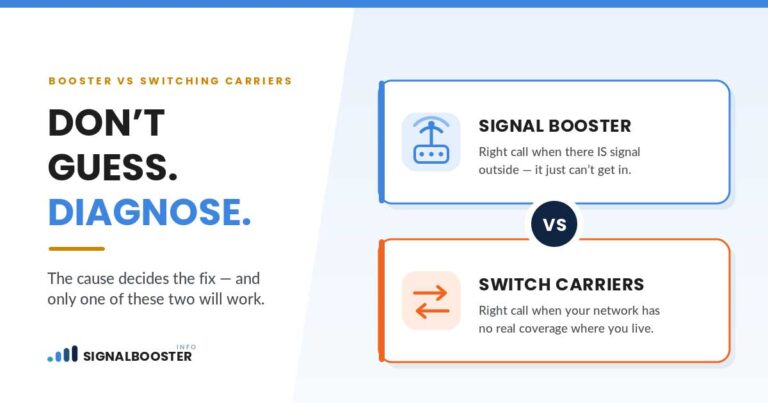
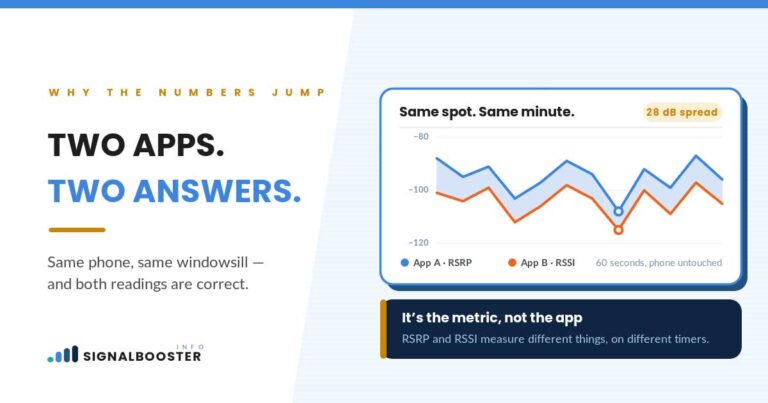
These get confused constantly because a phone showing zero or one bar looks identical either way. The bars display does not tell you which of the two is happening, only that whatever is happening, it is bad. Telling them apart matters because the fix for one does nothing for the other, a point this piece comes back to at the end.
What Distance Alone Actually Does to a Signal
Radio signal loses power as it travels, in every direction, continuously, the way light dims as it spreads out from a bulb. This is a smooth, gradual process. There is no point a fixed number of miles from a tower where signal simply stops, it keeps thinning out the farther it travels, which is why coverage maps show gradients rather than hard edges.
Because the falloff is gradual, distance alone rarely produces a total dead zone with nothing at all in the way. Given a genuinely clear path, a signal that is merely far tends to arrive weak but present, not absent, and a weak-but-present signal is exactly the situation an outdoor antenna and amplifier are built to capture and bring indoors.
What an Obstruction Does That Distance Doesn’t
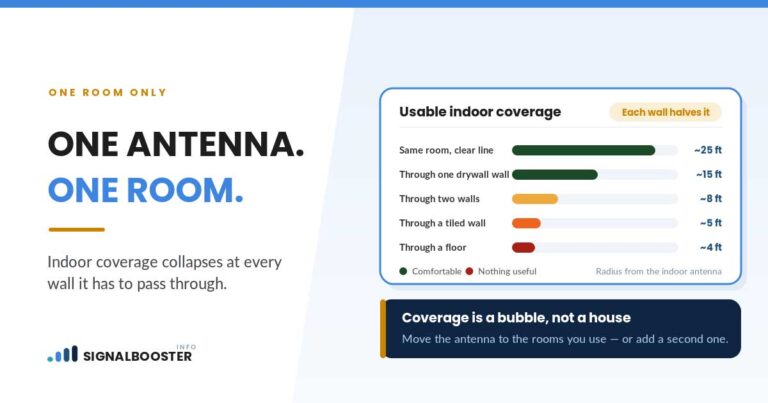
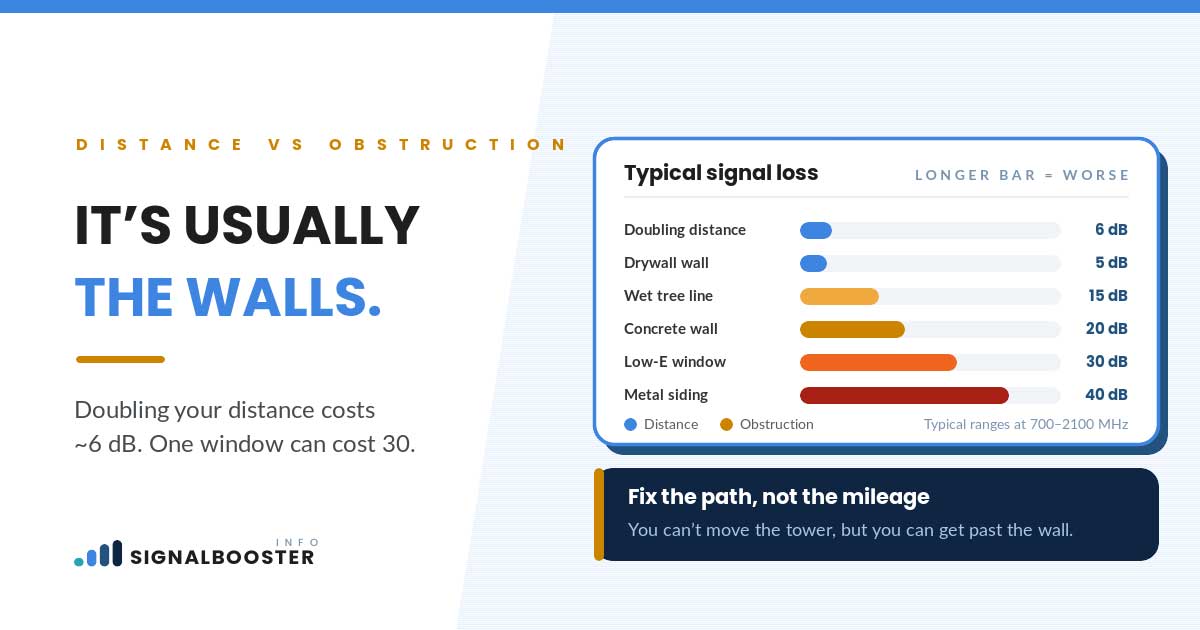
An obstruction does not thin a signal out evenly, it removes a chunk of it in one place, and how much depends on what the obstruction is made of and how much of it stands in the path. A wall, a hillside, a stand of trees, or a building’s own metal-framed construction can each strip away a substantial share of an otherwise healthy signal in the space of a few feet, in a way that has nothing to do with how far the tower is.
This is also where frequency matters and distance-only thinking breaks down. It is well established in radio engineering that higher-frequency bands, which carry more capacity, are attenuated more by physical obstacles than lower-frequency bands are. A carrier’s higher-frequency signal can be perfectly strong outdoors and struggle far more than a lower-frequency signal from the same tower once it has to pass through a wall, which is one reason two people on the same street, on different carriers or different network layers, can report very different indoor experiences from what looks like the same distance to the same tower.
Why “Close But Blocked” Is Often Worse Than “Far But Clear”
Put the two mechanisms side by side and the reader’s exact complaint stops being confusing.
| Distance alone | A significant obstruction | |
|---|---|---|
| How the loss happens | Gradual, continuous thinning as signal spreads out | Concentrated loss where the obstacle sits |
| Predictability | Fairly predictable; farther is worse, consistently | Can be abrupt; one wall or hillside can outweigh miles of open path |
| What’s usually still true outdoors | Weak but present, if the path is otherwise clear | Can be strong right outside, then drop sharply a few feet later |
| What raw proximity tells you | A meaningful predictor on its own | Not reliable on its own; the path matters more than the miles |
A signal that has traveled a genuine distance but arrived over open, unobstructed ground can easily be more usable than a signal from a much closer tower that has to fight through a hillside, a treeline, or a building’s own walls to reach you. “Close” describes a distance. It says nothing about what stands in between, and that is exactly the assumption this piece exists to correct.
The Obstructions Most Readers Don’t Think to Check
Some obstructions are obvious once you look for them. Others are the kind that get blamed on “bad coverage” for years before anyone identifies them correctly.
Terrain. A hill, ridge, or even a modest rise in the land between you and a tower can sit directly in the signal’s path the same way a wall does. Being in a valley or on the far side of a slope from the nearest tower matters more than the straight-line distance on a map suggests.
Foliage. Dense trees, especially in full leaf, absorb and scatter signal, and this one is seasonal: a spot that reads fine in winter can perform noticeably worse once the trees around it fill in for summer.
Building materials. What your walls, siding, and roof are made of can matter more than anything outside the property line. This site’s dedicated piece on whether stucco and metal siding block cell signal covers which materials are the real culprits and why the common assumptions about stucco specifically are often wrong.
Which floor you’re on. Being higher or lower in a building changes both the amount of structure the signal has to pass through and the angle it arrives at, covered in why signal is weaker on some floors than others.
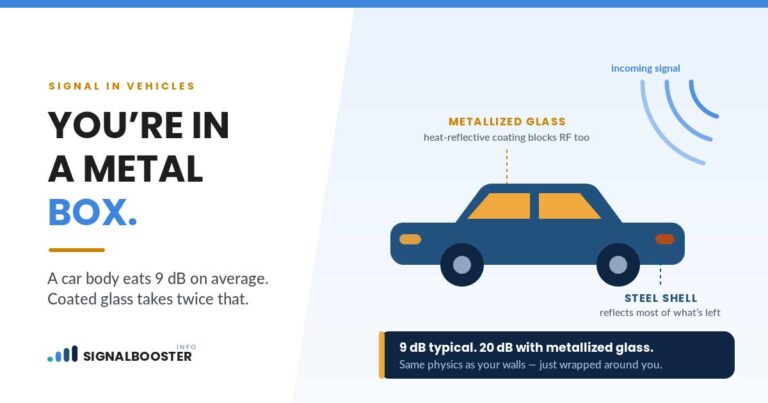
Being inside a vehicle. A car or truck body is its own obstruction, independent of where the vehicle is parked relative to any tower, which why signal is worse in a car goes through in more detail.
A Simple Way to Tell Which One Is Your Problem
You do not need to know the exact distance to the nearest tower to tell distance and obstruction apart. The behavior of the signal tells you.
If your signal is uniformly weak everywhere on and around your property, indoors and outdoors alike, with no sharp change at any particular wall, door, or spot, that pattern points toward distance or general coverage rather than a specific obstruction. There is simply not much signal reaching the area to begin with.
If your signal is noticeably better in one place than another just a few feet away, especially a sharp drop the moment you step through a doorway, move to an interior room, or go below ground, that pattern points toward an obstruction. Something local is removing signal that was otherwise present nearby.
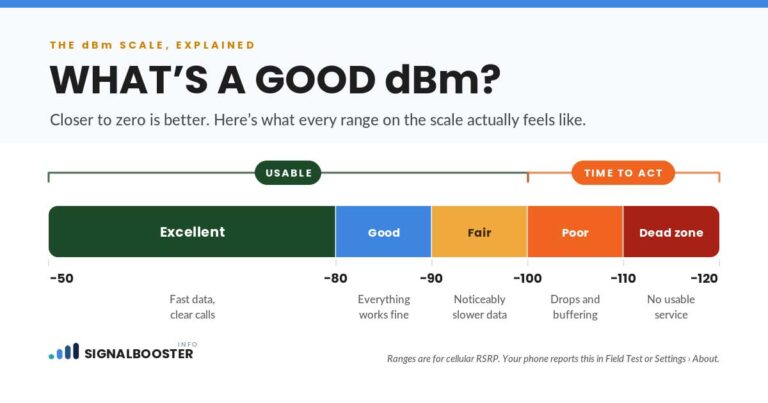
The practical version of this test: check your signal reading just outside your home, then just inside, then in the room where the problem is worst. A steady decline suggests distance and general coverage. A sudden drop at one specific boundary points to whatever sits at that boundary.
What Each Cause Means for Whether a Booster Helps
This distinction changes what actually fixes the problem, which is the entire reason it is worth working out.
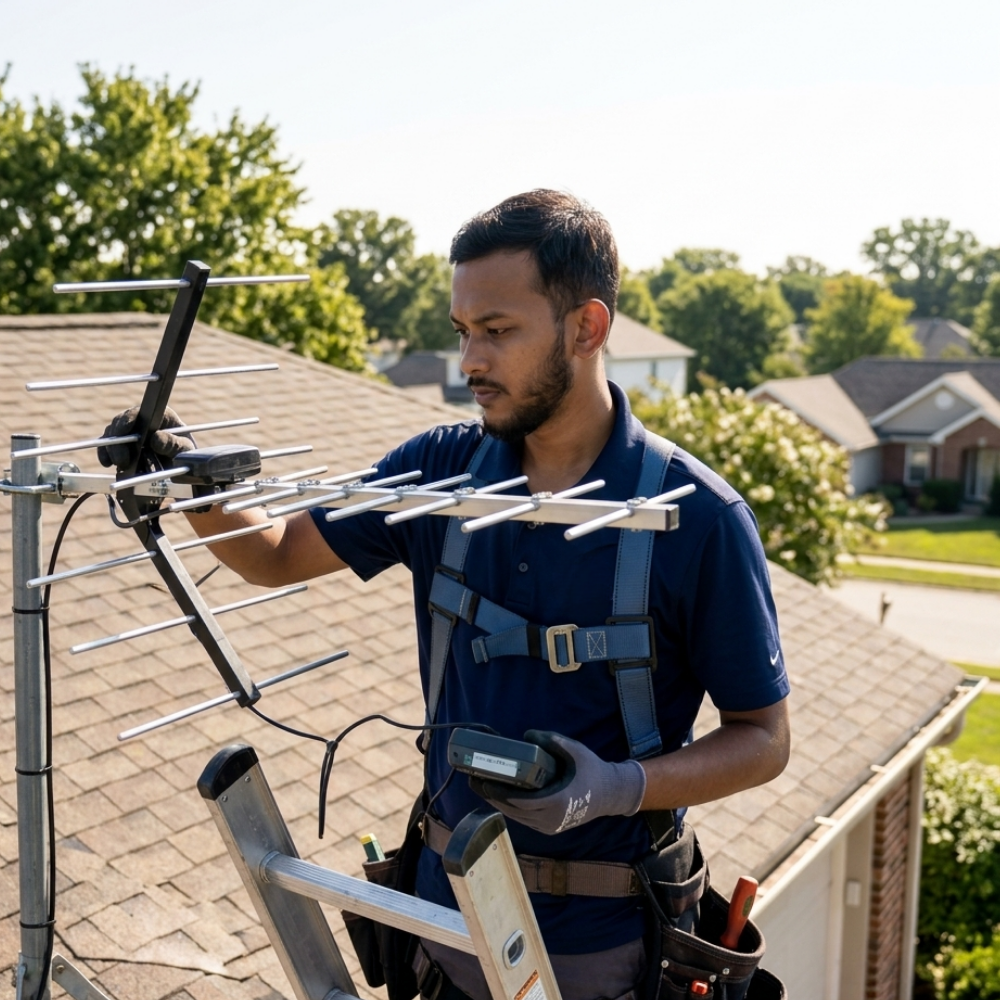
A distance-driven weak signal, present but faint outdoors, is close to the ideal case for an outdoor antenna and amplifier. There is a real, usable signal to capture outside; it just needs to be pulled in and strengthened before it reaches the rooms where it is needed. Our overview of what a signal booster is and how it works covers that mechanism directly.
An obstruction-driven problem can also be solved the same way, provided a usable signal still exists somewhere accessible, typically outdoors or at a roofline, even if it disappears once it hits the obstruction. The equipment does not need distance to be short, it needs a genuine signal to start from.
Where neither distance nor an obstruction workaround helps is the case where both stack together: a location that is genuinely far from any tower and also blocked by terrain, foliage, or structure, with no accessible spot on the property where a usable outdoor signal exists at all. No equipment creates signal that is not there to begin with, which is why confirming there is something usable outdoors, before spending anything, is the step worth doing first. If your own reading of the property leaves you unsure where the nearest usable tower even is, how to find your nearest cell tower is the logical next step from here.
FAQ
Why is my signal bad when I’m close to a cell tower?
Proximity alone does not guarantee a clear path. Terrain, foliage, and building materials can each remove a significant share of signal regardless of how close the tower is, and a nearby but blocked tower can perform worse than a distant one with an open path.
Does distance or obstruction cause more signal loss?
Distance causes gradual, predictable loss with no sudden cliffs. An obstruction can cause abrupt, concentrated loss in one specific spot, and depending on what it is made of, it can outweigh the effect of considerable extra distance.
Do higher frequency bands lose more signal to obstacles?
Yes, that is an established principle in radio propagation: higher-frequency signals are generally attenuated more by physical obstacles than lower-frequency signals from the same tower, which is part of why indoor reception can vary between carriers and network layers even at the same distance.
How can I tell if it’s distance or an obstruction causing my weak signal?
Look at the pattern. A gradual, uniform weakness across your whole property suggests distance. A sharp drop at one specific point, a wall, a doorway, or a particular floor, suggests an obstruction sitting right at that boundary.
Will a signal booster help if the problem is an obstruction, not distance?
Often yes, as long as a usable signal exists somewhere accessible outdoors, such as a roofline, that the equipment can capture before the obstruction blocks it. It will not help if no usable signal reaches anywhere on the property at all.