Short answer: yes, steel grain bins and metal silos can cut cell signal, but “grain bin cell signal interference” is not quite the right description of what happens. A bin does not transmit anything that jams your phone. Its steel shell blocks and reflects radio waves, so it casts a signal shadow behind it and can bounce signal in unexpected directions. The effect is local: it matters when a bin stands between you (or your booster’s outdoor antenna) and the tower, and it usually shrinks or disappears when you move out of that shadow or get the antenna above it.
This guide explains how to tell whether bins are really your problem, how to measure around them, and what that means for placing a booster antenna on a farm.
Blocking Is Not Interference, and the Difference Changes the Fix
In cellular terms, interference means unwanted radio energy: other signals landing on the same frequencies your phone is trying to use. A grain bin is not a radio source. It is a large metal object.
What a steel bin does is:
- Block. Cellular signal does not pass through a steel wall well. HiBoost, a booster manufacturer, puts it this way in its rural Midwest signal guide, which we read on September 27, 2026: “Metal buildings like barns and sheds can act like signal blockers, reflecting or absorbing cellular waves so they never reach your phone.”
- Reflect. Signal that hits a curved steel wall bounces off it. Sometimes that reflection helps, filling in a spot that would otherwise be dark. Sometimes it arrives slightly out of step with the direct signal and makes readings unstable.
Why this matters: interference is a network or equipment problem, and you cannot fix it by moving across the yard. A shadow from a bin is a geometry problem, and you often can.
When Grain Bin Cell Signal Interference Is Real, and When It Is Not
A single bin is a tall but fairly narrow obstacle. Unlike a ridge or a long tree line, it only blocks a thin slice of directions. So whether bins are hurting you depends almost entirely on where they sit relative to the tower.
Bins are a likely cause when:
- The bins, dryer or leg stand in the direction of your carrier’s tower from where you lose signal.
- Signal drops as you walk behind the bins and returns as you step out from behind them.
- You lose signal inside the bin yard, surrounded by steel on several sides, but not in open ground nearby.
Bins are probably not the cause when:
- The bins sit off to one side, away from the tower direction.
- Signal is just as weak in an open field with nothing in the way.
- Readings are poor at every spot on the property, at every time of day.
In that last case, the problem is distance, terrain or the tower itself, and the explainer on distance vs obstruction is the better starting point.
How to Test Whether the Bins Are the Problem
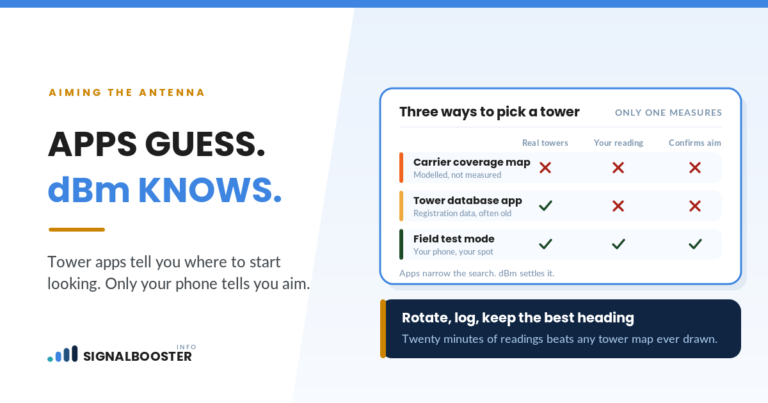
You need your phone, its real signal readings and about twenty minutes. Bars will not do: they are a rough, manufacturer-specific scale, and a one-bar change can hide a real difference. Our guide on how to check your phone’s real signal strength in dBm shows where to find RSRP and a quality figure such as SINR or RSRQ.
- Turn Wi-Fi off so the phone stays on cellular.
- Find the tower direction. Use a locator app as a starting hint, then confirm it with your readings rather than trusting the pin.
- Walk an arc around the bins. Stay on the ground and well clear of the bins, augers and equipment. Stop every few steps, hold the phone still for half a minute, and write down the typical reading at each stop.
- Look for the dip. If readings fall sharply on the side of the bins away from the tower and recover on the tower side or off to the flanks, you have found the shadow.
- Repeat at a second time of day. If the pattern holds, it is geometry. If it moves around, network load or distance is playing a bigger part.
Take the typical value at each stop, not the best flash. Readings fluctuate from moment to moment, and a single good number proves little.
What the Bin Yard Does to Your Readings
A cluster of bins, a dryer, a leg and metal buildings close together behaves differently from one bin in a field. Stand in the middle of it and you are partly surrounded by steel, which can block several directions at once and create a tangle of reflections.
Two practical effects follow:
- Readings can swing more than usual. Small steps change which reflections reach the phone, so expect a noisier set of numbers inside the yard than outside it.
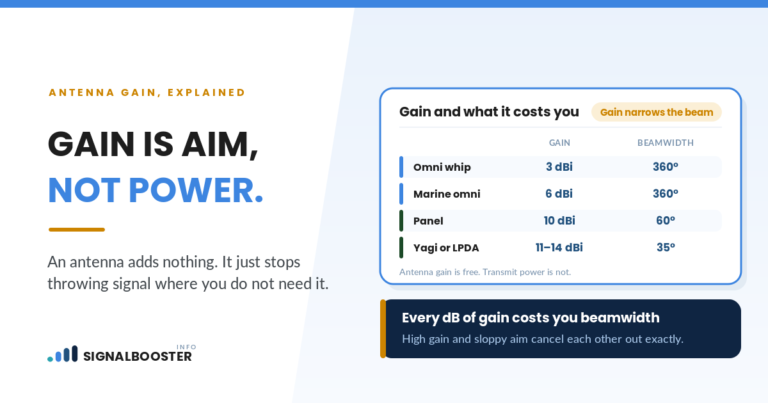
- The strongest direction can mislead. A strong reading pointing at a bin wall may be a reflection, not the tower. If you are trying to judge where a directional antenna should point, take your direction readings from open ground clear of the bins, not from the middle of the yard.
Inside a Bin, a Phone Is Not a Safety Plan
The inside of a steel bin is close to a sealed metal enclosure. Do not count on a phone working inside one, and never treat a phone as the way someone inside a bin will call for help.
This is the part where signal stops being a convenience question. OSHA’s grain handling overview, read on September 27, 2026, states that “Moving grain acts like ‘quicksand’ and can bury a worker in seconds.” Among the protections it lists for bin entry are to “Turn off and lock out all powered equipment associated with the bin,” to “Provide an observer stationed outside the bin or silo being entered,” and to “Test the air within a bin or silo prior to entry.”
Follow the OSHA guidance and your operation’s own entry procedures. A booster is not a substitute for any of them, and nothing in this article is advice on entering a bin.
Where a Booster Antenna Fits on a Farm With Bins
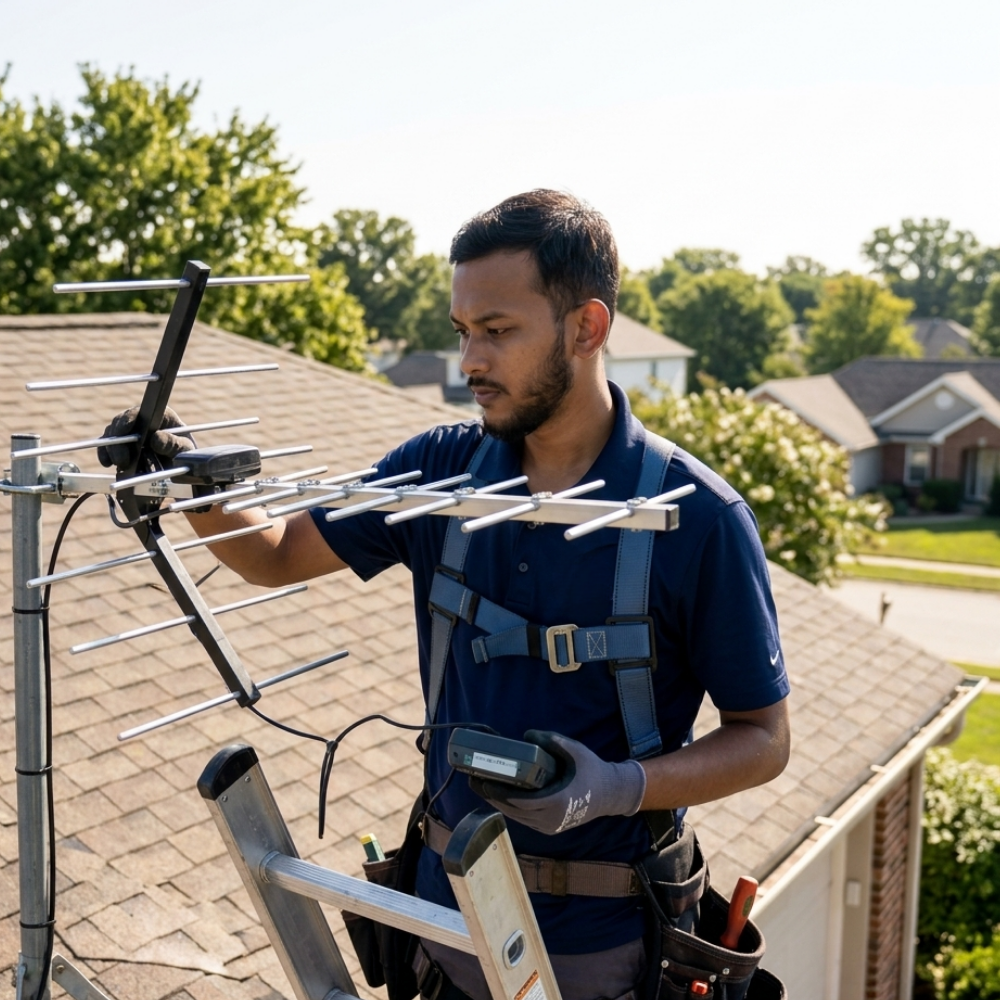
If your testing shows bins are shadowing the house, shop or office, the outdoor (donor) antenna of a booster is the part that has to get clear of them. The principle is simple: the donor antenna needs a path to the tower that no bin blocks.
Options an installer will usually weigh:
- Move sideways out of the shadow. Because a bin is narrow, a different corner of the roof or a mast set off to one side can clear it.
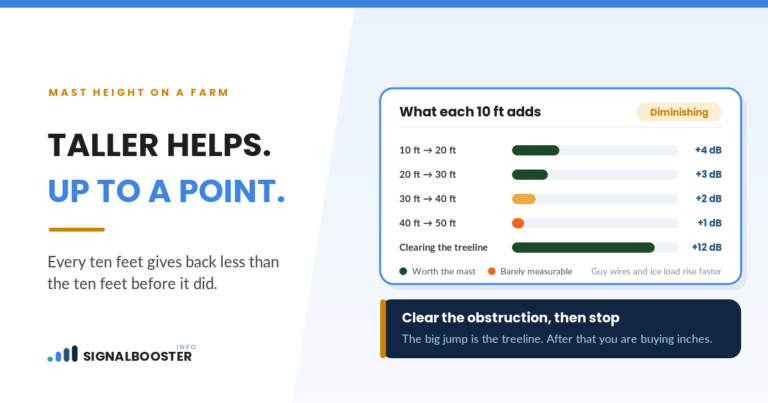
- Go higher. An antenna above the top of the obstruction sees past it. Bins are tall, so this is not always practical.
- Use a different building. A shop or shed with a clear line toward the tower may make a better donor location than the house, with the cable run planned carefully.
HiBoost’s guide also mentions farm structures such as “grain silos or windmill frames” as possible tall mounting points. Whether any particular bin can carry an antenna, and how it would be reached, is a question for the bin’s owner and a qualified installer, not a do-it-yourself job. OSHA’s same overview notes that “Falls from height can occur from many walking/working surfaces throughout a grain handling facility.” Roof, mast and bin-top work belongs with a qualified installer, and any new outlet or wiring belongs with a licensed electrician.
Also keep the booster’s own layout in mind. The indoor and outdoor antennas need enough separation to avoid feedback, and a metal structure near the donor antenna changes how the system behaves. The guide to antenna mounting mistakes covers the common placement errors.
Bins Versus Metal Buildings
Grain bins get the attention because they are tall and obvious, but on many farms the building you are standing in matters more than the bins outside. Steel siding and steel roofs block signal from the inside out, and the shop, machine shed or metal-sided house is often the real dead zone. The article on whether metal siding or stucco blocks cell signal covers building materials in detail.
A useful rule of thumb from the testing above: if signal is poor indoors but fine in the open yard, suspect the building. If it is poor in one sector of the yard and fine elsewhere, suspect the bins.
What We Could Not Find
We looked for published measurements of signal loss behind grain bins specifically and did not find any we would trust. The numbers that circulate for “metal buildings” in general come from vendor pages, vary widely, and are not tied to a stated test. So this article gives you no dB figure for a bin. Your own before-and-after readings on your own property are the only numbers that apply to it.
FAQ
Do grain bins interfere with cell phone signal?
They block and reflect it rather than interfering with it in the radio sense. A steel bin casts a signal shadow on the side away from the tower and can bounce signal around the bin yard. The effect is strongest when a bin stands directly between you and the tower.
Will my phone work inside a grain bin?
Do not rely on it. A steel bin is close to a sealed metal enclosure. Follow OSHA’s grain handling guidance and your operation’s entry procedures, which call for an observer stationed outside the bin, rather than counting on a phone.
Can I mount a booster antenna on a grain bin?
Some installers use tall farm structures as mounting points, but whether a specific bin can carry one and how it can be reached safely is a decision for the owner and a qualified installer. Bin-top and height work carries serious fall risk.
How do I know if the bins or the tower distance is my problem?
Walk an arc around the bins with your phone’s dBm readings on. A sharp dip behind the bins that recovers in the open points to the bins. Weak readings everywhere, including open ground, point to distance or terrain.
Does a full bin block more signal than an empty one?
We found no published measurement comparing full and empty bins, so we do not give a figure. The steel shell blocks and reflects signal either way. If it matters for your site, test the same spots when the bins are full and again when they are empty.